

• India CSR Awards 2025
  • India CSR Leadership Summit
  • Guest Posts
Wednesday, February 18, 2026
India CSR
  • Home
  • Corporate Social Responsibility
    • Art & Culture
    • CSR Leaders
    • Child Rights
    • Culture
    • Education
    • Gender Equality
    • Around the World
    • Skill Development
    • Safety
    • Covid-19
    • Safe Food For All
  • Sustainability
    • Sustainability Dialogues
    • Sustainability Knowledge Series
    • Plastics
    • Sustainable Development Goals
    • ESG
    • Circular Economy
    • BRSR
  • Corporate Governance
    • Diversity & Inclusion
  • Interviews
  • SDGs
    • No Poverty
    • Zero Hunger
    • Good Health & Well-Being
    • Quality Education
    • Gender Equality
    • Clean Water & Sanitation – SDG 6
    • Affordable & Clean Energy
    • Decent Work & Economic Growth
    • Industry, Innovation & Infrastructure
    • Reduced Inequalities
    • Sustainable Cities & Communities
    • Responsible Consumption & Production
    • Climate Action
    • Life Below Water
    • Life on Land
    • Peace, Justice & Strong Institutions
    • Partnerships for the Goals
  • Articles
  • Events
  • हिंदी
  • More
    • Business
    • Finance
    • Environment
    • Economy
    • Health
    • Around the World
    • Social Sector Leaders
    • Social Entrepreneurship
    • Trending News
      • Important Days
        • Festivals
      • Great People
      • Product Review
      • International
      • Sports
      • Entertainment
    • Case Studies
    • Philanthropy
    • Biography
    • Technology
    • Lifestyle
    • Sports
    • Gaming
    • Knowledge
    • Home Improvement
    • Words Power
    • Chief Ministers
No Result
View All Result
  • Home
  • Corporate Social Responsibility
    • Art & Culture
    • CSR Leaders
    • Child Rights
    • Culture
    • Education
    • Gender Equality
    • Around the World
    • Skill Development
    • Safety
    • Covid-19
    • Safe Food For All
  • Sustainability
    • Sustainability Dialogues
    • Sustainability Knowledge Series
    • Plastics
    • Sustainable Development Goals
    • ESG
    • Circular Economy
    • BRSR
  • Corporate Governance
    • Diversity & Inclusion
  • Interviews
  • SDGs
    • No Poverty
    • Zero Hunger
    • Good Health & Well-Being
    • Quality Education
    • Gender Equality
    • Clean Water & Sanitation – SDG 6
    • Affordable & Clean Energy
    • Decent Work & Economic Growth
    • Industry, Innovation & Infrastructure
    • Reduced Inequalities
    • Sustainable Cities & Communities
    • Responsible Consumption & Production
    • Climate Action
    • Life Below Water
    • Life on Land
    • Peace, Justice & Strong Institutions
    • Partnerships for the Goals
  • Articles
  • Events
  • हिंदी
  • More
    • Business
    • Finance
    • Environment
    • Economy
    • Health
    • Around the World
    • Social Sector Leaders
    • Social Entrepreneurship
    • Trending News
      • Important Days
        • Festivals
      • Great People
      • Product Review
      • International
      • Sports
      • Entertainment
    • Case Studies
    • Philanthropy
    • Biography
    • Technology
    • Lifestyle
    • Sports
    • Gaming
    • Knowledge
    • Home Improvement
    • Words Power
    • Chief Ministers
No Result
View All Result
India CSR
No Result
View All Result
Home Articles

What are the 4 Types of CSR – Corporate Social Responsibility?

India CSR by India CSR
May 12, 2023
in Articles, Corporate Social Responsibility
Reading Time: 8 mins read
4 Types of CSR

4 Types of CSR

Share Share Share Share

The 4 types of CSR – Corporate Social Responsibility are: economic, legal, ethical, and philanthropic.


Corporate Social Responsibility (CSR) is a self-regulating business model that helps a company be socially accountable to itself, its stakeholders, and the public. It represents a commitment by a company to manage the social, environmental, and economic effects of its operations responsibly and in line with public expectations. The term Corporate social responsibility (CSR) is known as a business model that helps a company be socially accountable to itself, its stakeholders, and the public.

It means that a company considers the impact of its actions and decisions on society, the environment, and its own well-being. It also means that a company strives to operate in ways that enhance rather than harm society and the environment.
CSR can take many forms depending on the company and industry. Some common examples of CSR include: supporting social causes, donating to charities, volunteering for community service, implementing green practices, ensuring ethical labor standards, complying with legal regulations, and creating value for shareholders and customers.

CSR can benefit a company in various ways, such as: improving its reputation, trustworthiness, and competitiveness; attracting and retaining ethical employees, customers, investors, and partners; reducing costs and risks; increasing innovation and productivity; and creating a positive social impact.

CSR is not a fixed or universal concept, but rather a dynamic and evolving one. Different companies may have different interpretations and approaches to CSR based on their values, goals, culture, and context. CSR is also influenced by the expectations and demands of various stakeholders, such as customers, employees, investors, regulators, communities, and society at large.

Therefore, CSR requires a company to be responsive and adaptable to the changing needs and preferences of its stakeholders.

4 Types of CSR

CSR also requires a company to balance its economic, legal, ethical, and philanthropic responsibilities, which are the four main types of CSR according to Carroll’s pyramid mode. There are generally four types of CSR, often described as the four pillars of CSR:

  1. Economic Responsibility
  2. Legal Responsibility
  3. Ethical Responsibility
  4. Philanthropic Responsibility

Economic Responsibility

  • This is the fundamental responsibility of a business.
  • It means running the business profitably, which provides jobs, products, services, and taxes that fuel the economy.
  • It’s about creating wealth in a responsible and sustainable manner.
India CSR
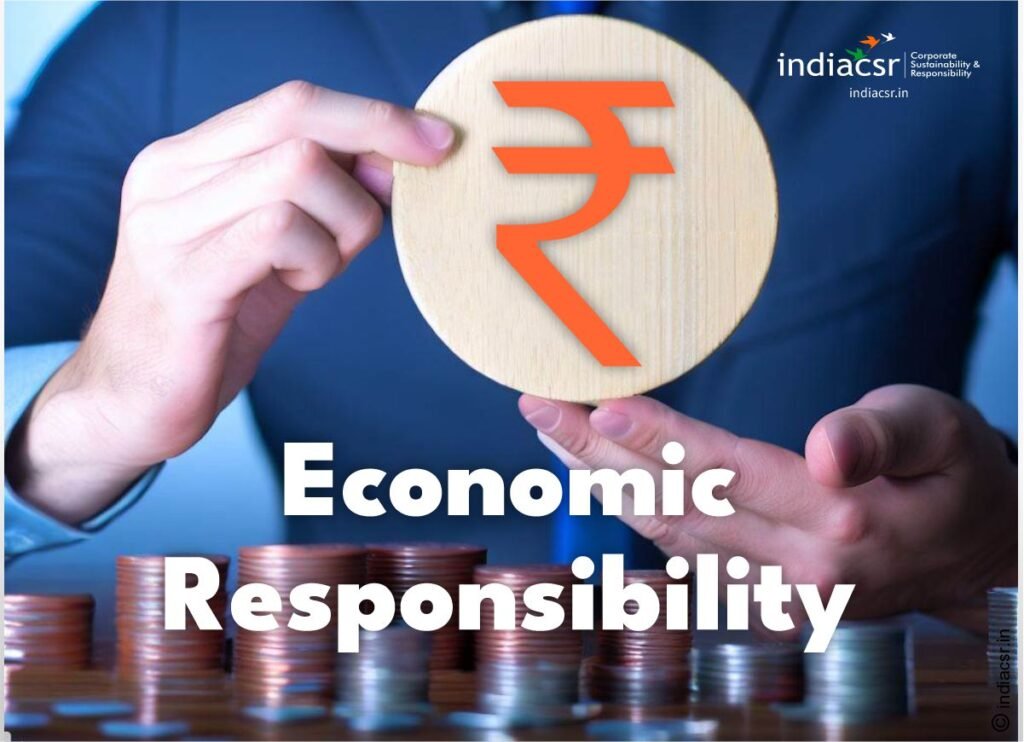
Economic Responsibility

The economic responsibility of business is one of the types of corporate social responsibility (CSR), which is the idea that a business has a responsibility to the society that exists around it. Economic responsibility means ensuring an economic advantage both to the region from where the purchase arrived and to the region where it is marketed.

It also means that a business should provide goods and services that meet the needs and wants of consumers, create jobs and compensation for employees, and generate profits for shareholders and investors. The end goal is not to simply maximize profits, but to make sure the business operations positively impact the environment, people, and society.

Economic responsibility is the most basic social responsibility of a business, as it reflects the primary purpose of a business: to create value for society by producing goods and services that satisfy customer needs.

Without economic responsibility, a business cannot survive or grow in the long run. However, economic responsibility alone is not enough to ensure a business’s social legitimacy and right to operate. A business also needs to consider its environmental, ethical, and philanthropic responsibilities, which are the other types of CSR.

These responsibilities reflect the expectations of various stakeholders, such as customers, employees, investors, regulators, communities, and society at large. By fulfilling these responsibilities, a business can enhance its reputation, trustworthiness, and competitiveness in the market. Therefore, economic responsibility is not only a duty but also an opportunity for a business to create shared value for itself and society.

Legal Responsibility

  • This means obeying the law and playing by the rules.
  • Businesses are expected to comply with all relevant legislation and regulations.
India CSR
Legal Responsibility

The legal responsibility of business is another type of corporate social responsibility (CSR), which is the idea that a business has a responsibility to the society that exists around it. Legal responsibility means that a business should comply with the law and follow any applicable regulations, court orders, and ethical standards. A business should not engage in any illegal or fraudulent activity that may harm its customers, employees, investors, competitors, or society at large. A business may be held liable for damages if it fails to meet its legal responsibilities1.

Legal responsibility is an essential social responsibility of business, as it reflects the minimum expectation of society from a business: to obey the law and respect the rights of others. Without legal responsibility, a business may lose its social legitimacy and right to operate, and may face legal sanctions or penalties. Legal responsibility also helps a business to protect its reputation, trustworthiness, and competitiveness in the market. However, legal responsibility alone is not enough to ensure a business’s social contribution and value creation.

A business also needs to consider its environmental, ethical, and philanthropic responsibilities, which are the other types of CSR. These responsibilities reflect the higher expectations of various stakeholders, such as customers, employees, investors, regulators, communities, and society at large. By fulfilling these responsibilities, a business can enhance its social impact and shared value for itself and society.

Ethical Responsibility

  • This goes beyond the obligations set by law.
  • It involves doing what’s right, fair, and just, even when there’s no legal requirement.
  • Ethical responsibilities can cover a range of areas, from fair treatment of employees to sourcing practices, to transparency with consumers.
India CSR
Ethical Responsibility

Ethical responsibility in business is another type of corporate social responsibility (CSR). It is the idea that a business has a responsibility to the society that exists around it. Ethical responsibility means that a business should behave in ways that are expected by society but not necessarily required by law. It involves following moral standards and principles that guide the decisions and actions of a business. A business should not only avoid causing harm, suffering, waste, or destruction, but also be expected to do good for the environment, people, and society.

Ethical responsibility is a higher social responsibility of business than a legal responsibility. It reflects the voluntary choice of a business to go beyond the minimum expectations of society and law. By fulfilling its ethical responsibility, a business can enhance its reputation, trustworthiness, and competitiveness in the market. It can also attract and retain ethical employees, customers, investors, and partners who share the same values and principles.

However, ethical responsibility is not the highest social responsibility of a business. A business also needs to consider its philanthropic responsibility, which is the idea that a business should contribute to the well-being and development of society through charitable donations or actions2. This responsibility reflects the generosity and goodwill of a business towards society.

Philanthropic Responsibility

  • This involves voluntarily or mandatory contributing to the community and improving quality of life.
  • Businesses can do this through donations, supporting local organizations, or employee volunteer programs, for example.
India CSR
Philanthropic Responsibility

The philanthropic responsibility of a business is the highest type of corporate social responsibility (CSR). It is the idea that a business has a responsibility to the society that exists around it. Philanthropic responsibility means that a business should voluntarily contribute to the well-being and development of society through charitable donations or actions. It involves going above and beyond what is expected by society or law and showing generosity and goodwill towards society.

Philanthropic responsibility is a discretionary social responsibility of a business. It reflects the choice of a business to give back to society without any obligation or expectation of return. By fulfilling its philanthropic responsibility, a business can demonstrate its values and compassion, and create a positive social impact.

It can also enhance its reputation, trustworthiness, and competitiveness in the market. It can also attract and retain ethical employees, customers, investors, and partners who share the same social vision.

However, philanthropic responsibility is not a substitute for other social responsibilities of business. A business also needs to consider its environmental, ethical, and legal responsibilities, which are the other types of CSR. These responsibilities reflect the basic expectations of society and law from a business. By fulfilling these responsibilities, a business can ensure its social legitimacy and right to operate.


  • Disclaimer: These categories are not mutually exclusive, and many CSR initiatives can address more than one type of responsibility at the same time. For example, a company might create a product that both generates profit (economic responsibility) and has environmental benefits (ethical responsibility). It’s also important to note that different stakeholders may prioritize different types of CSR, so businesses often need to balance various interests and expectations.
Tags: Corporate Social Responsibility (CSR)Economic Responsibility of BusinessEthical Responsibility of BusinessLegal Responsibility of BusinessPhilanthropic Responsibility of BusinessSocial Responsibility of BusinessWhat is Business ResponsibilityWhat is Corporate Social ResponsibilityWhat is CSR

CSR, Sustainability, and ESG success stories hindustan zinc
ADVERTISEMENT
India CSR

India CSR

India CSR is the largest media on CSR and sustainability offering diverse content across multisectoral issues on business responsibility. It covers Sustainable Development, Corporate Social Responsibility (CSR), Sustainability, and related issues in India. Founded in 2009, the organisation aspires to become a globally admired media that offers valuable information to its readers through responsible reporting.

Related Posts

India csr news
Corporate Social Responsibility

CSR: Tata AI Sakhi Immersion Program Empowers 1,553 Rural Women Entrepreneurs

7 hours ago
CSR: Phenom Cares and Bayireddi Foundation Impact 750 Lives in Hyderabad
Corporate Social Responsibility

CSR: Phenom Cares and Bayireddi Foundation Impact 750 Lives in Hyderabad

10 hours ago
CSR: TK Elevator Empowers Children with Education and Mentorship in India
Corporate Social Responsibility

CSR: TK Elevator Empowers Children with Education and Mentorship in India

12 hours ago
VESCOA’s Beach Clean-Up Drive at DadarChowpatty
Articles

VESCOA’s Beach Clean-Up Drive at DadarChowpatty

14 hours ago
India CSR News
Corporate Social Responsibility

CSR: HCLFoundation Supports National T20 Tournament for Visually Impaired

1 day ago
CSR: Wishes and Blessings Milk Drive Supports 1,500 Children on Mahashivratri
Corporate Social Responsibility

CSR: Wishes and Blessings Milk Drive Supports 1,500 Children on Mahashivratri

1 day ago
Load More
Ambedkar Chamber
ADVERTISEMENT
India Sustainability Awards 2026
ADVERTISEMENT

LATEST NEWS

Flipkart Conducts E-Commerce Workshop for SHG Women at SARAS Mela

CSR: Tata AI Sakhi Immersion Program Empowers 1,553 Rural Women Entrepreneurs

How a Demat Account Helps You Start Your Investment Journey

महिलाएं हिन्दुस्तान जिंक के सखी कार्यक्रम से जुड़कर स्वयं और देश को आत्मनिर्भर बनाने में महत्वपूर्ण भूमिका निभाएं- मन्नालाल रावत

CSR: Phenom Cares and Bayireddi Foundation Impact 750 Lives in Hyderabad

Types of Aluminium Doors and Windows Used in Dubai – Mazari Contracting

Economy India Largest Media on Indian Economy and Business
ADVERTISEMENT
Ad 1 Ad 2 Ad 3
ADVERTISEMENT
ESG Professional Network
ADVERTISEMENT

TOP NEWS

LevelUpSkool: Transforming Education with Financial Market Expertise and AI Skill-Based Learning

Understanding the Brain-Glucose Connection: What Alzheimer’s, Diabetes, and CGM Have in Common

How HomeSol Turned a 100 sq ft Steel Office into Mumbai’s Most Trusted Real Estate Ecosystem

XLRI Records Strong Final Placements for PGDM (BM) & PGDM (HRM) Batch 2024–26

CSR: TK Elevator Empowers Children with Education and Mentorship in India

ROAS Digital Expands White-Label Performance Marketing Capabilities; Invests in AI Systems and Talent Growth

Load More
STEM Learning STEM Learning STEM Learning
ADVERTISEMENT

Interviews

Prof. Kang Sung Lee, PhD
Interviews

Prof. Kang Sung Lee on Academia, Policy, and Industry-Linked Career Pathways

by India CSR
February 5, 2026

Despite being an advanced economy, South Korea faces a severe demographic crisis.

Read moreDetails
Magma Group CEO and Founder, Neal Thakker

Embedding CSR in Responsible Manufacturing at Magma Group: An Interview with Neal Thakker

January 21, 2026
Sudeep Agrawal, CFO & Head – CSR, Ashirvad by Aliaxis

Integrating Financial Leadership With Impactful CSR Initiatives: An Interview with Sudeep Agrawal, Ashirvad by Aliaxis

December 29, 2025
Satish Jha

Interview with Satish Jha: Pioneering CSR in Education

December 5, 2025
Load More
Facebook Twitter Youtube LinkedIn Instagram
India CSR Logo

India CSR is the largest tech-led platform for information on CSR and sustainability in India offering diverse content across multisectoral issues. It covers Sustainable Development, Corporate Social Responsibility (CSR), Sustainability, and related issues in India. Founded in 2009, the organisation aspires to become a globally admired media that offers valuable information to its readers through responsible reporting. To enjoy the premium services, we invite you to partner with us.

Follow us on social media:


Dear Valued Reader

India CSR is a free media platform that provides up-to-date information on CSR, Sustainability, ESG, and SDGs. We need reader support to continue delivering honest news. Donations of any amount are appreciated.

Help save India CSR.

Donate Now

Donate at India CSR

  • About India CSR
  • Team
  • India CSR Awards 2025
  • India CSR Leadership Summit
  • Partnership
  • Guest Posts
  • Services
  • ESG Professional Network
  • Content Writing Services
  • Business Information
  • Contact
  • Privacy Policy
  • Terms of Use
  • Donate

Copyright © 2025 - India CSR | All Rights Reserved

No Result
View All Result
  • Home
  • Corporate Social Responsibility
    • Art & Culture
    • CSR Leaders
    • Child Rights
    • Culture
    • Education
    • Gender Equality
    • Around the World
    • Skill Development
    • Safety
    • Covid-19
    • Safe Food For All
  • Sustainability
    • Sustainability Dialogues
    • Sustainability Knowledge Series
    • Plastics
    • Sustainable Development Goals
    • ESG
    • Circular Economy
    • BRSR
  • Corporate Governance
    • Diversity & Inclusion
  • Interviews
  • SDGs
    • No Poverty
    • Zero Hunger
    • Good Health & Well-Being
    • Quality Education
    • Gender Equality
    • Clean Water & Sanitation – SDG 6
    • Affordable & Clean Energy
    • Decent Work & Economic Growth
    • Industry, Innovation & Infrastructure
    • Reduced Inequalities
    • Sustainable Cities & Communities
    • Responsible Consumption & Production
    • Climate Action
    • Life Below Water
    • Life on Land
    • Peace, Justice & Strong Institutions
    • Partnerships for the Goals
  • Articles
  • Events
  • हिंदी
  • More
    • Business
    • Finance
    • Environment
    • Economy
    • Health
    • Around the World
    • Social Sector Leaders
    • Social Entrepreneurship
    • Trending News
      • Important Days
      • Great People
      • Product Review
      • International
      • Sports
      • Entertainment
    • Case Studies
    • Philanthropy
    • Biography
    • Technology
    • Lifestyle
    • Sports
    • Gaming
    • Knowledge
    • Home Improvement
    • Words Power
    • Chief Ministers

Copyright © 2025 - India CSR | All Rights Reserved

This website uses cookies. By continuing to use this website you are giving consent to cookies being used. Visit our Privacy and Cookie Policy.

