

Words Vikas Parasram Meshram
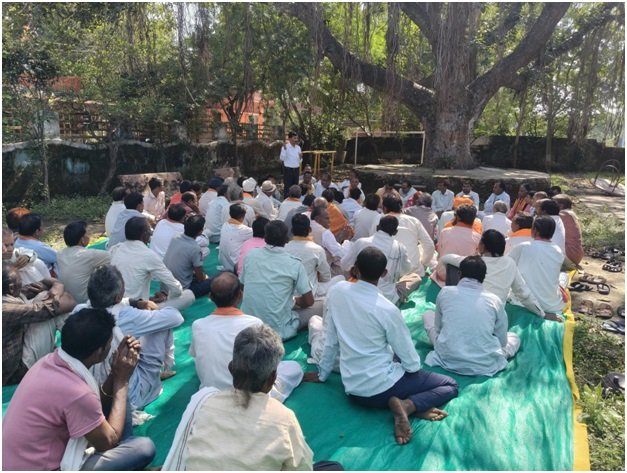
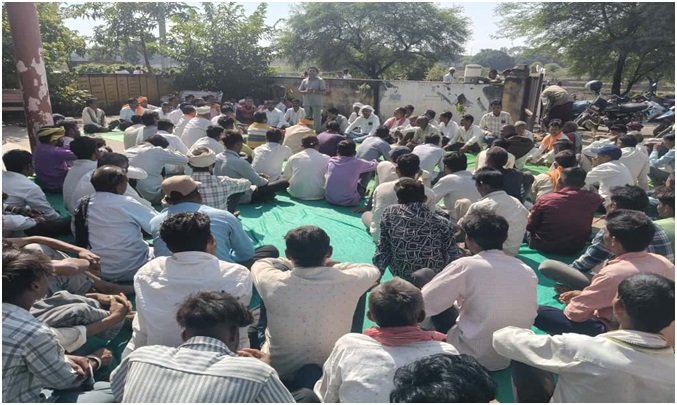
NEW DELHI (India CSR): A social movement has begun in the Banswara district of South Rajasthan, preparing society to tackle modern challenges while respecting traditions. Through social reform meetings organized via Krushi avm Aadivasi Swaraj Sagthan formed by Vaagdhara, the tribal community has united and made decisions against their problems. From 34 gram panchayats in Anandpuri sub-division to 95 villages in the Gangadtalai panchayat samiti area, hundreds of people from tribal society have together launched a campaign against social evils, wasteful expenditure, and social disintegration. These are not merely meetings, but are taking the form of a people’s movement that has the potential to reshape the future of tribal society.
Collective Village Resolutions
At a meeting held at the Chhaja Panchayat Bhavan in Anandpuri tehsil, representatives from many villages including Jetiyawada, Kathiriya, Bhojela, Koba, Damaira, Bori, Nawatapara, and Barkota unanimously decided that DJ, dowry, and intoxication would not be permitted at any social event. To enforce these rules, a five-member committee has been formed in each village that will take strict action against violations.
DJ Alcohol Ban
Even stricter rules were made at a meeting held in Wankakhuta village in Kushalipada, Sajjangarh tehsil. A fine of 51,000 rupees was fixed for playing DJ music, while society will punish anyone who comes to any event after drinking alcohol. Declaring alcohol and DJ culture to be fatal for society, a complete ban on them was announced.
Addiction Free Society
The problem of intoxication had taken a serious form in tribal society and the younger generation was ruining their future by falling prey to it. To tackle this, society has imposed a complete ban on serving liquor, bidi, cigarettes, tobacco, gutka, and paan-masala at all social events. There is a complete ban on smoking and drinking, and keeping children under 18 years of age free from intoxication has been made mandatory. There is a complete ban on selling alcohol in villages, and emphasis is being placed on motivating youth toward sports, education, and employment.
Simple Marriage Reforms
In the blind race of modernity, marriages had become a matter of prestige, and families would spend lakhs for show even while drowning in debt. Understanding this problem, society has taken concrete steps. The sacred ritual of kanyadaan will be performed only by parents; food will be only pure vegetarian limited to dal, rice, and lapsi. Only one bus and one vehicle have been designated for the wedding procession, and only one person from each household will participate in the wedding ceremony. The Notara wedding procession will take place only from 9 AM to 6 PM.
Traditional Customs Revival
At a joint meeting of villages Ganeshpura, Bhitpada, and Bhedipada in Gangadtalai tehsil, the decision was made to use traditional musical instruments, which is not only cheaper but also keeps cultural heritage alive. Important reforms have also been made regarding death feasts and shroud customs. Upon death, only one shroud each will be brought from the maternal side and from home, the Toliya custom has been discontinued, and the son-in-law will bring only one pot. Reforming the Mamera custom as well, it was decided that this will be done only by the maternal uncle, and after a girl’s marriage, only one Mamera from the parents’ home will be valid.
Women Leadership Inclusion
Equal participation of women has been ensured in all Agricultural and Tribal Swaraj Organizations. Special discussion took place in meetings about women’s participation in social decisions. This step is important because strengthening the status of women and their voice in tribal society is necessary. When women are included in the decision-making process, the development of society will be more comprehensive and sustainable.
Severe Social Penalties
Strict penalty provisions have also been fixed for violations to make social rules effective. If any person abducts a girl or woman and commits misconduct, he will be expelled from society. For Natara within a village or gotra, there will be a fine of 5 lakh rupees and social boycott. A married person performing Natara will also face a 5 lakh fine and expulsion from the village. If a minor girl or boy performs Natara, they will be returned, and taking legal action without asking society will result in a fine of 5,000 rupees.
Revived Panchayat Justice
To avoid the complexities and expenses of the modern justice system, society has decided to revive the traditional Panch-Panchayat system. Except in special circumstances, common family and social disputes will be resolved through mutual consent at the panchayat and society level. This system not only saves time and money but also strengthens the internal unity of society. In these village meetings, an extremely courageous decision was taken that if any political party or candidate in any type of election distributes or is caught distributing alcohol or money, society will not vote for that party or candidate. This is a revolutionary step toward making the democratic process clean and transparent.
Ongoing Reform Monitoring
The organizations have decided to mandatorily organize social reform meetings twice a year, which will enable review of rules and amendments as needed. Village-to-village awareness campaigns will be conducted so that every person is aware of these decisions. Members have been given the responsibility to ensure participation in meetings of all community-based organizations in their area and to monitor government facilities like anganwadis, schools, and health centers.
Government Community Bridge
Vaagdhara’s Krushi avm Aadivasi Swaraj Sagthan are working as a bridge between government and community. It is the responsibility of organization members to make the community aware of government schemes, help eligible beneficiaries obtain scheme benefits, maintain regular contact with sarpanch and government officials, and assist in applications and follow-up actions.
Mass Community Participation
The greatest feature of these meetings has been widespread public participation. Large numbers of community members were present at meetings held at Chhana Panchayat Bhavan, Wankakhuta, Ganeshpura’s Atal Seva Kendra, and Dhalar. Youth, elderly, women, panches, public representatives, and social workers all together prepared the blueprint for their society’s future.
Grassroots Leadership Network
Office bearers of Agricultural and Tribal Swaraj Organizations have played a leading role in this social revolution. Dedicated office bearers like Ram Singh, Man Singh, Chhatr Singh, Wal Singh, Bahadur, Dinesh, Amuli, Roop Singh, Ganga, Kailash, Vijaypal, Tolaram, Champa, Narsingh, Anil, Chokha, Philis, Sarita, Dhan Singh, Janta, Narendra, Devchandra, Parasing, Maggu, Sita, Hukmchand, Kal ji, Dev ji, Jagmal, Kamal, Devendra Singh, Shantilal Garasia, Ishwar Lal Garasia, Raju Bhai Yadav, Dhanji Damor, Ganesh Damor, Jivanlal Motiya Damor, Jivanlal, Rakesh Dhamot, Daulatram, Himmatlal, Kamla, Shankarlal, Veersingh, Kantilal, Olachand, Ambalal, Ramesh Bhai, Dhanpal Nat, Prabhulal, and Hiralal have provided strength to these meetings by connecting people in their respective areas.
Village Awareness Campaigns
These office bearers have worked to raise awareness in society by going village to village. They explained to people how intoxication, wasteful expenditure, and social evils are hollowing out the entire society. These leaders believe that unless society itself comes forward to solve its problems, no external effort can succeed. Therefore, working at the grassroots level, they contacted every family and connected them to this movement. It is the commitment and dedication of these office bearers that has taken this movement to every person. Their resolve is that they will make their society educated, healthy, addiction-free, and self-reliant, and they are continuously working toward this.
Catalyst Organizational Role
In this entire campaign, the role of Vaagdhara organization has been that of a catalyst. They have not only created organizations but made people realize their power and showed that the community can solve its own problems. But the real power lies in the community, and Vaagdhara has only provided guidance while the community has made decisions itself.
Implementation Collective Challenge
This journey has just begun and the real challenge will be implementing these decisions on the ground. But when every member of the community becomes part of this change, success is certain. This is not just the story of a few villages, but the story of those millions of people who want change, who want to give their children a better future, and who want to preserve their culture and dignity.
Vision Empowered India
Vaagdhara’s Krushi avm Aadivasi Swaraj Sagthan have proven that change is possible. Now there is a need to carry this torch forward, to take this movement to more villages, and to build a society that is educated, healthy, prosperous, and dignified. This is the time to witness history, this is the time to become part of change, and this is the time to build a new India where every community is empowered, every person is respected, and every child can fulfill their dreams.
Abstract
This article documents a community-led social reform movement among tribal communities in Banswara district of southern Rajasthan. Through agricultural and Adivasi Swaraj organisations facilitated by Vaagdhara, the community has collectively addressed substance abuse, excessive social expenditure, and weakening traditional institutions. By blending indigenous values with contemporary social needs, the initiative promotes participatory governance, women’s involvement, and self-regulated social norms. The experience offers a compelling grassroots model of sustainable social transformation rooted in cultural integrity and collective responsibility.
About the Author

Vikas Parashram Meshram is a social worker, independent writer, and researcher focusing on tribal communities, rural development, and social justice. With extensive grassroots experience, he documents community-driven initiatives and indigenous governance practices through his writing.
(India CSR)