

• India CSR Awards 2026
  • India CSR Leadership Summit
  • Guest Posts
Saturday, July 11, 2026
India CSR
  • Home
  • Corporate Social Responsibility
    • Art & Culture
    • CSR Leaders
    • Child Rights
    • Culture
    • Education
    • Gender Equality
    • Around the World
    • Skill Development
    • Safety
    • Covid-19
    • Safe Food For All
  • Sustainability
    • Sustainability Dialogues
    • Sustainability Knowledge Series
    • Plastics
    • Sustainable Development Goals
    • ESG
    • Circular Economy
    • BRSR
  • Corporate Governance
    • Diversity & Inclusion
  • Interviews
  • SDGs
    • No Poverty
    • Zero Hunger
    • Good Health & Well-Being
    • Quality Education
    • Gender Equality
    • Clean Water & Sanitation – SDG 6
    • Affordable & Clean Energy
    • Decent Work & Economic Growth
    • Industry, Innovation & Infrastructure
    • Reduced Inequalities
    • Sustainable Cities & Communities
    • Responsible Consumption & Production
    • Climate Action
    • Life Below Water
    • Life on Land
    • Peace, Justice & Strong Institutions
    • Partnerships for the Goals
  • Articles
  • Events
  • हिंदी
  • More
    • Business
    • Finance
    • Environment
    • Economy
    • Health
    • Around the World
    • Social Sector Leaders
    • Social Entrepreneurship
    • Trending News
      • Important Days
        • Festivals
      • Great People
      • Product Review
      • International
      • Sports
      • Entertainment
    • Case Studies
    • Philanthropy
    • Biography
    • Technology
    • Lifestyle
    • Sports
    • Gaming
    • Knowledge
    • Home Improvement
    • Words Power
    • Chief Ministers
No Result
View All Result
  • Home
  • Corporate Social Responsibility
    • Art & Culture
    • CSR Leaders
    • Child Rights
    • Culture
    • Education
    • Gender Equality
    • Around the World
    • Skill Development
    • Safety
    • Covid-19
    • Safe Food For All
  • Sustainability
    • Sustainability Dialogues
    • Sustainability Knowledge Series
    • Plastics
    • Sustainable Development Goals
    • ESG
    • Circular Economy
    • BRSR
  • Corporate Governance
    • Diversity & Inclusion
  • Interviews
  • SDGs
    • No Poverty
    • Zero Hunger
    • Good Health & Well-Being
    • Quality Education
    • Gender Equality
    • Clean Water & Sanitation – SDG 6
    • Affordable & Clean Energy
    • Decent Work & Economic Growth
    • Industry, Innovation & Infrastructure
    • Reduced Inequalities
    • Sustainable Cities & Communities
    • Responsible Consumption & Production
    • Climate Action
    • Life Below Water
    • Life on Land
    • Peace, Justice & Strong Institutions
    • Partnerships for the Goals
  • Articles
  • Events
  • हिंदी
  • More
    • Business
    • Finance
    • Environment
    • Economy
    • Health
    • Around the World
    • Social Sector Leaders
    • Social Entrepreneurship
    • Trending News
      • Important Days
        • Festivals
      • Great People
      • Product Review
      • International
      • Sports
      • Entertainment
    • Case Studies
    • Philanthropy
    • Biography
    • Technology
    • Lifestyle
    • Sports
    • Gaming
    • Knowledge
    • Home Improvement
    • Words Power
    • Chief Ministers
No Result
View All Result
India CSR
No Result
View All Result
Home Finance

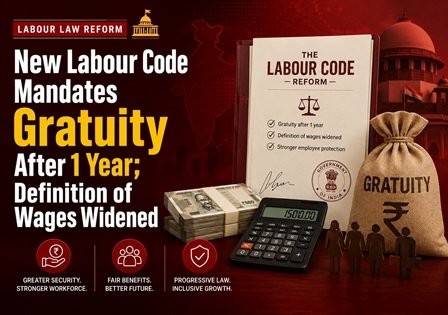
New Labour Code Mandates Gratuity After 1 Year; Definition of Wages Widened

Employers Must Prepare for Higher Gratuity Costs and Payroll Restructuring Requirements Now

India CSR by India CSR
July 11, 2026
in Finance
Reading Time: 8 mins read
New Labour Code Mandates Gratuity After 1 Year

New Labour Code Mandates Gratuity After 1 Year

Share Share Share Share
WhatsApp icon
WhatsApp — Join Us
Instant updates & community
Google News icon
Google News — Follow Us
Get our articles in Google News feed

Learn how India’s new Labour Code provides gratuity after one year for fixed-term employees and expands the wage definition for benefit calculations.

India’s labour landscape is undergoing a major transformation with the implementation of the new labour code from 21 November 2025. One of the most significant reforms relates to gratuity eligibility and wage computation. Employees working on fixed-term contracts can now become eligible for gratuity after just one year of continuous service, while the definition of wages used for gratuity calculations has also been broadened.

These changes are expected to improve social security benefits for millions of employees and encourage organisations to reassess their compensation structures and long-term liabilities.

What Is Changing Under the New Labour Code?

The new labour code consolidates multiple labour legislations into four comprehensive codes, including the Code on Social Security, 2020 and the Code on Wages, 2019.

The revised gratuity framework introduces two major changes:

  • Fixed-term employees become eligible for gratuity after completing one year of continuous service with the same employer.
  • The definition of wages has been standardised, ensuring that wages constitute at least 50% of total remuneration for gratuity and other social security calculations.

These provisions aim to bring greater fairness to employees engaged in contract-based or project-oriented roles.

Gratuity Eligibility: Old Rules vs New Rules

ParticularsEarlier RulesNew Labour Code Rules
Eligibility for permanent employees5 years of continuous serviceNo change
Eligibility for fixed-term employeesGenerally not eligible before 5 yearsEligible after 1 year of service
Wage definition for gratuityBasic salary and DA consideredBroader definition with 50% remuneration threshold
CoverageMostly regular employeesIncludes more fixed-term and contractual workers

The revised framework significantly expands gratuity coverage, especially in industries where contractual hiring is common.

Why the One-Year Eligibility Rule Matters

Under the previous system, employees working on short-term assignments frequently missed out on gratuity benefits despite contributing several productive years.

Consider this example:

An employee joins a technology company on a two-year fixed-term contract and completes 18 months of service before the project concludes.

Earlier scenario

  • Gratuity was generally unavailable because the employee had not completed five years of service.

Under the new labour code

  • The employee may now qualify for gratuity benefits after completing one year of continuous service.

This reform particularly benefits professionals working in sectors such as:

  • Information technology
  • Manufacturing
  • Startups
  • Logistics
  • Consulting services
  • Business process outsourcing

Employees who frequently move between projects can now build a stronger retirement corpus over time.

Expanded Definition of Wages

Another notable aspect of the new labour code is the revised wage structure.

Previously, companies often designed salary packages with a lower basic salary and higher allowances, which reduced gratuity payouts.

Under the revised rules:

Wages include

  • Basic salary
  • Dearness allowance
  • Retaining allowance

In addition, if excluded components exceed 50% of total remuneration, the excess amount may be added back while calculating wages.

Illustration

Suppose an employee receives an annual package of ₹12 lakh.

ComponentEarlier StructureRevised Framework
Basic salary₹3.6 lakh₹6 lakh
Allowances₹8.4 lakh₹6 lakh
Gratuity calculation base₹3.6 lakh₹6 lakh

A higher wage base means employees could receive substantially larger gratuity payments upon exit.

Impact on Employers

While employees stand to gain, organisations may experience higher financial obligations.

Companies relying heavily on project-based hiring models will need to prepare for:

1. Increased Gratuity Costs

Earlier eligibility means gratuity liabilities may arise much sooner than before.

2. Payroll Restructuring

Human resource teams will have to review salary compositions to comply with the 50% wage requirement.

3. Better Workforce Planning

Employers may revisit contract durations, retention strategies and budgeting processes.

Businesses should also conduct periodic actuarial assessments to estimate future gratuity obligations.

Additional Labour Reforms Introduced

The gratuity amendments are only one part of the broader reforms introduced under the new labour code.

Some other notable measures include:

Annual Health Check-ups

Employees above the age of 40 are entitled to free annual medical examinations.

Wider ESIC Coverage

Establishments employing fewer than ten workers can voluntarily opt for coverage under the Employees’ State Insurance Scheme. However, businesses involved in hazardous activities may have mandatory enrolment requirements.

Recognition of Gig and Platform Workers

For the first time, workers associated with digital platforms have received formal recognition under labour laws. Aggregators may contribute between 1% and 2% of annual turnover towards social security schemes, subject to prescribed limits.

Portable Benefits

An Aadhaar-linked Universal Account Number enables workers to access benefits seamlessly across states and employers.

How Employees Can Assess Their Benefits

Employees should proactively evaluate the implications of the revised gratuity framework.

A few practical steps include:

  • Reviewing employment contracts to understand whether they qualify as fixed-term engagements.
  • Examining salary structures to identify the proportion allocated towards basic wages.
  • Using a gratuity calculator to estimate expected payouts under the revised wage definition.
  • Discussing gratuity provisions with the HR department to clarify eligibility conditions.

Professionals may also compare their take-home pay under different compensation structures through a salary calculator to understand how salary revisions affect long-term benefits.

Is Gratuity Enough for Retirement?

Gratuity can provide a useful financial cushion at the time of retirement, resignation or career transition. However, it is generally designed as a one-time payment and may not adequately replace regular income after retirement.

For example, even a gratuity corpus of Rs. 15–20 lakh may not sustain an individual for two decades or more after retirement, especially considering inflation and healthcare expenses.

Employees should therefore view gratuity as only one component of their retirement strategy.

Combining gratuity benefits with suitable pension plans, provident fund accumulations and long-term investments can help create a more dependable income stream during retirement.

Final Thoughts

The introduction of one-year gratuity eligibility for fixed-term employees marks one of the most employee-friendly reforms under the new labour code. By widening access to gratuity and strengthening the wage definition, the government aims to provide better financial protection to contract workers and professionals engaged in evolving employment arrangements.

For employees, the changes translate into earlier access to retirement benefits and potentially higher payouts. For employers, they necessitate careful planning, payroll adjustments and proactive compliance measures.

Understanding these reforms today can help both organisations and workers make informed financial decisions and maximise the long-term value of employment benefits.

(India CSR)

Tags: GratuityGratuity EligibilityLabour Code
India CSR Image 1 India CSR Image 2

CSR, Sustainability, and ESG success stories hindustan zinc
ADVERTISEMENT
India CSR

India CSR

India CSR® is the largest media on CSR and sustainability offering diverse content across multisectoral issues on business responsibility. It covers Sustainable Development, Corporate Social Responsibility (CSR), Sustainability, and related issues in India. Founded in 2009, the organisation aspires to become a globally admired media that offers valuable information to its readers through responsible reporting.

Related Posts

SBI Disburses ₹2.59 Lakh Crore in Home and Home-Related Loans in FY 2025-26
Finance

SBI Disburses ₹2.59 Lakh Crore in Home and Home-Related Loans in FY 2025-26

2 days ago
Global Indices Influence the Indian Stock Market
Finance

How Global Indices Influence the Indian Stock Market

2 days ago
SIP Calculator for Child Education and Retirement Planning
Finance

Mutual Fund Goal Planner Calculator: How Much SIP Do You Need for Child’s Education or Retirement?

3 days ago
Micro Finance in India
Finance

SAVE Microfinance Raises ₹40 Crore from Indian Overseas Bank and Northern Arc Capital

4 days ago
Profit Margin
Finance

What is Profit Margin? Meaning, Formula, Types, Importance and Examples

1 week ago
Retirement calculator
Finance

What to Check Before Investing in the Best Retirement Plans

4 weeks ago
Load More
CSR Raigarh Summit 2026
ADVERTISEMENT
bba
ADVERTISEMENT
FKCCI
ADVERTISEMENT

Interviews

Dr. Vikas Garg, Chairman, Ebix Group
Interviews

CSR: Compliance Gives You a Floor, But Purpose Gives You a Legacy: Dr. Vikas Garg, Chairman, Ebix Group

by India CSR
June 29, 2026

Ebix Group aligns CSR with technology, financial inclusion and digital literacy.

Read moreDetails
Harkirat Kaur, CEO, Hartek Foundation

Building Resilient Communities Through Sustainable Development: Harkirat Kaur, CEO, Hartek Foundation

June 22, 2026
Indu Mehta, Chief Sustainability Officer (CSO) at Bhilwara Energy Limited @IndiaCSR

ESG in India Has Moved Beyond Storytelling: Bhilwara Energy’s Indu Mehta on Sustainability as an Operating Discipline

May 30, 2026
Sourabh Lohtia, Chief Marketing & Communications Officer, PNB MetLife

Targeted Skilling Can Build Confident Futures for Underprivileged Women: Sourabh Lohtia, PNB MetLife

May 29, 2026
Load More
Ad 1 Ad 2 Ad 3 Ad 4 Ad 5 Ad 6
ADVERTISEMENT

CSR UPDATES

ThinkSharp Foundation Felicitated for Digital Class Project in Pune

Admissions Open for BBA in CSR, Sustainability and ESG at Rungta International Skills University, Bhilai

Marico CSR Spending Report FY26

Marico Advances Purpose-Led Growth, ESG Roadmap and Community Impact in FY26

CSR: HCL Foundation and UP Govt. to Collaborate for Sustainable Cities

CSR: Honeywell Advances Future-ready Skills Through STEM-led School Transformation Program

STEM Learning STEM Learning STEM Learning
ADVERTISEMENT
Facebook Twitter Youtube LinkedIn Instagram
India CSR Logo

India CSR is the largest tech-led platform for information on CSR and sustainability in India offering diverse content across multisectoral issues. It covers Sustainable Development, Corporate Social Responsibility (CSR), Sustainability, and related issues in India. Founded in 2009, the organisation aspires to become a globally admired media that offers valuable information to its readers through responsible reporting. To enjoy the premium services, we invite you to partner with us.

Follow us on social media:

Subscribe to Our Newsletter

Don't miss out on the latest updates in corporate social responsibility. Subscribe to our newsletter at indiacsr.in and be part of the positive change.
Please enable JavaScript in your browser to complete this form.
Loading

  • About India CSR
  • Team
  • India CSR Awards 2026
  • India CSR Leadership Summit
  • Partnership
  • Guest Posts
  • Services
  • ESG Professional Network
  • Content Writing Services
  • Business Information
  • Contact
  • Privacy Policy
  • Terms of Use
  • Donate

Copyright © 2026 - India CSR | All Rights Reserved

No Result
View All Result
  • Home
  • Corporate Social Responsibility
    • Art & Culture
    • CSR Leaders
    • Child Rights
    • Culture
    • Education
    • Gender Equality
    • Around the World
    • Skill Development
    • Safety
    • Covid-19
    • Safe Food For All
  • Sustainability
    • Sustainability Dialogues
    • Sustainability Knowledge Series
    • Plastics
    • Sustainable Development Goals
    • ESG
    • Circular Economy
    • BRSR
  • Corporate Governance
    • Diversity & Inclusion
  • Interviews
  • SDGs
    • No Poverty
    • Zero Hunger
    • Good Health & Well-Being
    • Quality Education
    • Gender Equality
    • Clean Water & Sanitation – SDG 6
    • Affordable & Clean Energy
    • Decent Work & Economic Growth
    • Industry, Innovation & Infrastructure
    • Reduced Inequalities
    • Sustainable Cities & Communities
    • Responsible Consumption & Production
    • Climate Action
    • Life Below Water
    • Life on Land
    • Peace, Justice & Strong Institutions
    • Partnerships for the Goals
  • Articles
  • Events
  • हिंदी
  • More
    • Business
    • Finance
    • Environment
    • Economy
    • Health
    • Around the World
    • Social Sector Leaders
    • Social Entrepreneurship
    • Trending News
      • Important Days
      • Great People
      • Product Review
      • International
      • Sports
      • Entertainment
    • Case Studies
    • Philanthropy
    • Biography
    • Technology
    • Lifestyle
    • Sports
    • Gaming
    • Knowledge
    • Home Improvement
    • Words Power
    • Chief Ministers

Copyright © 2026 - India CSR | All Rights Reserved

This website uses cookies. By continuing to use this website you are giving consent to cookies being used. Visit our Privacy and Cookie Policy.

