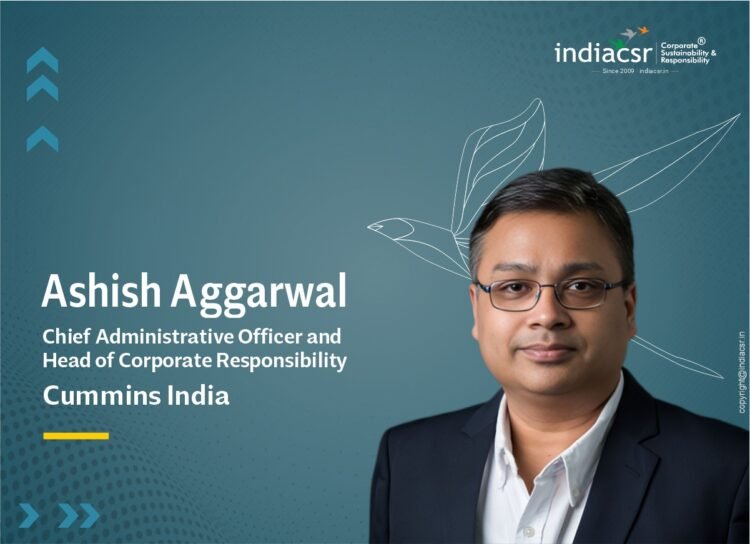


Ashish Aggarwal Shares Cummins India’s CSR Vision in Environment, Education, and Women Empowerment
By Rusen Kumar
NEW DELHI (India CSR): Ashish Aggarwal, Chief Administrative Officer and Head of Corporate Responsibility at Cummins India, leads the company’s strategic CSR initiatives, focusing on Environment, Education, and Equity. Celebrating 35 years of the Cummins India Foundation, the company has delivered measurable impact through watershed and renewable energy projects, air quality initiatives, and organic waste management. Programs like EmpowHer, Project Sakhi, and Cummins Powers Women have empowered thousands of women with livelihoods, financial inclusion, and leadership skills, while scholarship and skill-building initiatives such as the Cummins College of Engineering for Women, Nurturing Brilliance, and TEC equip youth with employable skills. Through employee engagement via ‘Every Employee Every Community’ (EEEC), strong governance, and community ownership, Cummins ensures sustainable, long-term impact, transforming lives, strengthening communities, and advancing inclusive and future-ready development across India.
1. Vision and impact often go hand in hand for legacy companies. What is Cummins India’s core vision and strategy to drive long-term, measurable social impact?
At Cummins India, we are driven by our mission of making people’s lives better by powering a more prosperous world. As the Cummins India Foundation completes 35 years this year, we continue to strengthen our commitment to building stronger communities through focused, long-term interventions.
Our strategy is anchored in three priority areas: Environment, Education, and Equity. Over the years, we have enabled access to quality education for underrepresented youth through scholarships and skill-building programs, promoted gender and social equity by creating pathways to opportunity, and advanced environmental stewardship through large-scale watershed and renewable energy projects. These efforts have touched millions of lives, helping communities become more resilient, self-reliant, and future-ready.
Employee engagement is integral to our approach. The ‘Every Employee Every Community’ (EEEC) program aligns volunteering with our focus areas, thereby amplifying our impact. Together, these initiatives reflect our belief that sustainable business growth and community well-being are inseparable, and that purposeful action today is key to building a legacy for tomorrow.
2. Cummins has been investing in environmental and water conservation efforts for many years. What kind of tangible change have you seen on the ground?
Over the years, Cummins India’s investments in environmental and water conservation have delivered tangible and measurable changes.
In Maharashtra, the Monsoon Resilient Maharashtra project has helped drought-prone communities become less dependent on erratic rainfall. By combining watershed development with community participation, it has improved water availability, supported farmers, enhanced productivity, and created sustainable income opportunities for women and vulnerable households.
Air quality is another critical challenge. Through our Cleaner Air Better Life platform, we have collaborated with multiple stakeholders to address pollution sources, with a focus on crop residue burning across Punjab and Haryana. The impact is visible: stubble burning has reduced significantly—from 97% in 2017 to 50% in 2023—showcasing how collective action can improve quality of life.
Our water conservation initiatives, including desilting a 1.2 km stretch near Khadakwasla Dam, Pune, and creating new ponds, have conserved over 800 million gallons of water, building resilience against future scarcity.
In parallel, organic waste programs like Nirmalya converted around 150 tons of festival waste every year into compost for farmers and gardens, while the Zero Waste Slum Project eliminated five chronic dumping sites. Together, these initiatives reflect Cummins’ commitment to sustainable communities and measurable environmental impact.
3. Women and rural communities are key beneficiaries of your social initiatives. Could you share an example of how these efforts have transformed lives?
Cummins India’s social initiatives place women and rural communities at the center of change. Through EmpowHer, we have strengthened financial inclusion and entrepreneurship by enabling rural women to build livelihoods in areas like tailoring, food processing, and poultry farming. Over 70 self-help groups have been formed, impacting more than 700 women across communities, including Nandurbar. Complementing this, Project Sakhi has enabled over 4,000 individuals, many of them women, to access government welfare schemes.
At a larger scale, Cummins Powers Women mobilizes leaders and resources to advance gender equity through education, economic empowerment, and advocacy. From training adolescent girls to champion issues like menstrual health and education, to supporting grassroots leaders addressing gender-based violence, the program has already touched the lives of more than 64,000 individuals.
Together, these efforts are helping women gain independence, dignity, and leadership in their communities.
4. Education and innovation appear to be strong themes in your CSR approach. How are these helping shape future-ready talent?
At Cummins India, education and innovation form the bedrock of our Corporate Responsibility initiatives, shaping future-ready talent equipped to meet tomorrow’s challenges. We focus on building employability, nurturing curiosity, and fostering problem-solving skills that empower youth to thrive in a rapidly evolving economy. By combining academic support with hands-on learning, we create opportunities for students to explore technology, leadership, and innovation.
A flagship example is the Cummins College of Engineering for Women in Pune and Nagpur, India’s first all-women engineering college, established with our support. The institution has empowered thousands of women engineers to pursue careers in STEM, breaking barriers and contributing to a more inclusive, skilled, and future-ready workforce.
Through the Nurturing Brilliance Scholarship Program, we support meritorious students from financially and socially disadvantaged backgrounds to pursue engineering degrees and diplomas. Beyond financial aid, mentorship from senior Cummins employees and access to digital soft skills training help students become industry ready. To date, the program has benefited more than 1140 students.
As an inclusive extension of this program, we have recently launched the Nurturing Brilliance Wings, aimed at supporting students with disabilities with the firm belief that brilliance knows no bounds.
Our Technical Education for Communities (TEC) initiative bridges the skills gap by providing standardized, market-relevant vocational training. Last year, we trained 385 students across two sites in Maharashtra, equipping youth with employable skills for sustainable livelihoods.
5. Many of your CSR programs focus on creating community ownership. How do you ensure that these projects continue to thrive even after the initial support?
At Cummins India, the true measure of our Corporate Responsibility programs lies in their ability to thrive beyond our initial support. From the outset, we co-create solutions with local stakeholders and align them with long-term community needs. By prioritizing socially and economically backward groups, we reinforce resilience and equity.
Capacity building, skill development, and knowledge transfer form the core of our approach, enabling individuals and institutions to sustain outcomes independently. A key enabler is our EEEC initiative, where employees, often from the same local communities, act as brand ambassadors. Their active involvement fosters trust, strengthens ownership, and helps embed projects deeply within the community fabric.
Strong governance structures, transparency mechanisms, and regular impact assessments ensure accountability, while continuous feedback enhances adaptability. By embedding collaboration, capability, and accountability, communities are empowered to drive these projects forward, sustaining them beyond our direct involvement.
6. What are the key areas or societal challenges that the organization plans to prioritize in its CSR roadmap over the next five years?
At Cummins India, our Corporate Responsibility roadmap continues to be anchored in empowering communities, advancing equity, and creating sustainable impact. Recognizing that societal needs are dynamic, our programs are designed with agility, seeking feedback and enabling course corrections at every stage. By working closely with our NGO partners and engaging employees deeply, we continuously identify evolving community needs and design interventions that remain relevant and effective.
Our priorities continue to align with Cummins India’s focus areas of education and skill development, environmental stewardship, and social justice, redefined to local contexts, supported by scalable projects and employee-led engagement.
Through these priorities, Cummins India will continue to create long-term, meaningful change while contributing to the nation’s inclusive and sustainable growth.
***
About Rusen Kumar
Rusen Kumar is a distinguished journalist, author, and visionary knowledge entrepreneur specializing in Corporate Social Responsibility (CSR) and sustainability in India. He is the founder and managing editor of India CSR Network, a leading platform dedicated to CSR and sustainability issues.
Copyright@IndiaCSR
Showcase your CSR achievements and share your insights with India’s leading CSR platform.
Contact us at biz@indiacsr.in I 9981099555 to feature your success stories and interviews.