


The week-long programme showcased how collaborative action between governments, startups, corporates, and global institutions can help scale climate technologies, attract investment, and create sustainable economic opportunities.

By Rusen Kumar
NEW DELHI: The inaugural Delhi Climate Innovation Week (February 20–27) (DCIW) 2026 has positioned India as an emerging global hub for climate solutions and innovation. The eight-day initiative, held across multiple venues in Delhi-NCR, brought together more than 110 events involving climate-tech startups, policymakers, investors, corporates, researchers, and multilateral institutions committed to accelerating climate action.
Organised by the Climate Collective Foundation in association with the Department for Promotion of Industry and Internal Trade (DPIIT), Ministry of Commerce and Industry, the public forum created a collaborative platform for deploying real-world climate solutions. The week focused on key themes such as clean mobility, artificial intelligence for climate, circular economy, climate finance, industry decarbonisation, nature-based solutions, gender-inclusive innovation, and the emerging green jobs economy.
Leading global organisations, including the European Union, UNFCCC, World Bank Group, IFC, Google, Mahindra Group, TERI, GIZ India, CDRI, Climate Group, and NITI Aayog, participated in the discussions. The event highlighted India’s rapidly expanding climate innovation ecosystem and strengthened the Global South’s collective voice on climate action ahead of COP30. Through policy dialogue, startup showcases, and ecosystem partnerships, the initiative underscored India’s growing role in shaping scalable and inclusive climate technologies for the future.
Pratap Raju, Founding Partner, Climate Collective Foundation, says, “When we launched Delhi Climate Innovation Week, we asked ourselves: can we create a platform focused on climate technologies and solutions rather than pledges and panels? This week answered that question. Over 110 events came together with one clear mandate — action. This week proved that India has the ecosystem, the innovation, and the urgency to lead climate innovation for the Global South. This was our inaugural edition, but the momentum created here sets the foundation for Delhi Climate Innovation Week to become an annual platform where climate solutions get deployed, not just discussed.”
The week covered a wide range of themes, including

- clean mobility,
- artificial intelligence for climate solutions,
- circular economy, climate finance,
- industry decarbonisation,
- nature-based solutions,
- gender-inclusive climate innovation,
- and the creation of green jobs.
AI as a Force Multiplier for Climate Action
Artificial intelligence emerged as one of the defining threads of DCIW 2026. The AI for Climate Tech x Google for Startups session convened around 70 founders, investors, researchers, and policymakers to examine AI’s role across prediction, emissions tracking, agricultural resilience, and urban systems. Google APAC’s Sustainability Programme Manager highlighted deployments including the Flood Hub platform — providing riverine flood forecasts up to seven days in advance — Project Greenlight for traffic-linked emissions reduction, and real-time air quality monitoring networks across 150+ Indian cities.
Google also announced the launch of the Google Centre for Climate Technology on the Manthan platform, in partnership with the Office of the Principal Scientific Advisor, and opened a call for proposals across three categories: low-carbon construction, sustainable aviation fuel, and green talent and workforce transition. The Mosambi Climate Conference hosted a dedicated session on AI for power grid transformation, with leaders from Greenko, Hitachi Energy India, India Smart Grid Forum, and REC Limited. The week also saw sessions specifically examining how AI must be deployed responsibly — multilingual, low-bandwidth, and powered by renewable energy — if it is to serve the Global South at scale.
Google Sees India’s Climate Innovation Ecosystem Ready to Scale
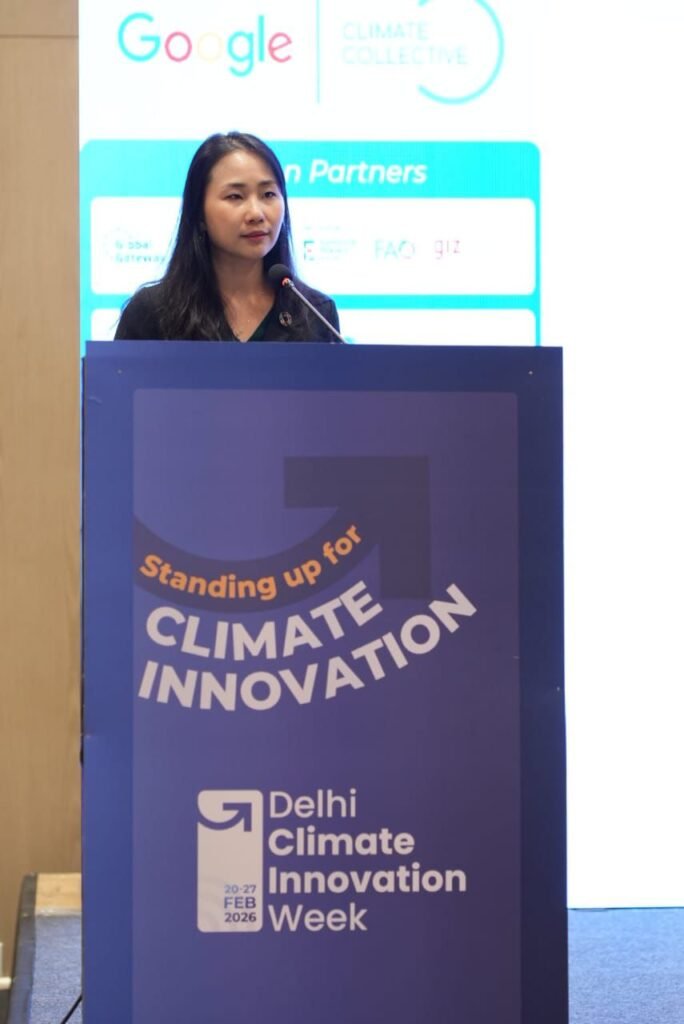
Speaking about the significance of the event, Kaela Montgomery, Sustainability Programme Manager at Google APAC, said that the discussions at Delhi Climate Innovation Week 2026 reflected a growing global recognition that climate risk and resilience can no longer be treated as secondary concerns in policymaking or economic planning.
“Delhi Climate Innovation Week 2026 highlighted that climate risk and resilience are no longer peripheral concerns,” she said, noting that climate action is now central to development strategies across governments, industries, and institutions. Montgomery further observed that one of the most important insights from the week-long event was the strength of India’s climate innovation ecosystem and its readiness to scale impactful solutions.
“One clear takeaway for us was that there is a robust climate innovation ecosystem in India with the appetite to scale,” she added, highlighting the growing collaboration among startups, researchers, investors, and policymakers working toward climate technologies. She also pointed out that the event showcased how artificial intelligence is emerging as a powerful accelerator of climate innovation, helping optimise climate technologies and enabling more efficient deployment of solutions.
“DCIW brought together discussions and examples on how impact of climate innovation can be accelerated through optimising with AI,” she said, emphasising the potential of digital technologies in strengthening climate adaptation strategies.
Montgomery added that scaling climate solutions requires structured pathways that allow innovations to move beyond pilot projects and contribute meaningfully to national priorities. “There is a need for structured pathways to scale solutions that support India’s priorities around climate adaptation, heat resilience, food security, and urban infrastructure,” she informed, underlining the importance of aligning innovation with real-world climate challenges.
Highlighting Google’s role in supporting climate innovation, she said the company is actively working to help startups and institutions move from experimentation to large-scale deployment. “At Google, we are doubling down on enabling startups and public institutions to move from pilots to production,” she said, referring to the company’s collaborative initiatives aimed at strengthening the climate technology ecosystem.
She further noted that Google has launched the Google Centre for Climate Technology in partnership with the Manthan platform and the Office of the Principal Scientific Advisor to the Government of India, which will support emerging climate solutions in key sectors. “We are seeking proposals around green talent, sustainable aviation fuel and low carbon construction,” she added, indicating the focus areas for future innovation and investment.
Montgomery concluded by emphasising the importance of long-term partnerships and ecosystem collaboration in driving climate action. “Our focus is on building scale, strengthening trust, and forging long-term ecosystem partnerships that position India as a global leader in climate resilience,” she said.
Climate Finance: De-Risking Capital for the Global South
Unlocking climate finance — particularly for adaptation and circular economy — was a central preoccupation across the week. The Mosambi Climate Conference hosted high-level dialogue on the investment case for adaptation and resilience, with speakers from Climate Policy Initiative and IFC examining blended finance instruments, risk-sharing mechanisms, and the structural conditions required to crowd in private capital at scale. The Climate Tech Investment Network’s Impact Workshop examined how impact measurement shapes portfolio selection and long-term fund strategy, with participants from Omnivore Capital, IIT Madras, and Shakti Sustainable Energy Foundation.
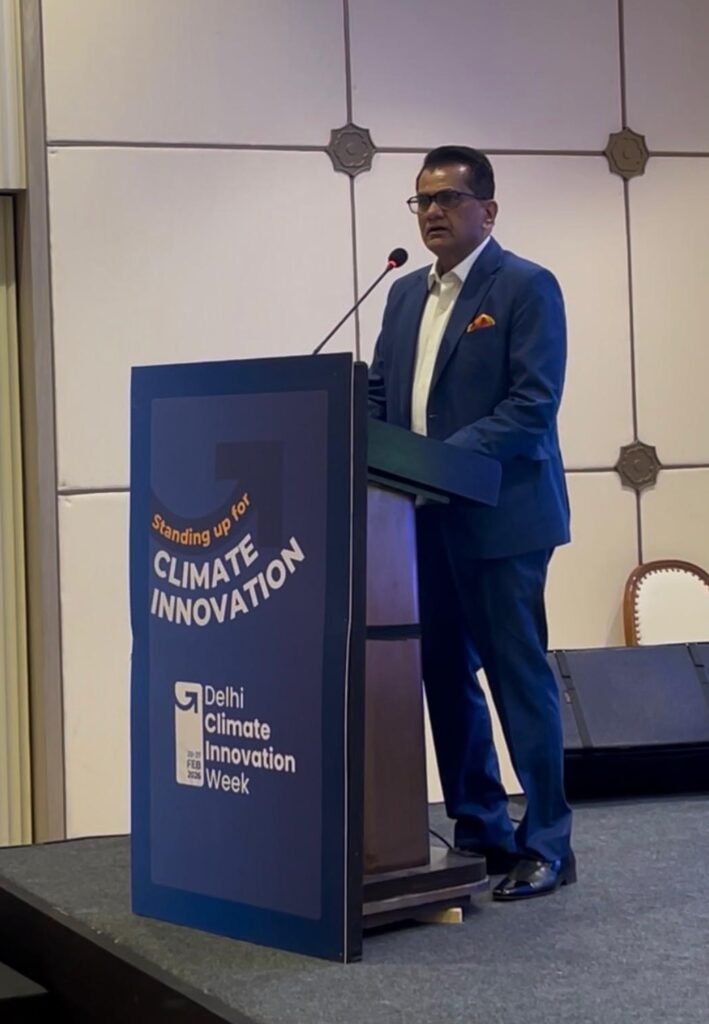
Amitabh Kant, Former G20 Sherpa and former CEO of NITI Aayog, made the case for India’s procurement scale as the key lever for making green technologies cost-competitive — citing India’s track record in solar and LED procurement as proof of concept for what is possible across climate tech more broadly.
Amitabh Kant, Former G20 Sherpa & Former Chief Executive Officer, NITI Aayog said, “The next phase of India’s sustainable growth story demands commercially viable models, de-risked financing structures, and large-scale procurement that drives green technologies at a discount, not a premium.“
“The choices India makes in this decade will shape not only its emission trajectory but also its technological leadership and economic competitiveness. The Delhi Climate Innovation Week must evolve into a globally recognised platform that accelerates this shift, catalysing partnerships, de-risking investments, and establishing India as a leader in scalable climate technologies,“, he added.
The week also saw the announcement of several key MoUs and initiatives, including a collaboration between Climate Collective Foundation and Mahindra Group on industry decarbonisation, and the launch of the Ecosystem Analytics Portal and Evidence Space to sharpen the evidence base for climate tech policy at the subnational level.
Climate Resilience: From Preparedness to Systemic Adaptation
Climate resilience — spanning disaster risk, urban adaptation, nature-based solutions, and food system security — ran as a consistent thread across the week. The Innovation for Resilience Summit convened AI-driven resilience practitioners alongside disaster risk experts from CDRI, Digital Green, Wadhwani AI, and IPE Global. The South-South Climate Forum brought together voices from across the developing world to align on shared adaptation priorities ahead of COP30.
The full-day dialogue on Innovating for Nature: Scaling up Nature-based Solutions in India drew 35–40 participants from government, finance, and multilateral institutions, with strong consensus on moving nature finance beyond pilots and embedding it into mainstream development finance — with emphasis on blended finance, AI-enabled MRV, and community-led delivery. The SAAF Cities roundtable brought together 45 participants to map systemic barriers preventing waste and water innovations from achieving sustained adoption within public systems.
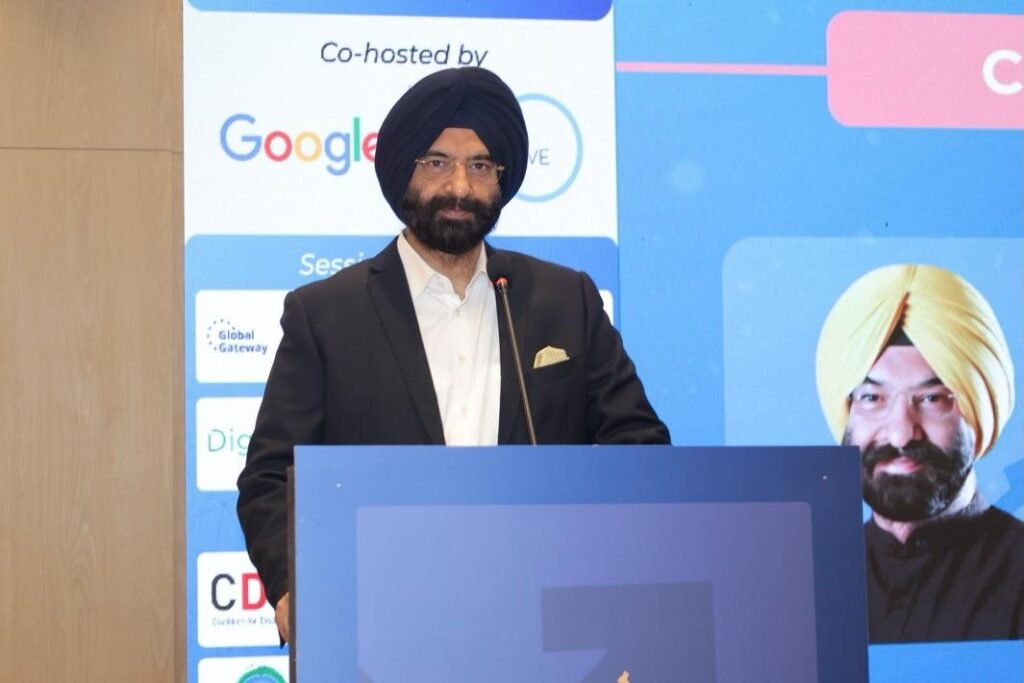
Manjinder Singh Sirsa, Minister for Industries, Food & Supplies, Environment, Forest & Wild Life, Govt of NCT of Delhi said, “Bringing innovators, policymakers, and industry leaders into the same room reflects the maturity of India’s climate ecosystem. My interactions with emerging sustainable startups at the Delhi Climate Innovation Week 2026 strengthen my conviction that the nation’s climate future is in capable hands. The responsibility before us now is to enable institutional collaboration and targeted support mechanisms, ensuring that India not only participates in but leads the global climate transition.”
Circular Economy: From Regulation to Real-World Transition
Circularity received its most concentrated attention on Day 6 with the Innovation for Circularity Summit — anchored by the EU-India Resource Efficiency and Circular Economy Initiative (EU-IRECEI), implemented by GIZ India, in partnership with Climate Collective Foundation. The invite-only convening moved well beyond frameworks to examine deployable solutions across FMCG, packaging, electronics, textiles, construction, and hospitality.
Earlier in the week, the Repairability for Circular Economy dialogue drew 50 participants from government, OEMs, and academia to deliberate on operationalising right-to-repair frameworks — examining compliance readiness, spare-parts ecosystems, and skilling repair technicians at scale. The week also featured sessions on designing circular business models, materials circularity in climate tech supply chains, and zero-waste-to-landfill construction practices. The national launch of The Zero Prize — a ₹5-crore results-based pollution innovation challenge by the School of Policy & Governance, IIT Delhi — signalled a shift towards outcome-linked accountability in India’s environmental action ecosystem.
India’s growing centrality in global circular economy efforts was perhaps best captured by the European Commission’s presence at the Summit — a signal that India is no longer a peripheral voice in international environmental governance but an active co-shaper of its direction.
Octavian Stamate, International Relations Officer, Sub-Saharan Africa, India & South Asia, European Commission Directorate-General for Environment said, “We are on a track to expand and strengthen our engagement with India on matters related to environmental protection. With EU’s improved regulations like the Ecodesign for Sustainable Products Regulation, circular economy is a top priority in EU environmental policy, as we are moving from a linear model towards more circularity in the economy, to reduce our overall environmental footprint and live within nature boundaries. We find India as a partner in this endeavour and look forward to deepening our cooperation and dialogue, including at the upcoming World Circular Economy Forum here in India.”
Dr. Rachna Arora of GIZ India noted that the EU-India partnership — active since 2016 — had evolved from awareness-building to driving implementation at ecosystem scale, with innovators, ministry partners, and industry now gathered not to discuss the transition but to accelerate it.
Industry Decarbonisation and Deep Climate Tech
The Industry Net Zero Innovation Summit (INZIS) convened corporate sustainability leaders — including Mahindra Group’s Chief Sustainability Officer alongside Dalberg Advisors and Invest India — to examine how industry can integrate more deeply into climate tech global value chains. The Mosambi Climate Conference’s session on Translating Deep Climate Tech through stronger Industry-Academia Linkages brought together Imperial College London, TERI’s Director General Dr. Vibha Dhawan, and Third Derivative’s research team to examine what it takes to move deep tech from labs to deployment. Clean mobility featured prominently in opening-week sessions, with OMI Foundation’s panels on EV charging infrastructure and inclusive urban mobility setting an early agenda for policy-aligned decarbonisation.
Gender Equity and Inclusive Climate Innovation
Gender-responsive climate innovation was woven across the week’s programming — not as a standalone track but as an embedded dimension of investment, entrepreneurship, and policy dialogue. The Women in Climate Evening at IFC convened 50 women founders, investors, DFI partners, and ecosystem enablers for candid, peer-level dialogue on capital access barriers, blended finance structures, and the conditions required for women-led ventures to scale. IFC’s Principal Country Officer framed women-led climate entrepreneurship as central to India’s next wave of job-rich, sustainable growth.
The Climate Drinks for Women in Climate gathering created off-record space for relationship-building among women founders and investors — recognising that ecosystem trust is as critical as capital. The Gender-Responsive Climate Innovation session on the closing day, held at Kiran Nadar Museum, centred lived realities and community voices in the climate solutions conversation. DCIW 2026 reflected a clear commitment: that the Global South’s climate leadership must be inclusive in its design, not just its aspiration.
Green Jobs and the Climate Workforce
DCIW 2026 gave sustained attention to the question of who will build and operate India’s climate economy — and whether the workforce pipeline is ready. The Climate Jobs Fair at TERI School of Advanced Studies, co-hosted by Climate Jobs Board and Climate Collective Foundation, connected students and early-career professionals directly with climate tech employers and ecosystem organisations. INECC’s Resume Readiness for Climate Careers and From Resume to Real Conversations sessions equipped a new generation of climate professionals with the practical tools to enter a rapidly expanding sector.
Google’s call for proposals under the Google Centre for Climate Technology explicitly identified green talent and workforce transition as one of three priority areas — alongside low-carbon construction and sustainable aviation fuel — signalling that skilling is a frontier challenge, not a downstream concern. The Women in Climate Evening’s framing around job-rich sustainable growth further underscored that an equitable green jobs economy is inseparable from the financing and innovation agenda. Across DCIW, a clear conviction emerged: climate solutions scale only as fast as the people equipped to deploy them.
Key Announcements and Outcomes
DCIW 2026 served as a launchpad for several significant initiatives: the Ecosystem Analytics Portal and Evidence Space for subnational climate policy alignment; an MoU between Climate Collective Foundation and Mahindra Group on industry decarbonisation; the Google Centre for Climate Technology on the Manthan platform; Google’s Market Access Programme for climate tech startups. The Climate Redesign Awards, Climate Collective Foundation’s recognition platform for early-stage climate tech startups, felicitated 24 innovators from across India — connecting them with investors, corporates, and ecosystem leaders at one of the Global South’s most visible climate stages.The week also served as an official World Circular Economy Forum Side Event and the venue for UNGIH’s Nineteenth Systemic Innovation Workshop.

The Delhi Climate Innovation Week 2026
Delhi Climate Innovation Week (DCIW) 2026 is an initiative of Climate Collective Foundation, convened in association with DPIIT, Ministry of Commerce and Industry, Government of India. A city-wide, ecosystem-led constellation of 110 events across Delhi-NCR from 20–27 February 2026, DCIW brought together founders, investors, policymakers, corporates, researchers, and community leaders to accelerate climate tech innovation across the Global South. Strategic partners include Mahindra Group, TERI, CDRI, Climate Group, India Climate Collaborative, Shakti Foundation, and WRI India. Event partners include the International Solar Alliance, Third Derivative, Global Resilience Partnership, IPE Global, IFC, Climate Champions Team, Marico Innovation Foundation, and Upaya Social Ventures, among many others.
Key People Featured at Delhi Climate Innovation Week 2026
| Name | Designation | Organisation | Key Role / Contribution |
|---|---|---|---|
| Pratap Raju | Founding Partner | Climate Collective Foundation | Highlighted the vision of Delhi Climate Innovation Week and the focus on deploying climate solutions |
| Kaela Montgomery | Sustainability Programme Manager (APAC) | Spoke about AI-driven climate innovation and the need to scale climate technologies | |
| Amitabh Kant | Former G20 Sherpa; Former CEO | NITI Aayog | Emphasised procurement-driven scaling of green technologies in India |
| Manjinder Singh Sirsa | Minister for Industries, Food & Supplies, Environment, Forest & Wildlife | Government of NCT of Delhi | Highlighted India’s growing climate innovation ecosystem |
| Octavian Stamate | International Relations Officer | European Commission (DG Environment) | Spoke on EU–India collaboration in circular economy initiatives |
| Dr. Rachna Arora | Senior Representative | GIZ India | Discussed implementation of EU–India Resource Efficiency and Circular Economy initiatives |
| Dr. Vibha Dhawan | Director General | The Energy and Resources Institute (TERI) | Participated in discussions on deep climate technologies and industry-academia collaboration |
About the Author: Rusen Kumar, Editor of India CSR, is a renowned thought leader in the area of Corporate Sustainability and Responsibility (CSR)
(India CSR)