

• India CSR Awards 2025
  • India CSR Leadership Summit
  • Guest Posts
  • Login
Sunday, March 15, 2026
India CSR
  • Home
  • Corporate Social Responsibility
    • Art & Culture
    • CSR Leaders
    • Child Rights
    • Culture
    • Education
    • Gender Equality
    • Around the World
    • Skill Development
    • Safety
    • Covid-19
    • Safe Food For All
  • Sustainability
    • Sustainability Dialogues
    • Sustainability Knowledge Series
    • Plastics
    • Sustainable Development Goals
    • ESG
    • Circular Economy
    • BRSR
  • Corporate Governance
    • Diversity & Inclusion
  • Interviews
  • SDGs
    • No Poverty
    • Zero Hunger
    • Good Health & Well-Being
    • Quality Education
    • Gender Equality
    • Clean Water & Sanitation – SDG 6
    • Affordable & Clean Energy
    • Decent Work & Economic Growth
    • Industry, Innovation & Infrastructure
    • Reduced Inequalities
    • Sustainable Cities & Communities
    • Responsible Consumption & Production
    • Climate Action
    • Life Below Water
    • Life on Land
    • Peace, Justice & Strong Institutions
    • Partnerships for the Goals
  • Articles
  • Events
  • हिंदी
  • More
    • Business
    • Finance
    • Environment
    • Economy
    • Health
    • Around the World
    • Social Sector Leaders
    • Social Entrepreneurship
    • Trending News
      • Important Days
        • Festivals
      • Great People
      • Product Review
      • International
      • Sports
      • Entertainment
    • Case Studies
    • Philanthropy
    • Biography
    • Technology
    • Lifestyle
    • Sports
    • Gaming
    • Knowledge
    • Home Improvement
    • Words Power
    • Chief Ministers
No Result
View All Result
  • Home
  • Corporate Social Responsibility
    • Art & Culture
    • CSR Leaders
    • Child Rights
    • Culture
    • Education
    • Gender Equality
    • Around the World
    • Skill Development
    • Safety
    • Covid-19
    • Safe Food For All
  • Sustainability
    • Sustainability Dialogues
    • Sustainability Knowledge Series
    • Plastics
    • Sustainable Development Goals
    • ESG
    • Circular Economy
    • BRSR
  • Corporate Governance
    • Diversity & Inclusion
  • Interviews
  • SDGs
    • No Poverty
    • Zero Hunger
    • Good Health & Well-Being
    • Quality Education
    • Gender Equality
    • Clean Water & Sanitation – SDG 6
    • Affordable & Clean Energy
    • Decent Work & Economic Growth
    • Industry, Innovation & Infrastructure
    • Reduced Inequalities
    • Sustainable Cities & Communities
    • Responsible Consumption & Production
    • Climate Action
    • Life Below Water
    • Life on Land
    • Peace, Justice & Strong Institutions
    • Partnerships for the Goals
  • Articles
  • Events
  • हिंदी
  • More
    • Business
    • Finance
    • Environment
    • Economy
    • Health
    • Around the World
    • Social Sector Leaders
    • Social Entrepreneurship
    • Trending News
      • Important Days
        • Festivals
      • Great People
      • Product Review
      • International
      • Sports
      • Entertainment
    • Case Studies
    • Philanthropy
    • Biography
    • Technology
    • Lifestyle
    • Sports
    • Gaming
    • Knowledge
    • Home Improvement
    • Words Power
    • Chief Ministers
No Result
View All Result
India CSR
No Result
View All Result
Home Articles

An Invasion of Locusts

India CSR by India CSR
July 3, 2020
in Articles, Prime
Reading Time: 7 mins read
India CSR
Share Share Share Share
WhatsApp icon
WhatsApp — Join Us
Instant updates & community
Google News icon
Google News — Follow Us
Get our articles in Google News feed

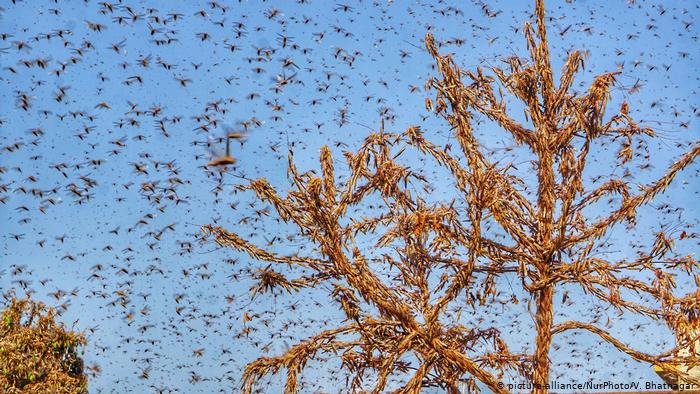
Over the weekend of 27 to 28 June 2020, social media was awash with videos and photos of the locust swarms that had entered Delhi, India. The images were unnerving, the collective sounds of their wings chilling as they flew tightly together like fighter pilots. The insects swept through the city and thousands of locusts settled on the terraces and roofs of homes before being swept away by high winds. The Indian government advised officials to remain on high alert, as they scaled up efforts to contain the migratory pest.

The public were told that staff would be deployed to help guide residents and villagers on how to disperse the locusts, suggesting, “making high decibel sound through beating of a drum [or] utensils, or playing high volume music on music system”.

Desert locusts are among the most destructive of migratory pests because of their speed and ability to multiply rapidly. Where adult locusts can fly up to 150 kilometers (93 miles) a day and eat their own body weight, which is equal to 2 grams’ worth of fresh vegetation in that period.

The United Nations (UN) has warned that locust swarms could lead to a potential food crisis. East Africa has seen the worst locust outbreak in decades, after climate change and conflict helped cause the resurgence of this biblical pest. While spraying pesticide is the most effective way of killing locusts, the coronavirus pandemic has slowed efforts to tackle the outbreak on the African continent and if not contained, agencies have warned that locust numbers will multiply, where their rising numbers could turn the infestation into a plague by the end of the year.

It got me thinking and I had many questions – Why did these locusts arrive in India? Where did they come from? What caused them, was it climate change? and crucially what would this mean for the local Indian farmers? As many of whom were already struggling because of the global COVID-19 pandemic, as some farmers had not been able to harvest their crops.
Book Launch Ceremony
ADVERTISEMENT

To help me answer some of these questions I spoke to Dr Piyush Mehta, from the Dr Y S Parmar University of Horticulture and Forestry, located in Himachal Pradesh, India; Asia’s second largest Government Agriculture University. The University is known for its research and expertise regarding the socio-economic development of India’s farming community. Dr Mehta has been working at the forefront of agribusiness academic activities for the last 18 years and has handled various key research projects for the Central government, which includes driving organic farming among young agri-entrepreneurs in India.

The Arrival of Locusts in India

According to UN data these desert locusts flew into India – stretching up to 7 kilometers (4 miles) long – from their breeding areas in Pakistan. They crossed into India’s western state of Rajasthan in early May and since then have pushed into five other different states in search of food. On June 20 2020, the UN’s Food and Agriculture Organization (FAO) advised that India should remain on high alert during the next four weeks, stating “spring-bred adult groups and swarms continue to appear along the Indo-Pakistan border, many of which have continued further east into several states of northern India because the monsoon rains have not yet arrived in Rajasthan, India.”

Climate Change

Bottom line is that climate change is a key driver of the current outbreak. During quiet periods, known as recessions, desert locusts are usually restricted to the semi-arid and arid deserts of Africa, the Near East and South-West Asia that receive less than 200 mm of rain annually. In normal conditions, locust numbers decrease either by natural mortality or through migration. Swarms of desert locusts have been recorded in the region for centuries, but unusual weather conditions in the last five years have created strong cyclones and heavy rains in the Arabian Peninsula, triggered higher than normal vegetation growth that created ideal conditions for locusts to feed on and surge, scientists say. Rising sea temperatures are expected to lead to more extreme rainfall – creating conditions for hatching and breeding. Cyclones that disperse the swarms are getting stronger and more frequent.  

Indian Farmers and India

The coronavirus pandemic has already created food insecurity for millions of Indians and the locusts’ invasion will pile even more pressure on farmers and livestock. It is feared that the upcoming monsoon season will create favourable breeding grounds for these pests and they will multiply exponentially. Dr Mehta helped me answer some key questions:

What does this locusts swarm mean for Indian farmers? Especially as many farmers have already been impacted by the pandemic and not been able to harvest their crops.

Dr Mehta: “The Indian farming community recognises this current locusts’ infestation as a disaster because of the imbalance of the overall environmental conditions and seed piracy. So, while the government agencies take steps to deal with this ‘plague,’ many of the farming groups have started to collaborate themselves to handle this problem, by supporting their respective farmer producer organisations and different community based organisations. 

The loss till now in India has been limited to the peripheries of the northern region, which could further escalate towards north-east regions of the country. The impact of this disaster is that it has damaged the ready to harvest crops, along with the forest regions – this will and already has been devastating to the farming operations, leading to a bigger downfall, that hasn’t been experienced on this scale to the overall agriculture productivity of the region since the last decade!”

How will it affect India’s food security?

Dr Mehta: “The existing buffer of food stock in the country has been experiencing a continuous dip over the last few years, while simultaneously the issue of food security has also been used as a political tool, which has made the problem worse.

The locusts attack has been reported since the start of this year, which now has spread to almost all over the northern region of the country covering Uttar Pradesh, Madhya Pradesh, Punjab, Haryana and Rajasthan. These areas contribute to around 68 percent of the wheat, 52 percent of the rice supply, 73 percent of the sugar and 62 percent of the oilseeds supply to the food stock.

Therefore, I believe it would place some very difficult challenges for the farming community and vis-a-vis to the overall growth of the country in the future, which will lead to increased food prices, inflation rate and eventually reducing the comprehensive economic growth of the nation.

It has also been observed, that in spite of having vast food production avenues that exist in the country, our food supply has largely become more import driven. This has resulted in our domestic farmers receiving marginal prices for their produce. All this has further intensified the ongoing threat on managing our food security. This could be turned around, if the government agencies uplifted the confidence of the Indian farming community with support, growth driving policies and programmes.”

What should the government doing to protect farmers against these kind of plagues?

Dr Mehta: “It is hard to understand that when India is primarily an agrarian economy, why there’s very little investment and support?! While the agricultural sector is a tax free industry in the country, it receives the least consideration and support. This needs to change, particularly during times like these.

The government efforts are mainly focused on chemical spray, and other means of non-chemical measures are also being used to contain this menace, such as spraying a mixture of linseed oil, sodium bicarbonate that will affect the proliferation of the locusts’ growth cycle. These non-chemical measures are better for the environment and for the farmer, and the government should be supporting this option first.

We needs to see strategies, implemented quickly, which includes attempting to stop the locusts from travelling to other regions. To also stop them from eating during night and instead capture them, using them as fodder for poultry, and duck feed.”

What Lies Ahead

While climate change is a global phenomenon, the developing world, with regions like Africa, India and Pakistan stand out for their vulnerability because of the low levels of socioeconomic development. People living in poverty face compounding vulnerabilities to climate change impacts, because they don’t have the resources to quickly recover from its effects. In this case, as we can see after our conversation with Dr Mehta that desert locusts are ravaging crops in the field before harvesting, wiping out livestock and wildlife feed, and also savings, assets and livelihoods.

Controlling desert locust swarms using chemical pesticides is one approach, yet the impact of these chemicals on the environment and other critical ecosystems that are key to our food security, such as bees and other insects, which pollinate up to 70 per cent of our food cannot be ignored, particularly as these pesticides have an impact on human health. Extensive research is ongoing regarding biological control and other means of non-chemical control with the current focus on pathogens and insect growth regulators. However, control by natural predators and parasites is limited, as locusts can quickly move away from most natural enemies. While people and birds often eat locusts, this is not enough to significantly reduce population levels over large areas.

The FAO will continue to provide detailed briefings and forecasts on locusts and issue timely advance warnings to those countries in danger of invasion. But these farming communities need to be empowered and equipped with technologies, as swarms of desert locusts are threatening large areas of pastures and crops, overwhelming countries in the Horn of Africa, the Middle East, and South Asia. The FAO warns that right now we are witnessing the worst infestation in 25 years in Ethiopia and Somalia, in 26 years in India, and the worst in 70 years in Kenya. The crisis has affected 23 countries till now. This is a single global outbreak, and if it reaches plague levels, it could cover 20 percent of the earth’s land mass.

India Responsible Education & AI Summit 2026
ADVERTISEMENT
Ambedkar Chamber
ADVERTISEMENT
ESG Professional Network
ADVERTISEMENT
India Sustainability Awards 2026
ADVERTISEMENT
India CSR Image 1 India CSR Image 2
Tags: LocustsLocusts in India

CSR, Sustainability, and ESG success stories hindustan zinc
ADVERTISEMENT
India CSR

India CSR

India CSR is the largest media on CSR and sustainability offering diverse content across multisectoral issues on business responsibility. It covers Sustainable Development, Corporate Social Responsibility (CSR), Sustainability, and related issues in India. Founded in 2009, the organisation aspires to become a globally admired media that offers valuable information to its readers through responsible reporting.

Related Posts

Energy security crisis and global transition toward renewable energy amid geopolitical conflict
Articles

Energy Security in an Age of Conflict—The Case for Accelerating the Transition

1 day ago
Fuel Crisis in India
Articles

What’s Cooking: Is it Oil or Politics in India?

2 days ago
Dr. Priti Adani
Articles

Opportunity, Skill and Confidence: When These Three Come Together, Women Can Achieve Anything

6 days ago
Pavan Kaushik with Rural Women Entrepreneurs.
Articles

Why Empowering Rural Women Entrepreneurs is Key to India’s Future

6 days ago
Pritika Chand Head – Corporate Social Responsibility Jindal Stainless
Articles

Women’s Livelihood Participation Can Transform Local Economies

6 days ago
Gurmit Singh Arora, National President, Indian Plumbing Association.
Articles

Net-Zero Buildings Are Not Green Without Water Sustainability at the Core

2 weeks ago
Load More
India Responsible Education & AI Summit 2026
ADVERTISEMENT
Ambedkar Chamber
ADVERTISEMENT
ADVERTISEMENT
India Sustainability Awards 2026
ADVERTISEMENT

LATEST NEWS

हिन्दुस्तान जिंक द्वारा संचालित समाधान परियोजना के तहत् पशुपालन को बढ़ावा देने के लिए काॅफ रैली का आयोजन

Chennai Startup Motherly Is Building What Indian Maternal Care Has Always Lacked

Rungta University and India CSR to Offer Academic Programs in CSR and Sustainability

Amethyst Wellness: Where Luxury Ayurveda Meets Scientific Well-Being in Surat & Ahmedabad

Child Labour Busted in Raipur Urla Industrial Area; Cases Filed Against Factory Operators

CSR: MMI Narayana Hospital Supports Four Schools in Raipur

Economy India Largest Media on Indian Economy and Business
ADVERTISEMENT
Ad 1 Ad 2 Ad 3
ADVERTISEMENT
ESG Professional Network
ADVERTISEMENT

TOP NEWS

समाज सेवा के क्षेत्र में बड़े बदलाव लाने वाली अपनी कोशिशों के लिए सीए अभय भुतडा को फिलांथ्रोपिस्ट ऑफ द ईयर अवार्ड 2026 मिला

हिंदुस्तान जिंक ने चंदेरिया में ‘तेजस्विनी’ ऑल-वुमन ऑपरेशनल शिफ्ट शुरू की

CSR: Yamaha Donates Medical Equipment to Noida Govt Hospital

Devansh Singh: The 21-Year-Old Entrepreneur from Prayagraj Building ElixoMedia and Redefining Performance Marketing

Petronet LNG CSR Spending Report of Rs 67.24 Crore for FY25

हिंदुस्तान जिंक-सीएमआर ग्रीन टेक्नोलॉजीज की जिंक पार्क में जिंक एलॉय निर्माण हेतु साझेदारी

Load More
STEM Learning STEM Learning STEM Learning
ADVERTISEMENT

Interviews

Kayana Monga, a student at Shiv Nadar School, Noida, Founder - Project Muskan
Interviews

An Interview with Student Changemaker Kayana Monga Working on Rural Mental Health

by India CSR
March 12, 2026

Student-led Project Muskan brings mental health awareness and care to rural children across India.

Read moreDetails
Meha Patel, Vice Chairperson of Zydus Foundation

Interview: Meha Patel on Zydus Foundation’s Vision for Sustainable Social Impact

March 11, 2026
Prachi Kaushik, Founder and Director of Vyomini Social Enterprise

Menstrual Hygiene Awareness Must Go Beyond Pad Distribution: Prachi Kaushik, Vyomini Social Enterprise

March 8, 2026
Prerrit Mansingh, Secretary, Aayom Welfare Society

Scaling Compassion into Structured Social Change: An Interview with Prerrit Mansingh

February 28, 2026
Load More
Facebook Twitter Youtube LinkedIn Instagram
India CSR Logo

India CSR is the largest tech-led platform for information on CSR and sustainability in India offering diverse content across multisectoral issues. It covers Sustainable Development, Corporate Social Responsibility (CSR), Sustainability, and related issues in India. Founded in 2009, the organisation aspires to become a globally admired media that offers valuable information to its readers through responsible reporting. To enjoy the premium services, we invite you to partner with us.

Follow us on social media:


Dear Valued Reader

India CSR is a free media platform that provides up-to-date information on CSR, Sustainability, ESG, and SDGs. We need reader support to continue delivering honest news. Donations of any amount are appreciated.

Help save India CSR.

Donate Now

Donate at India CSR

  • About India CSR
  • Team
  • India CSR Awards 2025
  • India CSR Leadership Summit
  • India Responsible Education & AI Summit 2026
  • Partnership
  • Guest Posts
  • Services
  • ESG Professional Network
  • Content Writing Services
  • Business Information
  • Contact
  • Privacy Policy
  • Terms of Use
  • Donate

Copyright © 2025 - India CSR | All Rights Reserved

Welcome Back!

Login to your account below

Forgotten Password?

Retrieve your password

Please enter your username or email address to reset your password.

Log In
No Result
View All Result
  • Home
  • Corporate Social Responsibility
    • Art & Culture
    • CSR Leaders
    • Child Rights
    • Culture
    • Education
    • Gender Equality
    • Around the World
    • Skill Development
    • Safety
    • Covid-19
    • Safe Food For All
  • Sustainability
    • Sustainability Dialogues
    • Sustainability Knowledge Series
    • Plastics
    • Sustainable Development Goals
    • ESG
    • Circular Economy
    • BRSR
  • Corporate Governance
    • Diversity & Inclusion
  • Interviews
  • SDGs
    • No Poverty
    • Zero Hunger
    • Good Health & Well-Being
    • Quality Education
    • Gender Equality
    • Clean Water & Sanitation – SDG 6
    • Affordable & Clean Energy
    • Decent Work & Economic Growth
    • Industry, Innovation & Infrastructure
    • Reduced Inequalities
    • Sustainable Cities & Communities
    • Responsible Consumption & Production
    • Climate Action
    • Life Below Water
    • Life on Land
    • Peace, Justice & Strong Institutions
    • Partnerships for the Goals
  • Articles
  • Events
  • हिंदी
  • More
    • Business
    • Finance
    • Environment
    • Economy
    • Health
    • Around the World
    • Social Sector Leaders
    • Social Entrepreneurship
    • Trending News
      • Important Days
      • Great People
      • Product Review
      • International
      • Sports
      • Entertainment
    • Case Studies
    • Philanthropy
    • Biography
    • Technology
    • Lifestyle
    • Sports
    • Gaming
    • Knowledge
    • Home Improvement
    • Words Power
    • Chief Ministers

Copyright © 2025 - India CSR | All Rights Reserved

This website uses cookies. By continuing to use this website you are giving consent to cookies being used. Visit our Privacy and Cookie Policy.



