

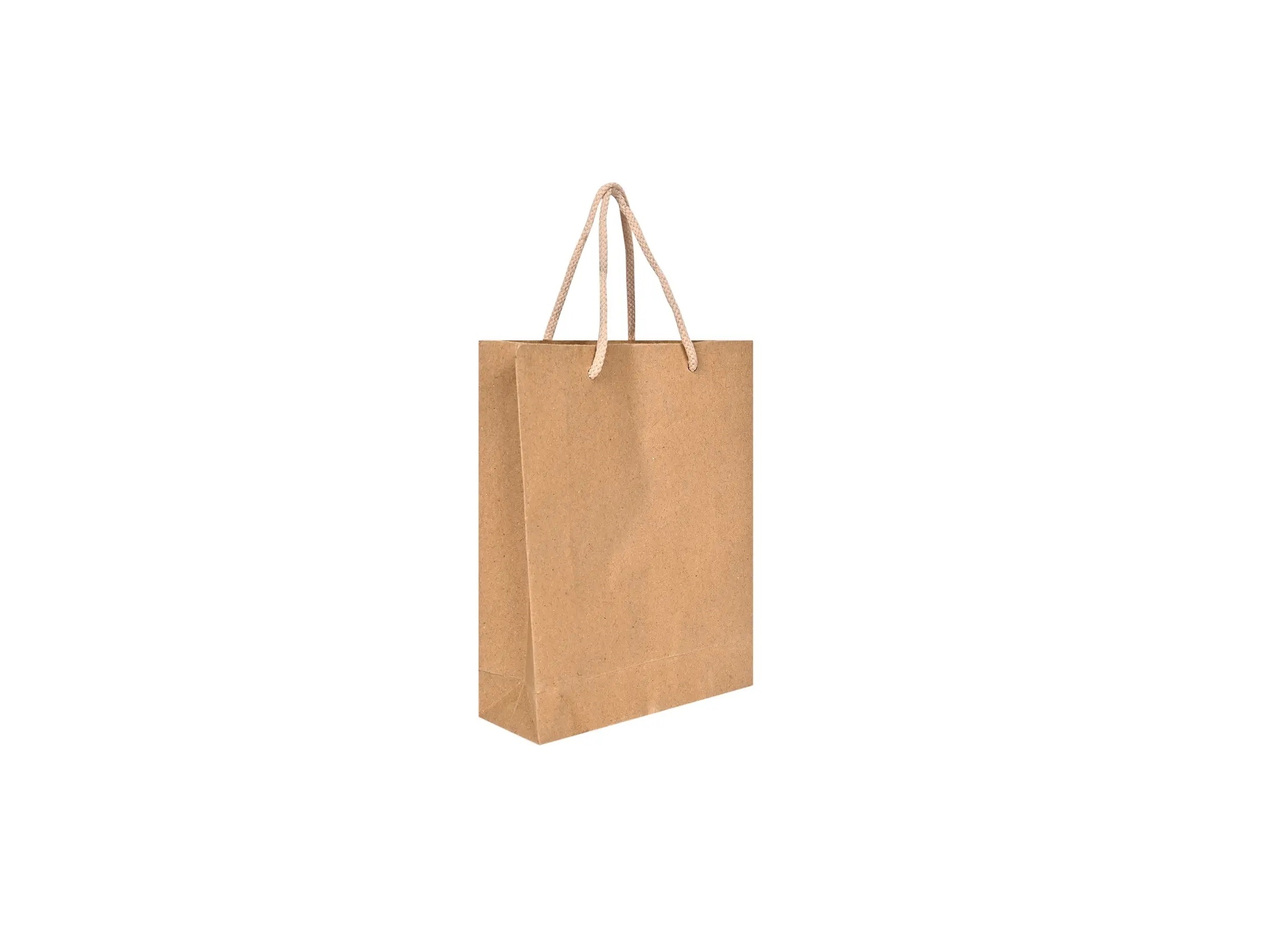



Retail chains, cafes and consumer brands across India have been swapping plastic carry bags for kraft paper bags, and the change usually lands in the next sustainability report as a headline. Customers notice it at the counter, and it photographs well. Whether it holds up as a sustainability claim is a separate question. Brown paper looks natural, but appearance proves nothing about the paper’s recycled content, whether local recyclers accept it, whether it is safe for food, or how much it can carry before the handle tears away.
This article sets out what a CSR or sustainability team should be able to document before it reports a move from plastic carry bags to paper. Specifications quoted come from the published bag range of Huandao Packaging, a Chinese printed-packaging maker, used as a concrete reference rather than an endorsement, alongside the Government of India’s own notice on plastic carry bags.
What India’s plastic rules actually changed
The Plastic Waste Management Amendment Rules, 2021 did two separate things. They banned a list of identified single-use plastic items, such as plastic cutlery, plates, straws and certain packing films, from 1 July 2022. For carry bags, though, they raised the minimum thickness instead of banning the category: from fifty to seventy-five microns from 30 September 2021, and to 120 microns from 31 December 2022. The same notification gave legal force to guidelines on Extended Producer Responsibility for plastic packaging.
That distinction matters for reporting. Any company that replaced thin plastic carry bags with paper did more than the law required, because thicker plastic carry bags remain permitted. Its report can say so honestly. What it cannot do is imply that paper was the only compliant choice, or that a switch to paper automatically lowers environmental impact. Life-cycle results for any bag depend on its weight, its material and how many times it is used, and those numbers have to come from the company’s own data.
Why kraft paper bags are not yet a claim
Packaging makers who are careful about this say it plainly. Huandao’s own bag specification notes that a natural-looking kraft paper bag does not establish recycled content or local recycling acceptance. In other words, the brown colour is a surface finish. Recycled fibre content has to be declared and documented on the order, and whether a finished bag is recyclable depends on the coatings, laminates, handles and adhesives it carries and on the collection system where it ends up.
On environmental labels, the same supplier asks buyers to state the destination, precise claim, and substantiating documents, and notes that broad, vague “eco-friendly” wording does not suffice. That is the right standard for a CSR team too. Every sustainability statement printed on the bag or written in the report should name one specific property and point to one document that proves it.
Where it stops: a bag’s material can support a claim, but it cannot make one. The claim comes from paperwork: a fibre declaration, a recycler’s acceptance, a test report.
Paper grade: what the gsm figure tells you
Paper bags are specified by paper type and grammage, written as gsm (grams per square metre). Huandao’s kraft paper bags use natural or white kraft at 120–200 gsm, while its coated art paper for printed gift and retail bags runs at 157–250 gsm. Kraft is a strong, long-fibre paper suited to everyday carrying. Coated art paper has a smooth mineral surface for photographic print, and that coating is one of the details a recycler will ask about.
Grammage also feeds straight into CSR accounting. Material consumption, packaging tonnage and any Extended Producer Responsibility reporting for paper all start from the weight of each bag multiplied by the number bought. Moving to a heavier paper grade to make bags feel premium increases tonnage, which a report has to show rather than hide.
Handle limits and carrying capacity
Most paper bags with handles fail at the handle, not the body. Huandao lists twisted paper, cotton rope, ribbon and die-cut handles, with optional eyelet reinforcement, and the choice changes both how the bag carries and how it can be recycled. Twisted paper keeps the bag single-material. Cotton rope and ribbon feel more premium but add a second material that usually has to be removed before pulping.
Load claims need a test, not an assumption. The same supplier states that a rope handle does not automatically qualify a higher carrying load under an agreed method such as EN 13590, the European standard for carrying capacity of bags with handles. If a retailer wants to say its paper bags carry the same shopping as the plastic ones they replaced, it should have a carrying-capacity result for the finished bag with the actual contents.
Food and contact use
Restaurants and bakeries are among the biggest users of paper bags in India, and food adds a compliance layer that colour cannot answer. For wet, greasy or unwrapped food, Huandao asks buyers to request a material and contact-use assessment before selecting the bag. Inks, coatings and adhesives can all migrate into food, and their suitability depends on the specific grade and the food in question.
In a CSR report, the practical step is simple. If any bag touches unwrapped food, the file should hold the supplier’s statement on which paper, ink and coating were used and the food-contact basis for each. Without it, a sustainability gain on plastic could turn into a food-safety question.
Print, ink and coatings
Printing is where a simple paper bag picks up most of its non-paper content. Huandao prints its kraft mailing bags with water-based flexo in 1–4 colours, while gift and retail bags can carry offset print, lamination, spot UV or hot foil. Each extra layer is a design choice with an end-of-life cost. Film lamination and heavy foil make a bag harder to pulp, and a full-coverage solid colour adds far more ink than a one-colour logo on natural kraft.
CSR teams can apply a simple rule here: keep the print as light as the brand allows, ask for the ink and coating system in writing, and treat any plastic film as a reason to check the recyclability claim again. Simple, single-material bags are the easiest to defend.
Order size, reuse and replacement
Custom printed bags are bought in large runs. Huandao’s standard MOQ is 1,000 pieces per size and style, and it quotes smaller runs case by case. Over-ordering for a single campaign, then discarding printed stock when the design changes, is a waste stream that rarely appears in sustainability reports but should. Planning one durable design across seasons, or keeping campaign graphics to a removable insert, avoids it.
Reuse changes the arithmetic too. Sturdy paper bags with a reinforced base that customers bring back several times spread their material over more trips. Lightweight bags used once and thrown away do not. Tracking even a rough reuse figure through store surveys gives the report a number that is defensible rather than assumed.
The evidence file behind kraft paper bags
Evidence behind common claims about kraft paper bags
| Claim in the report | Evidence needed | Who supplies it |
| Plastic carry bags removed | Purchase records before and after the switch | Procurement |
| Made with recycled fibre | Fibre content declaration tied to the order | Bag supplier and paper mill |
| Recyclable | Full materials list plus acceptance from a named local recycler | Supplier and waste contractor |
| Safe for food | Contact-use assessment for paper, ink and coating | Supplier |
| Carries as much as before | Carrying-capacity test on the finished bag | Supplier or test laboratory |
Readers comparing suppliers can look at how a Xiamen paper packaging maker sets out paper grades, handle options and the limits of its own claims, then ask every shortlisted supplier for the same documents. A supplier that refuses to put a sustainability statement in writing is giving the CSR team useful information.
Switching away from plastic carry bags is a reasonable step. It becomes a credible one when the report says exactly what changed, which document proves it, and where the evidence still has gaps.



