
• India CSR Awards 2026
  • India CSR Leadership Summit
  • Guest Posts
Saturday, November 14, 2026
India CSR®
  • Home
  • CSR
    • Art & Culture
    • CSR Leaders
    • Child Rights
    • Culture
    • Education
    • Gender Equality
    • Around the World
    • Skill Development
    • Safety
    • Covid-19
    • Safe Food For All
  • Sustainability
    • Sustainability Dialogues
    • Sustainability Knowledge Series
    • Plastics
    • Sustainable Development Goals
    • ESG
    • Circular Economy
    • BRSR
  • SUMMIT
  • AWARDS
  • Interviews
  • SDGs
    • No Poverty
    • Zero Hunger
    • Good Health & Well-Being
    • Quality Education
    • Gender Equality
    • Clean Water & Sanitation – SDG 6
    • Affordable & Clean Energy
    • Decent Work & Economic Growth
    • Industry, Innovation & Infrastructure
    • Reduced Inequalities
    • Sustainable Cities & Communities
    • Responsible Consumption & Production
    • Climate Action
    • Life Below Water
    • Life on Land
    • Peace, Justice & Strong Institutions
    • Partnerships for the Goals
  • Articles
  • Events
  • हिंदी
  • More
    • Business
    • Finance
    • Corporate Governance
      • Diversity & Inclusion
    • Environment
    • Economy
    • Health
    • Around the World
    • Social Sector Leaders
    • Social Entrepreneurship
    • Trending News
      • Important Days
        • Festivals
      • Great People
      • Product Review
      • International
      • Sports
      • Entertainment
    • Case Studies
    • Philanthropy
    • Biography
    • Technology
    • Lifestyle
    • Sports
    • Gaming
    • Knowledge
    • Home Improvement
    • Words Power
    • Chief Ministers
No Result
View All Result
India CSR®
No Result
View All Result
Home Business

Reusable Packaging From PP Honeycomb Board: What a Credible CSR Claim Has to Show

India CSR by India CSR
Reading Time: 7 mins read
India csr news
Share Share Share Share
WhatsApp icon
WhatsApp — Join Us
Instant updates & community
Google News icon
Google News — Follow Us
Get our articles in Google News feed
india csr awards
ADVERTISEMENT

Replacing single-use cardboard with reusable packaging is one of the easiest sustainability stories for a manufacturer to tell. A plant swaps paper layer pads and cartons for polypropylene ones, the waste bins empty faster, and the next sustainability report gets a photograph of neatly stacked returnable trays. The harder question is whether the claim survives scrutiny. An auditor, a customer’s procurement team or a journalist will eventually ask how many times each pad actually came back, what the return trucks emitted, and where the worn-out pads went.

For Indian companies that now report on resource use and plastic responsibility, and that supply overseas buyers with their own packaging targets, that question is not academic. This article looks at what reusable transit packaging made from PP honeycomb board and fluted polypropylene can honestly deliver, and what evidence a CSR or sustainability team should collect before putting it in a report. The product specifications quoted come from Shine Industrial Co., Ltd. (SHINE), a Chinese manufacturer of polypropylene packaging sheet, and are used here as a concrete reference point rather than an endorsement.
india csr awards
ADVERTISEMENT

Why the material matters before the claim does

Reusable transit packaging is usually built from two related polypropylene products. Fluted hollow sheet is the familiar twin-wall board. PP honeycomb board, sometimes called cellular board, uses a tri-layer structure with a honeycomb core, which gives a stiffer, flatter panel for its weight. SHINE lists its cellular honeycomb sheet at 4.0–11.0 mm thickness and up to 2000 mm wide, and recommends that range for collapsible pallet sleeve boxes, bottle layer pads and dunnage dividers.

Choosing the material is the foundation of the claim because reuse depends on durability. Polypropylene does not soften when wet the way paper corrugate does, can be wiped clean, and can be welded and edge-sealed so dirt and moisture do not get trapped in the flutes. A pad that survives washing and handling is a pad that can come back. A pad that delaminates after a handful of trips is a waste stream with a short delay.

That is also why cheaper grades can undermine a sustainability case. A thin, lightweight board may save money on the first order and then crack at the corners, which means more replacements, more material bought and more scrap. Durability is not a side feature of reusable packaging. It is the entire environmental argument.

Layer pads and converted packs: where most of the impact sits

In beverage, glass and food packaging plants, the most common reusable item is the layer pad, the flat sheet placed between tiers of bottles or jars on a pallet. SHINE documents plastic layer pads in formats from 1000 × 800 through 1200 × 1200 mm, 3–5 mm thick and 900–1200 g/m² in weight. That weight band is worth noting. It tells a buyer how much polymer goes into each pad, which is the number needed later to calculate material use and end-of-life tonnage.

Converted packs, such as sleeve boxes, totes and bottle trays, add processing. The company says its PP plant runs five automatic molders, three ultrasonic welding machines and three bottle-tray automatic sealing sets for this conversion work. Ultrasonic welding matters for reuse because it joins polypropylene without metal staples or glue, both of which complicate cleaning and recycling. Sealed edges matter because open flutes collect dust, water and residue, which can make a returned pad unusable in a food or pharmaceutical line.

For a CSR team, these details become questions to ask any supplier. Are the packs welded or stapled? Are edges sealed? What is the weight per pad? The answers decide both how many cycles the pack survives and how easily it can be recycled at the end.

The return loop decides whether the sustainability claim holds

Here is the part that marketing material often skips. A reusable pack only beats a single-use one if it actually returns, and returning it has its own costs. SHINE’s product page makes the point directly: independent research shows that reverse logistics and loss can erase a material-only saving, so this page does not publish a universal payback cycle. That is an unusually candid line from a packaging supplier, and it is the right starting point for any report.

The environmental balance depends on a handful of numbers that only the user company can measure:

  • Trip count. How many times does an average pad or box complete the loop before it is retired?
  • Loss rate. What share disappears at customer sites or gets thrown away by mistake?
  • Return freight. Are empty packs carried back on trucks that would run anyway, or on dedicated trips?
  • Cleaning. How much water, energy and detergent does each wash cycle use?
  • Replacement. How many new packs are bought each year to replace damaged or lost ones?

A closed loop between a bottling plant and its own warehouse, with return trips on backhaul trucks, can produce an excellent result. An open loop to hundreds of retail customers who rarely send pads back can produce a worse result than cardboard. The packaging is identical in both cases. The claim is not.

Evidence a sustainability report should hold for a reusable packaging switch

Claim in the reportEvidence neededWho holds it
Single-use packaging reducedCardboard purchase records before and after the switchProcurement
Packs are reused many timesTracked trip counts and annual replacement purchasesLogistics
Net emissions are lowerReturn freight and washing data, not only material weightOperations and the sustainability team
Packs are recycled at end of lifeWritten acceptance from a named recycler and tonnage recordsWaste contractor

End-of-life: recyclable in principle is not recycled in practice

Polypropylene is widely described as recyclable, and that word tends to travel straight into sustainability reports. The more careful position is the one SHINE itself publishes: recycling acceptance depends on local collection, labels, inks, contamination and converted components, so confirm the destination program before making an end-of-life claim. A printed, stapled or heavily soiled pad may be rejected by a recycler that happily accepts clean, single-material board.

For an Indian manufacturer, this links directly to the producer-responsibility obligations that now apply to plastic packaging. If a company introduces reusable polypropylene into its supply chain, it should be able to say where retired packs go, who takes them and in what volume. A supplier that offers take-back or that can confirm a mono-material build, with no glue, no metal and minimal print, makes that answer much easier to give.

Design choices made at purchase time shape all of this. Welded rather than stapled corners, sealed edges, a single polymer throughout, and printing kept to what is necessary all make it more likely that a retired pad becomes feedstock instead of landfill.

Supplier capacity, risks and limits of reusable packaging

A reusable programme also needs a supplier able to replace packs consistently for years. Mismatched replacements in a different size or weight cause handling problems on automated lines. SHINE describes its Jinan PP hollow and honeycomb factory as covering 30,000 square meters with 10 production lines and more than 20,000 tons of annual capacity. Figures like these are supplier self-descriptions, so a CSR team should verify them through a site audit or third-party inspection before relying on them in a supply-risk assessment.

There are honest limits worth stating in any report. Reusable polypropylene packaging is not automatically lower-impact; it depends on the loop. It is a poor fit for one-way export shipments where packs never come back. It needs storage space, cleaning capacity and someone accountable for counting returns. And without tracking, the trip-count figure in a report is a guess, which is precisely the kind of claim that invites accusations of greenwashing.

Readers comparing materials can review the board and layer pad specifications published by Shine Industrial Co., Ltd. alongside offers from other packaging suppliers. The useful comparison is not price per pad but expected trips per pad, weight per pad and what happens to the pad when it is retired.

Turning a packaging switch into a claim that stands up

Reusable packaging can be one of the most concrete environmental improvements a manufacturer makes, because it removes a visible waste stream every day. It becomes a credible CSR claim only when it is measured. Start with durable, mono-material packs such as welded PP honeycomb board and sealed plastic layer pads. Track every trip and every loss. Count the return freight and the washing. Name the recycler before the first pack retires.

Do that, and the report can state real numbers instead of hopeful ones. Skip it, and the photograph of stacked returnable trays is just a photograph. The difference between those two outcomes has little to do with the packaging and everything to do with the evidence behind it.

csr education cybernetyx
ADVERTISEMENT
India CSR Image 1 India CSR Image 2

CSR, Sustainability, and ESG success stories hindustan zinc
ADVERTISEMENT
India CSR

India CSR

India CSR® is the largest media on CSR and sustainability offering diverse content across multisectoral issues on business responsibility. It covers Sustainable Development, Corporate Social Responsibility (CSR), Sustainability, and related issues in India. Founded in 2009, the organisation aspires to become a globally admired media that offers valuable information to its readers through responsible reporting.

Related Posts

India CSR®
Business

Drone Federation India Hosts Components Conference, Issues 22 Policy Recommendations

India CSR®
Business

Electric Grand Touring Culture: Planning Weekend Coastal Runs in an Open-Top EV

India CSR®
Business

TDS Course with Certification: Skills, Benefits, and Career Opportunities

Water-Efficient
Business

Water-Efficient Landscaping Ideas for Sustainable Residential Spaces

India CSR®
Business

Kraft Paper Bags Instead of Plastic: What a CSR Claim Has to Prove

India CSR®
Business

Infinix GT 50 Pro Launched: Liquid Cooling, GT Triggers, and Is It Worth the Price?

Load More
csr education cybernetyx
ADVERTISEMENT
bba
ADVERTISEMENT

Interviews

Foundation for Excellence (FFE) @India CSR
Interviews

Beyond Graduation: How FFE Is Helping First-Generation Students Build Careers and Change Family Futures

by India CSR

In an interaction with India CSR, Ram Kolavennu, CEO, and Dr. Sudha Kidao, Managing Trustee, Foundation for Excellence (FFE), explain...

Read moreDetails
Isha Anand Director - Mixed Use RMZ Corp-India CSR

“ESG is Now a Core Business Strategy”: Isha Anand on Building Future-Ready Real Estate

Geetaj Channana, Chief Corporate Communications Officer, vivo India @india csr

“We Will Not Compromise on Credibility”, Says Geetaj Channana on vivo Ignite and India’s Young Innovators

Smitha Gopalkrishnan Asia Sustainability Leader & India CSR Leader 3M India-@India CSR

“Water Security Is a Shared Responsibility”: Smitha Gopalkrishnan on 3M India’s Water Stewardship Work

Load More
Ad 1 Ad 2 Ad 3 Ad 4 Ad 5 Ad 6
ADVERTISEMENT

CSR UPDATES

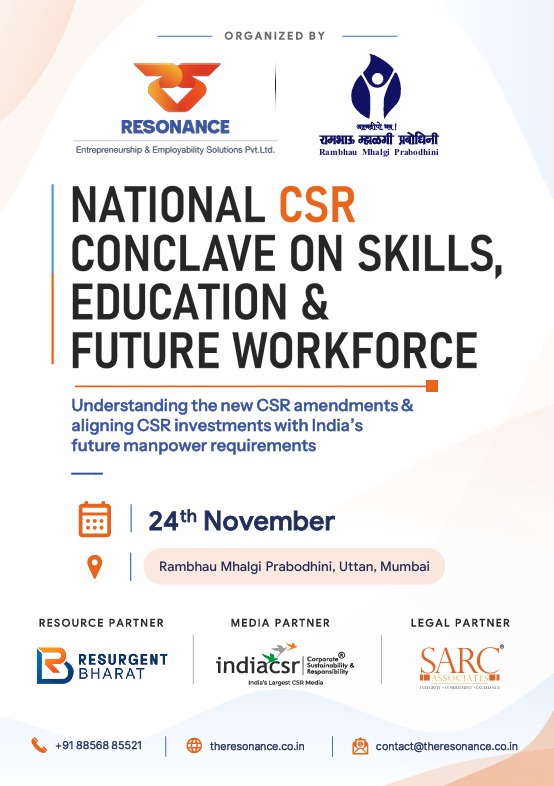
National CSR Conclave to Build Roadmap for Skills, Education and Future Workforce in Mumbai

From Classrooms to Communities: How Colgate Is Helping Build Healthier Futures for India’s Children

ProTeen announces ₹10 lakh Scholarship Programme for 40 Students across India

48th Jamnalal Bajaj Awards to Honour Gandhian Warriors for their Selfless Service, Courage and Social Impact

Marico unveils Nihar Shanti Mazbooti Ki Paathshala, a renewed Identity for its flagship CSR Education Initiative

91% of Non-Profits Seek Longer CSR Grants, Finds Give Grants’ dus spoke India Inc 2026

STEM Learning STEM Learning STEM Learning
ADVERTISEMENT
Facebook Twitter Youtube LinkedIn Instagram
India CSR Logo

India CSR® is the largest tech-led platform for information on CSR and sustainability in India offering diverse content across multisectoral issues. It covers Sustainable Development, Corporate Social Responsibility (CSR), Sustainability, and related issues in India. Founded in 2009, the organisation aspires to become a globally admired media that offers valuable information to its readers through responsible reporting. To enjoy the premium services, we invite you to partner with us.

Follow us on social media:

Subscribe to Our Newsletter

Don't miss out on the latest updates in corporate social responsibility. Subscribe to our newsletter at indiacsr.in and be part of the positive change.
Please enable JavaScript in your browser to complete this form.
Loading

  • About India CSR®
  • Team
  • India CSR® Awards 2026
  • India CSR® Leadership Summit
  • Partnership
  • Guest Posts
  • Services
  • ESG Professional Network
  • Content Writing Services
  • Business Information
  • Contact
  • Privacy Policy
  • Terms of Use
  • Donate

Copyright © 2026 - India CSR® | All Rights Reserved

No Result
View All Result
  • Home
  • CSR
    • Art & Culture
    • CSR Leaders
    • Child Rights
    • Culture
    • Education
    • Gender Equality
    • Around the World
    • Skill Development
    • Safety
    • Covid-19
    • Safe Food For All
  • Sustainability
    • Sustainability Dialogues
    • Sustainability Knowledge Series
    • Plastics
    • Sustainable Development Goals
    • ESG
    • Circular Economy
    • BRSR
  • SUMMIT
  • AWARDS
  • Interviews
  • SDGs
    • No Poverty
    • Zero Hunger
    • Good Health & Well-Being
    • Quality Education
    • Gender Equality
    • Clean Water & Sanitation – SDG 6
    • Affordable & Clean Energy
    • Decent Work & Economic Growth
    • Industry, Innovation & Infrastructure
    • Reduced Inequalities
    • Sustainable Cities & Communities
    • Responsible Consumption & Production
    • Climate Action
    • Life Below Water
    • Life on Land
    • Peace, Justice & Strong Institutions
    • Partnerships for the Goals
  • Articles
  • Events
  • हिंदी
  • More
    • Business
    • Finance
    • Corporate Governance
      • Diversity & Inclusion
    • Environment
    • Economy
    • Health
    • Around the World
    • Social Sector Leaders
    • Social Entrepreneurship
    • Trending News
      • Important Days
      • Great People
      • Product Review
      • International
      • Sports
      • Entertainment
    • Case Studies
    • Philanthropy
    • Biography
    • Technology
    • Lifestyle
    • Sports
    • Gaming
    • Knowledge
    • Home Improvement
    • Words Power
    • Chief Ministers

Copyright © 2026 - India CSR® | All Rights Reserved

This website uses cookies. By continuing to use this website you are giving consent to cookies being used. Visit our Privacy and Cookie Policy.
