

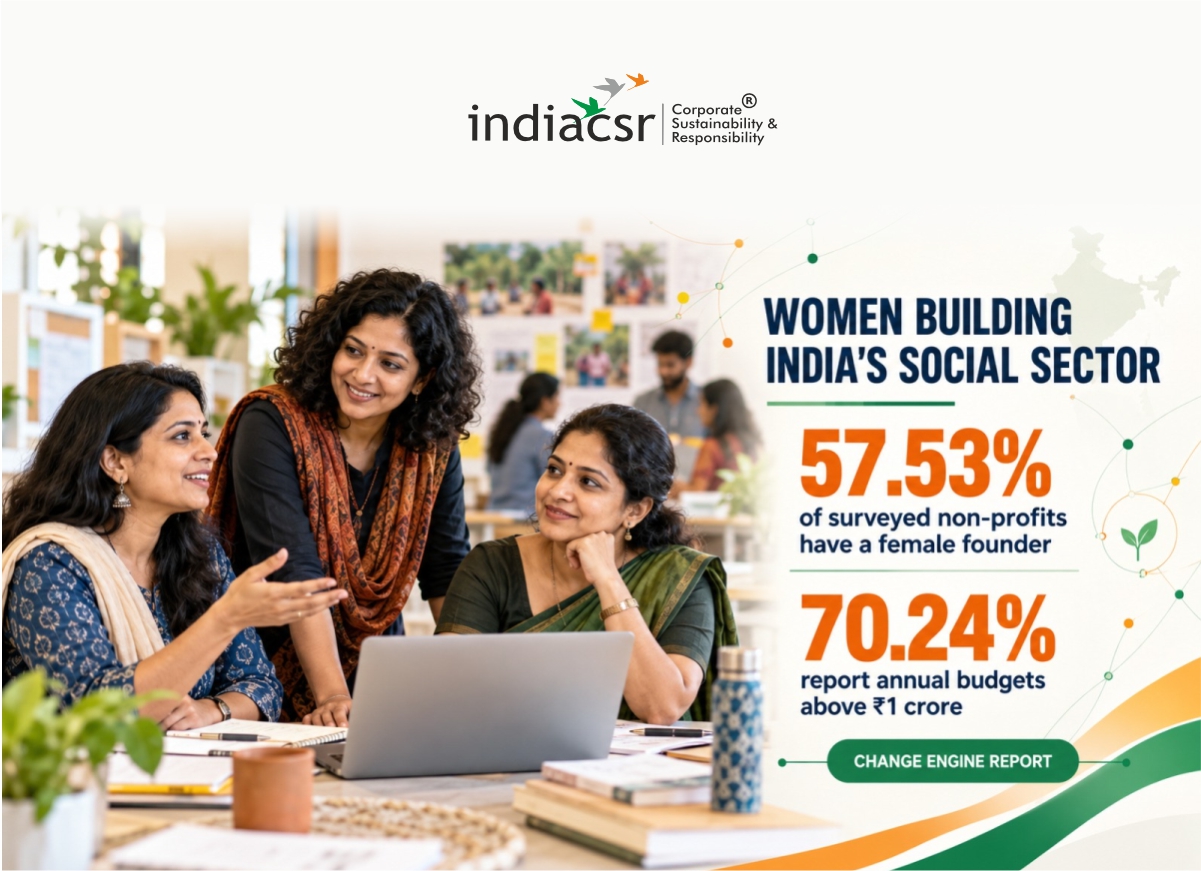


The surveyed non-profits have at least one female founder, while organisations with women on founding teams report larger budgets, better access to flexible funding and more multi-year grants.
NEW DELHI (India CSR): India’s social sector is telling a different gender story from the country’s conventional startup and corporate leadership ecosystem. A new study by Change Engine finds that nearly six in ten surveyed non-profits and social enterprises have at least one female founder. More importantly, the data suggests that organisations founded by women, or with women as part of the founding team, are reporting stronger access to resources that help institutions grow and sustain their work.
Change Engine’s report, Ease of Doing Good: Access to Flexible Funding – A Gender Lens, is based on a primary survey of more than 145 organisations working in the social-impact space. It finds that 57.53% of surveyed organisations have at least one female founder. This includes 30.82% with only female founders and 26.71% with both male and female founders.
The figure is more than three times the 18% share of Indian startups reported to have at least one woman founder, according to the comparison cited in the report. The study also contrasts the social sector’s representation with corporate leadership, where women reportedly hold only 1.8% of CEO positions, 4.4% of CFO positions and 29% of executive director roles.
The findings do not suggest that the funding challenge has disappeared for women-led institutions. In fact, the report underlines that flexible and unrestricted funding remains difficult to access across the non-profit ecosystem. Yet it offers an important insight: women are not merely participating in India’s social-development landscape; they are building a significant share of the institutions that are addressing some of the country’s most urgent social challenges.
***
A Gender Story Hidden in Plain Sight
India’s social sector has long been shaped by women leaders, community workers, educators, health professionals and grassroots organisers. However, data on who is founding and scaling non-profit institutions has been less visible in mainstream conversations around entrepreneurship and leadership.
Change Engine’s research brings this dimension into sharper focus. The study examines the relationship between founder composition and access to unrestricted funding, multi-year grants, fundraising ease and organisational budgets.
The sample included small, medium and large organisations. Around 41% had an annual budget below Rs.1 crore, 38% were medium-sized organisations and 21% were large organisations. The research sample also had an almost equal split between organisations eligible for foreign funding, including FCRA or US 501(c) eligibility, and those dependent only on domestic fundraising.
This makes the findings particularly relevant for the Indian social sector, where many organisations struggle to balance project delivery with the cost of retaining talent, investing in technology, building systems, conducting research and strengthening governance.
The report’s central message is not that gender alone determines an organisation’s success. Rather, it identifies a strong association between the presence of women founders and better access to several forms of funding that can support institutional growth.
Women Are Building India’s Social Startups: Change Engine Survey Finds Stronger Funding Outcomes for Female Founders
***
Bigger Budgets, Stronger Organisations
One of the most notable findings concerns organisational budgets. According to the report, 70.24% of organisations with at least one female founder have an annual budget of more than Rs. 1 crore. Among organisations with only male founders, the corresponding figure is 43.55%.
The difference is significant because annual budgets often determine an organisation’s ability to recruit skilled teams, develop stronger monitoring systems, invest in technology, expand programme reach and survive funding uncertainty.
The data becomes more revealing when founder composition is examined in greater detail. Among organisations with only female founders, 68.89% had annual budgets above ₹1 crore. Among organisations with both male and female founders, the figure was 71.79%. In comparison, only 43.55% of organisations founded exclusively by men had crossed the ₹1 crore annual-budget threshold.
The report also shows that 56.45% of male-only founder organisations had annual budgets below Rs. 1 crore. The comparable figures were 28.21% for organisations with mixed-gender founding teams and 31.11% for organisations with only female founders.
This suggests that women founders are helping build institutions that are not necessarily smaller, informal or peripheral. On the contrary, the survey indicates that women-led and gender-diverse founding teams are represented strongly among organisations with larger operating budgets.
For a sector that often measures success through the scale and depth of social impact, this is an important finding. It challenges the assumption that women’s leadership in development is limited to programme delivery or community mobilisation. Women are also building and leading institutions with substantial financial scale.
***
Why Flexible Funding Matters
The report’s second major finding relates to unrestricted or flexible funding. This form of funding is especially important because it can be used for organisational needs that are often excluded from project-specific grants.
Flexible funding allows non-profits to invest in talent, technology, research, compliance, leadership development, governance systems and organisational strengthening. It gives founders the ability to respond to emerging needs instead of using every grant only for narrowly defined programme activities.
According to the study, 38.10% of organisations with at least one female founder reported receiving more than ₹25 lakh in unrestricted funding. The comparable figure for organisations with only male founders was 27.42%.
The gap becomes even clearer when unrestricted funding is measured as a share of the organisation’s total annual budget. The report finds that 21.43% of organisations with at least one female founder had more than 25% of their annual budget available as unrestricted funding. For organisations with only male founders, the figure was 12.90%.
This is a significant difference because flexible funding gives an organisation room to plan beyond the next project cycle. It allows a non-profit to hire a finance professional, build data systems, support a leadership transition, strengthen safeguarding practices, or invest in new programme research without having to wait for a specific project grant.
However, Change Engine’s data also makes clear that unrestricted funding remains scarce across the sector. The report notes that around 80% of surveyed founders said they struggle to scale their work because of a lack of flexible funding.
This is the structural challenge at the heart of the report. While organisations with women founders appear to report relatively better outcomes, the overall funding environment still leaves most social-impact institutions without the long-term capital needed to build resilient organisations.
***
Multi-Year Grants Create Stability
The third important finding concerns multi-year funding, which the report defines as funding commitments of three years or more. Multi-year grants are particularly valuable because they allow organisations to plan beyond annual fundraising cycles.
Among organisations with at least one female founder, 65.48% reported access to multi-year funding. For organisations with only male founders, the figure stood at 56.45%.
The difference was sharper for larger grants. The study found that 27.38% of organisations with at least one female founder had received multi-year grants above ₹1 crore. In comparison, only 11.29% of male-only founder organisations had received grants of this size.
The data also shows that 48.39% of organisations with only male founders had received no multi-year grants at all. This figure was lower for organisations with both male and female founders, at 33.33%, and for organisations with only female founders, at 37.78%.
Multi-year funding can transform how an organisation works. It gives founders the ability to retain staff, make long-term commitments to communities, test and improve interventions, build partnerships with governments and avoid the disruption of constantly seeking the next grant.
For beneficiaries and communities, continuity is equally important. A programme addressing child nutrition, livelihoods, education, climate resilience, disability inclusion or women’s empowerment often needs several years to demonstrate meaningful outcomes. Short grant cycles can force organisations to focus on immediate outputs rather than sustained impact.
***
Donors Are Responding, but the Funding System Remains Difficult
The report asked organisations to rate the ease of raising unrestricted funds from CSR, high-net-worth individuals, domestic foundations, foreign foundations and crowdfunding or retail donors. The rating used a scale of one to five, with one representing the greatest difficulty and five representing the greatest ease.
Organisations with at least one female founder reported higher ease-of-fundraising scores across every category, with an overall average score of 2.41, compared with 2.06 for male-only founder organisations.
The gap was especially pronounced in access to foreign foundations. Organisations with at least one female founder reported an average score of 2.57, compared with 1.91 for male-only founder organisations.
The findings indicate that donors may be responding positively to women-led and gender-diverse organisations. However, the scores also reveal a larger truth: fundraising remains difficult for everyone. Even the higher scores remain below the midpoint of the five-point scale.
CSR funding, in particular, was rated as difficult by all founder groups. The average score for male-only organisations was 1.26, while organisations with both male and female founders reported a score of 1.33. Organisations with only female founders recorded a higher score of 1.63, but this too indicates significant difficulty in accessing flexible capital.
The report therefore calls attention to the need for donors, CSR teams and philanthropic institutions to look beyond project-bound grants. Funding an organisation’s capacity is not an administrative expense; it is an investment in sustained impact.
***
The Small-Cheque Challenge Cuts Across Gender
While women-founded organisations show stronger access to some forms of capital, the report finds one shared constraint across the ecosystem: the small-cheque problem.
A total of 82% of organisations with at least one female founder and 83% of male-only founder organisations said typical unrestricted funding cheques in India are below ₹25 lakh.
This means that the problem is not simply about who gets funded. It is also about the size and quality of funding available to non-profits. Small grants can support specific activities, but they often do not provide enough capital for an organisation to hire senior talent, develop technology, strengthen governance or build the infrastructure needed to scale.
The report also finds broadly similar fundraising timelines across founder groups, suggesting that women founders may have better access to some funding opportunities but still operate within the same slow and fragmented fundraising ecosystem.
***
Women’s Leadership Must Be Backed by Better Capital
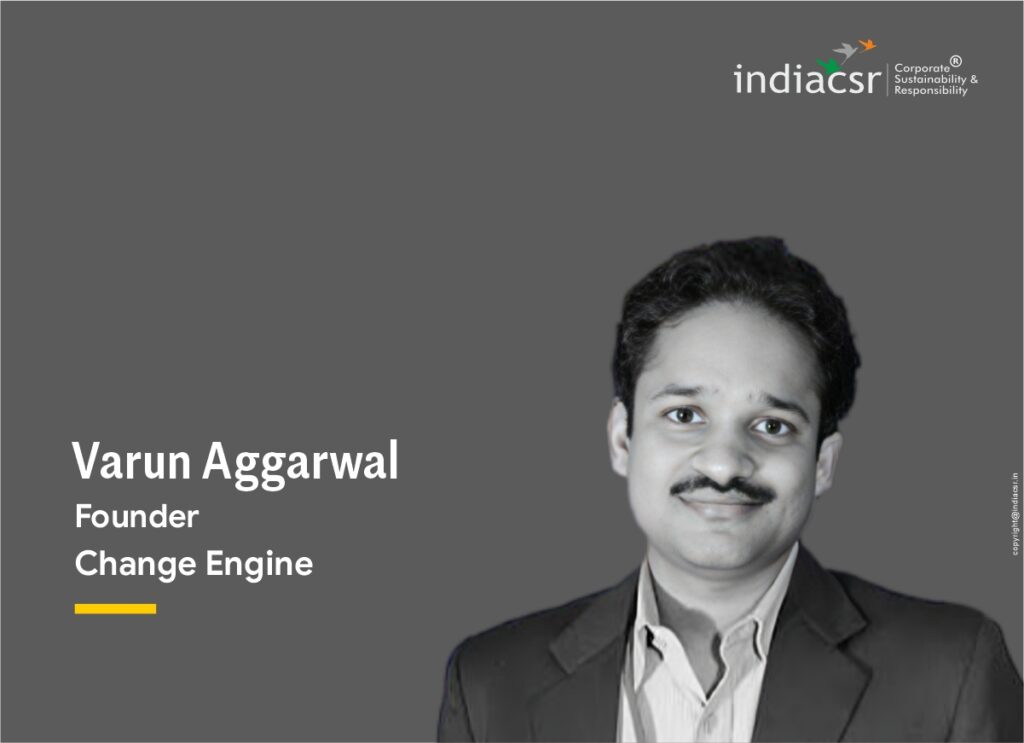
Varun Aggarwal, Co-founder of Change Engine, said women’s contribution to nation-building should be recognised more visibly in the social-development space.
“This needs to be celebrated nationally and we need to encourage more women to come in this sector,” he said, adding that stronger participation by women would create significant public good.
Shubham Bansal, Co-founder of Change Engine, said the findings validate what the organisation has observed through its accelerator work with social-sector founders. “Six in ten nonprofits in our survey were founded by a woman founder,” he said.
Change Engine describes itself as an accelerator that supports high-potential non-profit founders to build organisations capable of meaningfully impacting one million people. It has worked with 10 organisations that have collectively raised more than US$2 million in follow-on funding.
The report should be read as a survey-based insight rather than a census of India’s entire non-profit sector. It does not establish that a woman founder alone causes stronger funding outcomes. But it does present compelling evidence that women-led and gender-diverse founding teams are building institutions with substantial budgets, stronger access to flexible capital and greater likelihood of receiving multi-year support.
For India’s donors, philanthropists, CSR leaders and ecosystem builders, the message is clear. Women’s leadership in the social sector is already visible in the data. The next step is to ensure that this leadership is backed by larger, longer-term and more flexible funding so that high-impact institutions can focus less on surviving and more on solving the country’s most pressing challenges.



