



There is a quiet moment most security teams go through.
It usually comes after a breach disclosure hits the press. Or when a supplier calls to admit credentials have been found somewhere they should not be. Someone in the room asks a simple question. Are we already out there?
That question sits behind the rising interest in dark web monitoring tools. Not curiosity. Not trend. Unease.
The dark web is not mysterious to practitioners. It is simply another environment where people trade information. Some of it stolen. Some of it leaked. Some of it carelessly exposed and later indexed by the wrong audience. Monitoring it is less about drama and more about visibility. Quiet, continuous visibility into what is circulating beyond your perimeter.
Most organisations do not lack security controls. They lack awareness of what has already escaped them.
Why Dark Web Exposure is Not Always a Breach
It is tempting to assume that anything found on a hidden forum signals compromise. In reality, the picture is more complicated.
Credentials appear online for many reasons. A third party may have been breached. An employee may have reused a password across services. An old database dump might resurface years later. Sometimes it is simply harvested login data from commodity malware running on a single infected device.
The organisation often learns about it last.
Dark web monitoring tools sit in that gap between incident and awareness. They do not prevent the initial theft. They reduce the time between exposure and response. That difference matters more than most people admit.
Security teams who discover leaked VPN credentials months after publication are not facing a theoretical risk. They are dealing with the uncomfortable reality that someone else may have had access for some time.
This is where monitoring shifts from being a nice to have to a core part of risk management.
What These Tools Actually Do
Strip away the product descriptions and the idea is straightforward.
They search hidden forums, paste sites, marketplaces, encrypted chat channels and breach repositories for data that matches your organisation. Domains, email patterns, executive names, IP ranges, proprietary identifiers.
When something surfaces, the system flags it.
That sounds simple. It rarely is.
Accessing hidden communities requires persistent infrastructure, human intelligence, and sometimes established personas. Many sources are closed, invitation only, or deliberately deceptive. Automated scraping alone does not reach far enough.
The better platforms combine automated collection with analyst validation. That second part is often overlooked. Raw data without context creates noise. Context without timeliness creates delay. The balance is delicate.
You want to know when exposed credentials are still valid. You want to understand whether a dataset is newly leaked or recycled. You want to know whether a threat actor is discussing targeting your sector specifically.
It is less about volume and more about relevance.
Where Organisations Misjudge the Risk
A common misconception is that dark web monitoring is mainly for large enterprises. Financial institutions. Multinationals. Obvious targets.
Yet smaller firms are frequently discussed in breach forums precisely because they are softer targets. Managed service providers, regional law firms, healthcare clinics, engineering consultancies. Their data still carries value.
In several ransomware investigations over the past few years, attackers admitted they sourced initial credentials from publicly available dumps. No sophisticated zero day. Just reused passwords and exposed access.
Security teams who believe they are too small to appear on underground forums often discover the opposite.
The risk also extends beyond direct compromise. Leaked supplier credentials can expose shared environments. Executive email addresses can fuel phishing campaigns. Stolen data can be repackaged for extortion, even if the breach occurred elsewhere.
Monitoring gives early signal. It does not solve the underlying weaknesses, but it makes them visible.
How Dark Web Monitoring Fits into Broader Security Operations
It is easy to treat these tools as a separate layer. A bolt on to an existing stack.
In practice, their value depends on integration.
An alert about exposed credentials is meaningless if password reset processes are slow. Intelligence about ransomware chatter is wasted if incident response playbooks are outdated. Monitoring needs to feed directly into operational workflows.
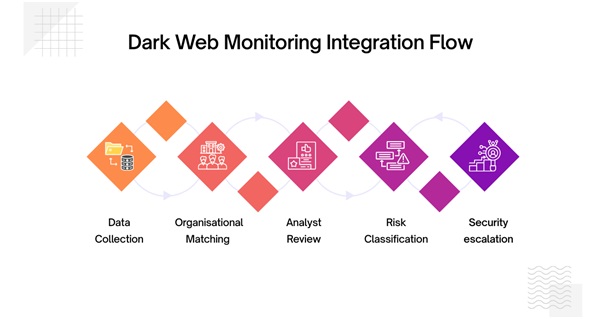
The relationship usually looks something like this.
- Data collection across hidden and restricted sources/Data Collection
- Matching against organisational identifiers/Organisational Matching
- Analyst review to confirm authenticity/Analyst Review
- Risk classification based on severity and validity/Risk Classification
- Escalation into security operations for remediation/Security escalation
Without this flow, alerts remain abstract. With it, they become part of routine defence.
Limitations That Rarely Get Discussed
It is worth acknowledging what dark web monitoring tools cannot do.
They cannot see everything. Some threat actor groups operate in tightly controlled channels. Some data is sold privately. Some forums shut down as quickly as they appear.
They also cannot confirm intent. Just because data appears in a marketplace does not mean it will be weaponised. Equally, absence of chatter does not mean absence of risk.
There is also the issue of false positives. Common surnames. Generic domain references. Old credential dumps resurfacing under new labels. Poor filtering creates alert fatigue quickly.
Experienced practitioners learn to treat monitoring as an intelligence source, not a guarantee. It informs judgement. It does not replace it.
Another uncomfortable reality is that discovery can raise difficult internal conversations. When exposed credentials trace back to password reuse or lax third-party controls, the issue shifts from external threat to internal discipline.
Monitoring often exposes governance weaknesses as much as external risk.
The Regulatory and Reputational Angle
Beyond security operations, there is a compliance dimension that boards increasingly recognise.
Data protection frameworks expect organisations to demonstrate awareness of risk. Ignorance is no defence. If customer data is circulating publicly and you have no mechanism to detect it, regulators may ask why.
In sectors such as finance and healthcare, supervisory bodies now expect some level of threat intelligence capability. Not necessarily elaborate programmes, but clear evidence of monitoring and response.
Reputational impact often moves faster than regulatory action. Journalists and researchers routinely scan breach repositories. If they discover your organisation’s data before you do, the narrative writes itself.
Dark web monitoring narrows that exposure window.
Selecting Tools Without Falling for Marketing
There is a tendency in security procurement to focus on feature lists.
Access coverage numbers. Machine learning claims. Global intelligence feeds.
A more grounded approach starts with questions that are harder to package.
- How are sources accessed?
- Are analysts involved in validation?
- How often are new sources added?
- What does a typical alert look like in practice?
- How quickly can we act on it?
Ask for anonymised examples. Not screenshots. Real cases showing detection to remediation timeline.
Another factor is integration. Does the platform connect with existing SIEM or ticketing systems? Can alerts trigger automated response? If intelligence sits in a separate dashboard that no one checks daily, it will drift into irrelevance.
Cost should also be weighed against risk reduction, not data volume. Thousands of alerts do not equate to protection. Fewer, accurate findings with clear remediation pathways are worth more.
Security maturity shapes the decision. Organisations with established SOC teams may prefer raw intelligence feeds. Smaller teams often need curated insights with clear guidance on priority.
There is no universal fit.
Human Judgement Still Matters
The presence of dark web monitoring tools does not eliminate the need for human interpretation.
An analyst deciding whether a credential set is fresh or recycled relies on experience. Understanding threat actor behaviour requires context built over time. Even deciding when not to escalate is a skill.
Over reliance on automation can create blind spots. Over reliance on manual review slows response.
The balance is subtle.
Security leaders who treat monitoring as a living intelligence function rather than a static product tend to gain more value. They review findings periodically. They adjust identifiers as the organisation evolves. They learn from false positives instead of ignoring them.
Monitoring is not a one-time setup. It is a relationship with an evolving threat landscape.
Conclusion
Dark web monitoring tools do not promise safety. They offer awareness. In many cases, that awareness arrives uncomfortably late, revealing data already exposed or credentials already traded.
Yet knowing changes the posture of an organisation. It shortens response time. It strengthens governance discussions. It moves risk from unknown to manageable.
For organisations unsure where to begin, CyberNX can help. They identify breaches, stolen credentials, infected devices and third-party data exposures with the help of cutting-edge technology and experienced professionals who know how to handle cyber threats well.
Security rarely fails because tools are absent. It fails when visibility is delayed and decisions come too late. Monitoring the darker corners of the internet will not prevent every incident, but it reduces the chance of being the last to know.
For many boards and security teams, that alone justifies the effort.



