

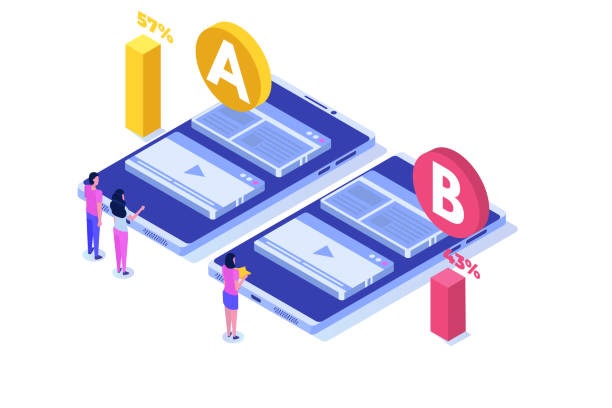



Picture a river that suddenly forks into two channels. Both channels carry the same water, the same fish, the same current — but a small island in the middle decides which boats drift left and which drift right. Downstream, someone stands with a notebook, counting how many boats from each channel actually reach the harbor safely. That island, and that notebook, are the entire soul of an A/B testing system. It isn’t a database table or a percentage split hidden in a config file. It’s a quiet arbiter sitting between a user’s click and the product’s response, deciding which version of reality they experience next. For anyone coming out of a full stack java developer training program, this is often the first project where “full stack” stops being a buzzword and starts meaning something concrete: you touch the request at the edge, shape it in the middle, and measure its consequence at the end.
The Fork in the River: Where Routing Happens
Every experiment begins with a decision point, and that decision point has to live somewhere stable — not on the client, where a refreshed page might flip the outcome, but in a layer that remembers. A hashing function takes a user identifier, salts it with the experiment name, and produces a deterministic bucket assignment. The elegance here is that the same user, visiting five times in a week, always lands in the same channel. No coin is flipped twice. This bucketing logic typically sits in a lightweight service or middleware layer, intercepting requests before they reach business logic, tagging each session with a variant label that travels with it like a passport stamp.
The Two Channels: Code Paths That Diverge Quietly
Once a user is bucketed, the application has to actually behave differently without collapsing into spaghetti. The cleanest pattern treats variants as feature flags rather than tangled if-else chains scattered across the codebase. A configuration service exposes a simple contract — “user X gets variant B for experiment Y” — and the frontend or backend consults it once, then renders accordingly. This is where backend skills matter enormously, because a poorly designed flagging layer becomes a maintenance swamp within months, full of dead code from experiments nobody remembers ending.

The Notebook by the Harbor: Metrics Collection
Routing without measurement is just randomness with extra steps. Every meaningful interaction — a click, a purchase, a session length — needs to be logged with its variant tag intact, then streamed into an analytics pipeline. The trick is avoiding two traps: sampling too sparsely to detect real differences, and logging so much that the event pipeline buckles under its own weight. A well-built system separates raw event ingestion from statistical analysis, letting a queue absorb bursts while a downstream job computes conversion rates, confidence intervals, and guardrail metrics on its own schedule.
The Statistician on the Bridge: Making Sense of the Numbers
Numbers without judgment are noise. A dashboard might show Variant B converting eleven percent higher, but if the sample size is small or the test has run for only two days, that gap could be pure chance. This is where statistical significance, sample ratio mismatch checks, and pre-registered stopping rules become the guardrails that keep a team from declaring victory prematurely. The strongest systems bake this discipline directly into the tooling, refusing to highlight a “winner” until the underlying math actually supports it.
The Rebuilt Bridge: Scaling and Maintaining the System
Experiments multiply. What began as one fork in the river becomes a delta with a dozen channels, each carrying its own logic, its own flags, its own metrics. Left unmanaged, this becomes brittle fast. The mature approach introduces experiment lifecycle management — automatic flag cleanup after a test concludes, guardrails against overlapping experiments that contaminate each other’s results, and a central registry so nobody accidentally runs three conflicting tests on the same button. Engineers who complete rigorous, project-based education, including full stack java developer training, often find this the most transferable skill of all: designing systems that stay legible as complexity grows, rather than collapsing under their own ambition.
Conclusion
An A/B testing platform is never just a coin flip wearing a lab coat. It’s a living piece of infrastructure — a fork, a set of quiet channels, a notebook, a careful statistician, and a bridge built to hold more traffic than it was ever meant to carry. Building one end-to-end, from the routing decision at the edge to the significance calculation at the end, teaches a kind of full-stack thinking that no single layer of the application can offer alone. It rewards patience, humility about what the numbers actually say, and a willingness to keep the system simple even as the business asks for more experiments, more variants, more nuance. Get that balance right, and the river keeps flowing — clear, measured, and honest about where it actually goes.


