


• India CSR Awards 2025
  • India CSR Leadership Summit
  • Guest Posts
Wednesday, February 11, 2026
India CSR
  • Home
  • Corporate Social Responsibility
    • Art & Culture
    • CSR Leaders
    • Child Rights
    • Culture
    • Education
    • Gender Equality
    • Around the World
    • Skill Development
    • Safety
    • Covid-19
    • Safe Food For All
  • Sustainability
    • Sustainability Dialogues
    • Sustainability Knowledge Series
    • Plastics
    • Sustainable Development Goals
    • ESG
    • Circular Economy
    • BRSR
  • Corporate Governance
    • Diversity & Inclusion
  • Interviews
  • SDGs
    • No Poverty
    • Zero Hunger
    • Good Health & Well-Being
    • Quality Education
    • Gender Equality
    • Clean Water & Sanitation – SDG 6
    • Affordable & Clean Energy
    • Decent Work & Economic Growth
    • Industry, Innovation & Infrastructure
    • Reduced Inequalities
    • Sustainable Cities & Communities
    • Responsible Consumption & Production
    • Climate Action
    • Life Below Water
    • Life on Land
    • Peace, Justice & Strong Institutions
    • Partnerships for the Goals
  • Articles
  • Events
  • हिंदी
  • More
    • Business
    • Finance
    • Environment
    • Economy
    • Health
    • Around the World
    • Social Sector Leaders
    • Social Entrepreneurship
    • Trending News
      • Important Days
        • Festivals
      • Great People
      • Product Review
      • International
      • Sports
      • Entertainment
    • Case Studies
    • Philanthropy
    • Biography
    • Technology
    • Lifestyle
    • Sports
    • Gaming
    • Knowledge
    • Home Improvement
    • Words Power
    • Chief Ministers
No Result
View All Result
  • Home
  • Corporate Social Responsibility
    • Art & Culture
    • CSR Leaders
    • Child Rights
    • Culture
    • Education
    • Gender Equality
    • Around the World
    • Skill Development
    • Safety
    • Covid-19
    • Safe Food For All
  • Sustainability
    • Sustainability Dialogues
    • Sustainability Knowledge Series
    • Plastics
    • Sustainable Development Goals
    • ESG
    • Circular Economy
    • BRSR
  • Corporate Governance
    • Diversity & Inclusion
  • Interviews
  • SDGs
    • No Poverty
    • Zero Hunger
    • Good Health & Well-Being
    • Quality Education
    • Gender Equality
    • Clean Water & Sanitation – SDG 6
    • Affordable & Clean Energy
    • Decent Work & Economic Growth
    • Industry, Innovation & Infrastructure
    • Reduced Inequalities
    • Sustainable Cities & Communities
    • Responsible Consumption & Production
    • Climate Action
    • Life Below Water
    • Life on Land
    • Peace, Justice & Strong Institutions
    • Partnerships for the Goals
  • Articles
  • Events
  • हिंदी
  • More
    • Business
    • Finance
    • Environment
    • Economy
    • Health
    • Around the World
    • Social Sector Leaders
    • Social Entrepreneurship
    • Trending News
      • Important Days
        • Festivals
      • Great People
      • Product Review
      • International
      • Sports
      • Entertainment
    • Case Studies
    • Philanthropy
    • Biography
    • Technology
    • Lifestyle
    • Sports
    • Gaming
    • Knowledge
    • Home Improvement
    • Words Power
    • Chief Ministers
No Result
View All Result
India CSR
No Result
View All Result
Home Articles

Safeguarding Smallholders: How India Can Protect Its Farmers in Global Trade Agreements

India CSR by India CSR
November 13, 2025
in Articles
Reading Time: 4 mins read
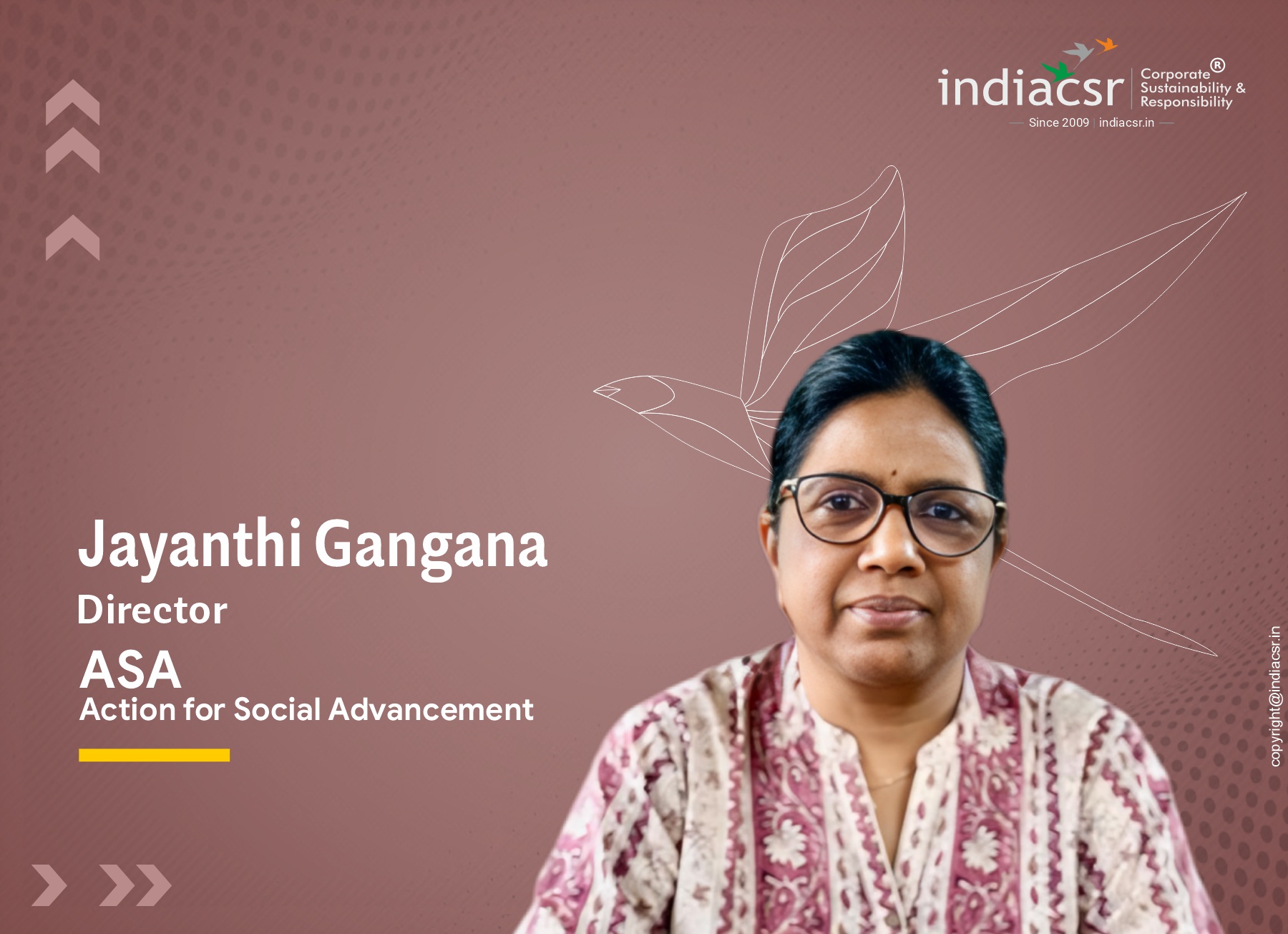
G. Jayanthi, Director & Founder, Trustee, Action for Social Advancement (ASA).
Share Share Share Share

By G. Jayanthi

NEW DELHI (India CSR): In an increasingly globalised agricultural market, India now faces a defining policy moment: how to integrate with global trade without leaving its smallest farmers behind. Unless we consciously build trade-agreements that protect small and marginal producers, we risk repeating patterns of unequal growth, rising debt, asset loss and rural distress.

India’s Smallholders: The Challenges

Smallholder farmers in India face a range of structural challenges that make them vulnerable. Landholdings are small and fragmented, input costs keep fluctuating, market linkages are not well established, and they have negligible bargaining power. Access to export markets also remains difficult for them due to strict global standards, high certification costs, and limited collective organisation. Excessive liberalisation of imports and slashing tariffs due to international trade agreements would expose these small producers to cheaper global competition and volatile commodity cycles. Without sufficient protection or buffer against risks, such a situation would be nothing less than catastrophic for them.

Global trade deals often assume that farmers will automatically gain from greater access. But experience shows that unless the rules are designed with smallholders in mind, the gains are skewed. India must ask: Who benefits from trade liberalisation? And how can we ensure that our farmers are not simply opening their gates to competition, but gaining from new opportunities on fair terms?

Why Trade Agreements Must Prioritise Smallholders

Over 80 % of India’s farming households are small or marginal. Trade policies must take into account their vulnerabilities otherwise they will end up further widening inequality, deepening rural fragility and concentrating growth in large agribusinesses.

Prioritizing smallholders is important for rural stability and food security. The ripple effects of marginalizing their interests in any trade deal would harm employment prospects of rural youth, trigger migration to cities and compromise viability of villages as economic units. Another important aspect is resilience in global markets. Smallholders organised into credible value chains are also better placed to ride global fluctuations and add value, rather than just being vulnerable to import surges.

Traditional Indian agriculture is increasingly valued worldwide for indigenous knowledge and sustainable practices that are in harmony with the rhythms of nature. If we sideline smallholders, we lose the authenticity and value-added potential of agriculture exports from India.

What India Needs to Do: Key Measures

Firstly, India must build treaty mechanisms that include safeguards for smallholders. When signing international trade deals, India must include sunset clauses, funds for adjustment programs for smallholders, and limits on import quotas for vulnerable crops grown by them. If imports threaten domestic produce grown by small farmers in any region of India, tariff safeguards should get triggered automatically. 

Secondly, India must facilitate access of smallholders to export-ready value chains. It must support groups of small farmers through capacity building, government credit, aggregation platforms, and certification support, such as organic or sustainability labels. Encouraging cooperative models, digital platforms and farmer-producer organizations (FPOs) will help bridge the gap between international traders and grassroot producers.

Thirdly, India must invest in risk-mitigation. When a trade deal impacts domestic producers, smallholders must receive support to help them transition to the new regime. This can include insurance schemes, retraining the farmers, credit support, and access to alternative crops or value-added processing. Adjustment programs sponsored by the government can cushion the shock of transition, preventing distress sale of farmlands and loss of livelihoods.

Fourthly, India needs to promote a proactive “Make in India” for agriculture and allied sectors. Just as manufacturing emphasises local value-addition, agriculture trade policy must encourage processing, packaging and branding within India. Keeping most parts of the value-addition within the country will allow farmers to receive a fairer portion of the end-consumer price. Trade agreements should reflect this objective by facilitating inputs, machinery and technologies to boost domestic processing of agricultural produce.

In the light of ongoing global pressures on India to open its agricultural sector to international trade, the question before policy makers should be: How can India balance its dual goals of economic growth through international trade and inclusive development of rural communities? One should not be at the cost of other. The ongoing trade negotiations with various countries present a strategic window for policy makers to embed smallholder-friendly clauses, enabling India to become not only an exporter of agricultural products, but also a model for equitable, inclusive trade. 

Stories abound: villages where smallholder farmers spent years building regenerative systems, only to struggle when cheaper imports flooded domestic markets; or FPOs that could have scaled if only a trade agreement had opened region-specific niche export windows. These narratives make trade policy real and human – they contextualise macro deals in the micro realities of India’s 140 million farming households.

India’s smallholders deserve to thrive — not just survive — in the global trade era. The diplomatic tables where tariffs are negotiated, and standards are set, must become arenas where the voices of marginal farmers are heard and their futures secured.

About the Author

G. Jayanthi, Director & Founder, Trustee, Action for Social Advancement (ASA).

(India CSR)


CSR, Sustainability, and ESG success stories hindustan zinc
ADVERTISEMENT
India CSR

India CSR

India CSR is the largest media on CSR and sustainability offering diverse content across multisectoral issues on business responsibility. It covers Sustainable Development, Corporate Social Responsibility (CSR), Sustainability, and related issues in India. Founded in 2009, the organisation aspires to become a globally admired media that offers valuable information to its readers through responsible reporting.

Related Posts

Childcare
Articles

Stronger Families, Stronger Bottom Lines: Why Childcare Support Is a Business Imperative

4 days ago
Satish Jha
Articles

Satish Jha: India Has Grown But Not Flourished

6 days ago
Corporate Social Responsibility
Articles

From Compliance to Impact: Designing Site-Specific and Need-Based CSR Programs

2 weeks ago
Gaurav Sharma, CHRO of Balancehero India.
Articles

Youth, Rural India and Sustainability — Why CSR Must Focus on Empowerment, Not Just Relief

2 weeks ago
Carbon Neutral Manufacturing: Technology Pathways and Investment Strategies
Articles

Carbon Neutral Manufacturing: Technology Pathways and Investment Strategies

1 month ago
CSR in India
Articles

Corporate Social Responsibility (CSR) Must Include Environmental Responsibility: Supreme Court Judgment

2 months ago
Load More
Ambedkar Chamber
ADVERTISEMENT
India Sustainability Awards 2026
ADVERTISEMENT

LATEST NEWS

Buy Khajur Online from GGT Foods – Fresh, Premium Dates You Can Trust

How Students Can Check If an Image Is AI-Generated

India Shelter Finance Loans spends ₹4.58 crore on CSR in FY25

CSR: Bank of India Donates Ambulance to Maratha Mandal Dental Institute in Belagavi

GoEducated.com Scales Pan-India; Announces Strategic Corporate Training & Channel Partner Partnership with Boston Institute of Analytics

CSR Must Reflect Local Realities, Says EESL CEO at IMPETUS Roundtable

Ad 1 Ad 2 Ad 3
ADVERTISEMENT
ESG Professional Network
ADVERTISEMENT

TOP NEWS

Stronger Families, Stronger Bottom Lines: Why Childcare Support Is a Business Imperative

WOW Advertisement Celebrates 5 Remarkable Years of Transforming Brand Visibility in Gujarat

CSR: NMDC Empowers Bastar Youth with 100% Placement Through Skill Training

Satish Jha: India Has Grown But Not Flourished

Between Criminalisation and Consent

Coca-Cola India Brings Clean Stadium Initiative to T20 World Cup 2026

Load More
STEM Learning STEM Learning STEM Learning
ADVERTISEMENT

Interviews

Prof. Kang Sung Lee, PhD
Interviews

Prof. Kang Sung Lee on Academia, Policy, and Industry-Linked Career Pathways

by India CSR
February 5, 2026

Despite being an advanced economy, South Korea faces a severe demographic crisis.

Read moreDetails
Magma Group CEO and Founder, Neal Thakker

Embedding CSR in Responsible Manufacturing at Magma Group: An Interview with Neal Thakker

January 21, 2026
Sudeep Agrawal, CFO & Head – CSR, Ashirvad by Aliaxis

Integrating Financial Leadership With Impactful CSR Initiatives: An Interview with Sudeep Agrawal, Ashirvad by Aliaxis

December 29, 2025
Satish Jha

Interview with Satish Jha: Pioneering CSR in Education

December 5, 2025
Load More
Facebook Twitter Youtube LinkedIn Instagram
India CSR Logo

India CSR is the largest tech-led platform for information on CSR and sustainability in India offering diverse content across multisectoral issues. It covers Sustainable Development, Corporate Social Responsibility (CSR), Sustainability, and related issues in India. Founded in 2009, the organisation aspires to become a globally admired media that offers valuable information to its readers through responsible reporting. To enjoy the premium services, we invite you to partner with us.

Follow us on social media:


Dear Valued Reader

India CSR is a free media platform that provides up-to-date information on CSR, Sustainability, ESG, and SDGs. We need reader support to continue delivering honest news. Donations of any amount are appreciated.

Help save India CSR.

Donate Now

Donate at India CSR

  • About India CSR
  • Team
  • India CSR Awards 2025
  • India CSR Leadership Summit
  • Partnership
  • Guest Posts
  • Services
  • ESG Professional Network
  • Content Writing Services
  • Business Information
  • Contact
  • Privacy Policy
  • Terms of Use
  • Donate

Copyright © 2025 - India CSR | All Rights Reserved

No Result
View All Result
  • Home
  • Corporate Social Responsibility
    • Art & Culture
    • CSR Leaders
    • Child Rights
    • Culture
    • Education
    • Gender Equality
    • Around the World
    • Skill Development
    • Safety
    • Covid-19
    • Safe Food For All
  • Sustainability
    • Sustainability Dialogues
    • Sustainability Knowledge Series
    • Plastics
    • Sustainable Development Goals
    • ESG
    • Circular Economy
    • BRSR
  • Corporate Governance
    • Diversity & Inclusion
  • Interviews
  • SDGs
    • No Poverty
    • Zero Hunger
    • Good Health & Well-Being
    • Quality Education
    • Gender Equality
    • Clean Water & Sanitation – SDG 6
    • Affordable & Clean Energy
    • Decent Work & Economic Growth
    • Industry, Innovation & Infrastructure
    • Reduced Inequalities
    • Sustainable Cities & Communities
    • Responsible Consumption & Production
    • Climate Action
    • Life Below Water
    • Life on Land
    • Peace, Justice & Strong Institutions
    • Partnerships for the Goals
  • Articles
  • Events
  • हिंदी
  • More
    • Business
    • Finance
    • Environment
    • Economy
    • Health
    • Around the World
    • Social Sector Leaders
    • Social Entrepreneurship
    • Trending News
      • Important Days
      • Great People
      • Product Review
      • International
      • Sports
      • Entertainment
    • Case Studies
    • Philanthropy
    • Biography
    • Technology
    • Lifestyle
    • Sports
    • Gaming
    • Knowledge
    • Home Improvement
    • Words Power
    • Chief Ministers

Copyright © 2025 - India CSR | All Rights Reserved

This website uses cookies. By continuing to use this website you are giving consent to cookies being used. Visit our Privacy and Cookie Policy.

