By Dr. Anangadev Singh
In India’s crowded non-profit landscape, credibility is the currency that decides whether an NGO survives or thrives. Compliance management for NGOs in India is a complex yet essential landscape involving legal, regulatory, and ethical obligations i.e. particularly sections 12A, 80G, TDS/TAN, Audit, ITR, FCRA, PT, PF, ESIC, and various policies i.e. HR, Finance, Governance,PoSH& CPP etc.Donors, governments and communities are increasingly demanding proof of transparency, accountability and legal soundness. Yet for thousands of small and grassroots organisations, compliance remains a daunting challenge. A timely initiative in Jharkhand shows how systematic reform can dramatically restore trust.
The Niranthara Classic Organisational Development Programme, a 28-month flagship intervention by Dhwani Foundation, has just graduated 28 grassroots NGOs from 15 districts. At its heart lies a powerful message: robust compliance management is not a bureaucratic burden — it is the bedrock of credibility.
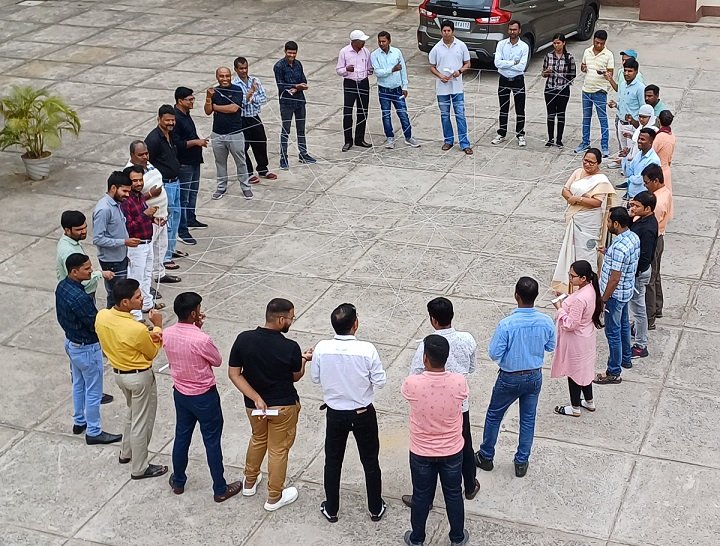
The programme worked across eight modules covering 205 parameters. The Compliance Management module alone addressed 42 critical parameters — from legal registration and renewals to FCRA filings, income-tax returns, statutory audits, internal policies and board governance. Leaders and finance managers of every NGO underwent intensive training, backed by expert mentoring, practical toolkits and field-level hand-holding.
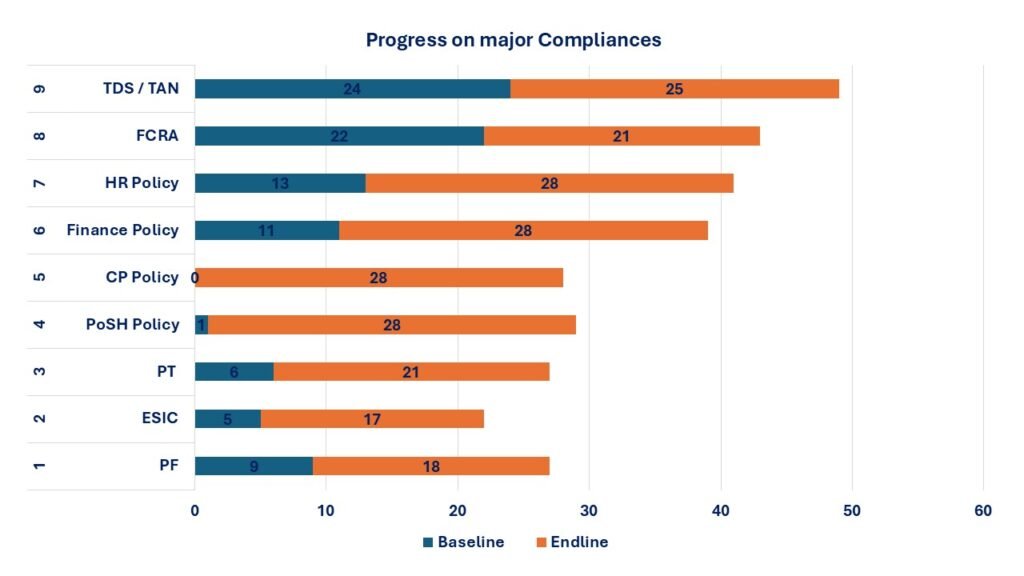
The results speak louder than any theory. A rigorous baseline-to-endline assessment recorded a spectacular jump in the overall Compliance Management Score — from 41 to 89.38, a gain of 48.38 points that more than doubled the starting performance.The below graph highlights the progress across nine major compliance areas, including the percentage of progress or decline:
Key breakthroughs were visible across the partners:
• All 28 NGOs now have in place five essential policies — PoSH, Child Protection, Finance, Governance and HR.
• Employee-related statutory compliances soared: Professional Tax (+250%), ESIC (+240%) and Provident Fund (+100%).
• Legal registrations, audits and book-keeping practices are now standard rather than exceptions.
These are not mere numbers and by improving their compliance scores, the NGOs in the Niranthara Program are better positioned to:
- Attract and Retain Funding: Donors are more likely to support organizations with robust compliance systems, as it assures them that their contributions will be used responsibly and legally.
- Enhance Reputation: A reputation for integrity and compliance strengthens the NGO’s standing within the community and with government bodies.
- Mitigate Legal and Financial Risks: Proactive compliance reduces the likelihood of legal challenges, fines, and reputational damage that can cripple small organizations.
- Improve Operational Efficiency: Well-defined compliance procedures often lead to better internal controls and more efficient resource management.
They translate directly into greater credibility. Donors can now trust that funds will be used legally and transparently. Government agencies see organisations that meet every statutory norm. Most importantly, communities and beneficiaries feel protected by strong safeguarding policies.
For the wider NGO sector, the lessons are clear. In an era when one compliance lapse can trigger media scrutiny, donor withdrawal or even licence cancellation, professionalism is no longer optional. The Niranthara experience proves that even small grassroots NGOs — often operating with limited resources — can achieve high standards when given structured support, continuous mentoring and practical tools.
Dhwani Foundation’s intervention has not only strengthened 28 organisations; it has demonstrated a replicable model for building a more resilient civil society ecosystem in Jharkhand and beyond. As NGOs across India face rising expectations from stakeholders, investing in compliance is investing in credibility itself.
When compliance becomes culture, trust becomes automatic. The Niranthara graduates are living proof that credible NGOs are not born — they are built, one policy, one filing and one accountable decision at a time.
About the Author
By Dr. Anangadev Singh, State Head-Dhwani Foundation, Jharkhand.
(India CSR)