By Dr. Prof. Anand Achari
NEW DELHI (India CSR): On a humid Mumbai morning this past September, long before the crowds began gathering at DadarChowpatty, hundreds of young volunteers stepped onto the sand with gloves and collection bags, ready to clear away the everyday waste that quietly builds up along one of the city’s busiest shorelines. The beach clean-up initiative, led by Vivekanand Education Society’s (VES) College of Architecture (VESCOA), became much more than a routine social activity. It emerged as a powerful demonstration of how educational institutions can shape environmentally responsible citizens ready to take part in real, on-ground environmental efforts.
The clean-up unfolded through a collaboration with Project Mumbai’s Jallosh movement and the Indian Green Building Council (IGBC), bringing together an unusually large and spirited crowd. Students, teachers, and community volunteers worked side by side, turning the stretch of DadarChowpatty into a hive of activity. Close to 300 NSS students and 20 faculty members from across VES institutes showed upwith an energy similar to what you’d expect for a popular college fest rather than a clean-up drive. By the end of the morning, the group had cleared more than 2,070 kilograms of waste, everything from plastic wrappers and paper scraps to pieces of cloth and even remnants of religious offerings that often wash ashore after festivals.
What stood out was how seamlessly students from different VES colleges blended into one team. Whether they came from architecture, law, pharmacy, polytechnic, business, engineering, arts and science, or management studies, the task at hand dissolved the boundaries between disciplines. For many of them, it became an important moment to see the direct impact a few hours of collective effort can have on a public space.
When asked about the reason for hosting such an initiative, Shri Rajesh Gehani, Secretary of VES, explained that the effort was rooted in VES’s belief that education extends far beyond the classroom. He noted that the clean-up drive was not just about restoring the beach, but about nurturing environmentally responsible citizens by instilling values of stewardship, mindful celebration, and active community participation. He added that VES takes immense pride in its NSS team and student volunteers for leading an initiative that reflects the institution’s long-standing commitment to social responsibility.
For more than five decades, VES has often organisedprograms like this that connect education with real-world impact. The beach clean-up fits into that approach, offering young volunteers a chance to directly engage with the environmental challenges facing their city. Such efforts underscore the simple truth that keeping public spaces clean is a shared responsibility, one that relies not on institutional campaigns alone but on consistent community participation. For the volunteers who stood and worked under the early morning sun, the experience was a chance to develop a sense of the sheer volume and variety of trash that ends up on a city beach and just how quickly it accumulates. It was a reminder of the everyday habits and public behaviours that contribute to Mumbai’s mounting waste problem. As bags filled up and the shoreline slowly began to look cleaner, the message became clear. That environmental responsibility isn’t abstract and that the journey toward cleaner, healthier environment begins with those willing to take the first step.
About the Author
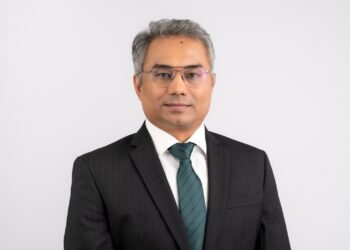
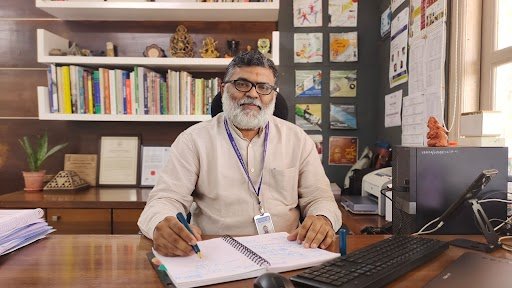
Dr. Prof. AnandAchari, Principal, VESCOA
(India CSR)