How a Court Order Sparked a Government Crackdown on Journalists and Platforms
- By intertwining judicial injunctions, government enforcement, and platform compliance, the case has revealed the vulnerabilities of free expression in the digital era.
- In September 2025, India’s media and digital space was jolted, exposing the fragile balance between corporate power, courts, and free speech.
In the second week of September 2025, India’s media and digital ecosystem was shaken by a development that exposed the fragile balance between corporate reputation, judicial authority, and freedom of speech. A Delhi civil court, acting on a defamation lawsuit filed by Adani Enterprises Limited, issued an ex parte injunction directing that allegedly defamatory content against the company be restrained. Soon after, the Ministry of Information and Broadcasting (MIB) took the unprecedented step of instructing platforms such as YouTube and Instagram to remove more than 200 pieces of content. The action, citing the court order, affected independent journalists, news outlets, and digital creators. For many observers, this was not just a story about one company’s reputation but a larger question about the nature of free speech in India. Critics described it as censorship cloaked in legal justification, while defenders insisted it was about protecting businesses from baseless attacks. The events reignited debates about prior restraint, defamation law, and the increasing power of the state in digital regulation. This story seeks to unpack the facts, reactions, and implications of the Adani content takedown and to place it in the broader context of India’s democratic traditions.
The Spark: Delhi Court’s Interim Injunction
On 6 September 2025, a Delhi civil court presided over by Senior Civil Judge Anuj Kumar Singh issued an interim injunction in response to a defamation suit filed by Adani Enterprises Limited (AEL). The order was granted ex parte—that is, without hearing the other side—raising immediate concerns about due process. The injunction named five journalists: Paranjoy Guha Thakurta, Ravi Nair, Abir Dasgupta, Ayaskanta Das, and Ayush Joshi. It restrained them from publishing what the court described as “unverified, unsubstantiated, and ex facie defamatory” content regarding the Adani Group. However, the scope of the order went far beyond those five names.
The court directed that if Adani Enterprises identified specific URLs, posts, or online materials that it considered defamatory, intermediaries such as social media platforms, hosting services, and even government agencies would be obligated to remove them within 36 hours. This effectively deputized a private corporation with the authority to identify offending content and trigger a mandatory takedown. For critics, this blurred the boundary between judicial caution and corporate censorship. For supporters, it represented a necessary step to prevent reputational harm in an era where damaging information spreads at lightning speed.
Government Enforcement: Ministry Steps In
The situation escalated on 16 September 2025 when the Ministry of Information and Broadcasting (MIB) issued a formal directive to enforce the Delhi court’s injunction. The ministry’s notice was striking in its scale and specificity: it demanded the removal of 138 YouTube videos and 83 Instagram posts that were flagged as defamatory under the order. The directive was not limited to the journalists named in the lawsuit; it extended to prominent independent creators, satirists, and established digital newsrooms.
The ministry gave a strict 36-hour deadline for compliance and required proof of takedown to be submitted. Platforms such as YouTube, owned by Google, and Instagram, owned by Meta, received direct copies of the notice and were effectively compelled to act. The ministry’s involvement transformed what might have remained a narrow court dispute into a full-scale national controversy. Critics argued that the government had gone beyond merely implementing a judicial decision, positioning itself as an active enforcer of corporate interests. Defenders insisted that the ministry had no choice but to act once a valid court order was in place. Either way, the government’s entry into the dispute magnified its stakes, drawing in the entire digital media landscape.
Who Was Targeted
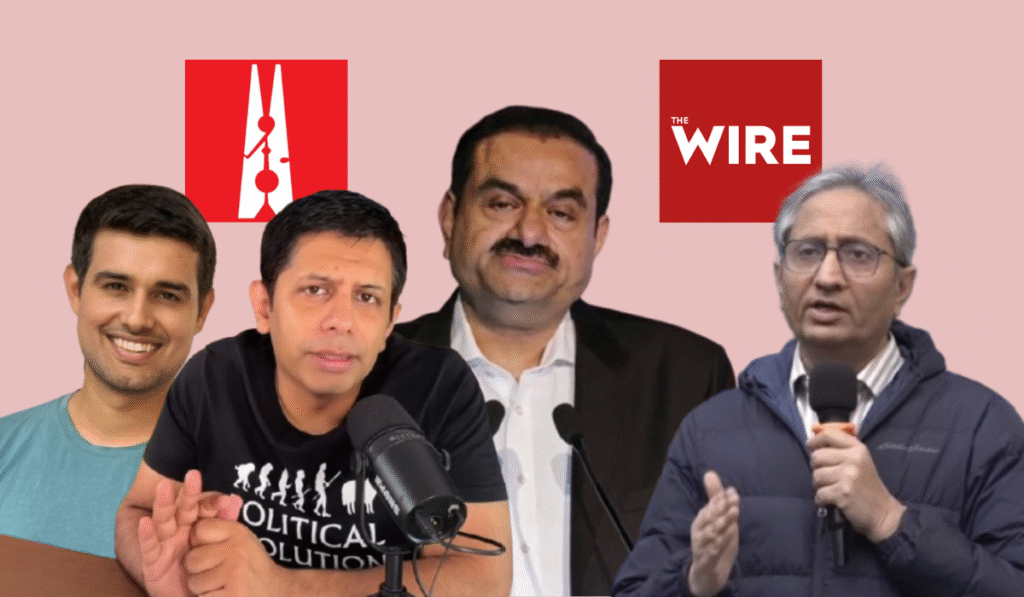
The list of those affected by the takedown directive reads like a roll call of India’s independent media and digital dissent. Veteran television anchor Ravish Kumar, known for his sharp critiques of political and corporate power, received takedown notices for several videos. Dhruv Rathee, one of India’s most-followed YouTubers with millions of subscribers, was also ordered to remove content. Satirical commentator Akash Banerjee, known as “Deshbhakt,” was affected, as were news organizations like The Wire, Newslaundry, and HW News.
Even regional voices with smaller followings were not spared. The sweep was so broad that it included political interviews, news analysis segments, satirical sketches, and incidental mentions of Adani in broader discussions. Many of those flagged had never been parties to the original defamation case, raising serious questions about how far a single court order could reach. For journalists and creators, the experience was disorienting: one day their content was live, the next it was under threat of deletion without prior notice or a chance to defend it. The breadth of the takedown showed how a corporate lawsuit could ripple outward to affect dozens of voices, chilling public debate in the process.

The Court Pushback
Amidst mounting criticism, there was a partial reprieve on 18 September 2025. A higher court, hearing appeals from some of the affected journalists, set aside parts of the original injunction. The gag order against four journalists—Ravi Nair, Abir Dasgupta, Ayaskanta Das, and Ayush Joshi—was quashed. The court observed that they had not been given an opportunity to present their case before the ex parte order and that continuing such a restraint would be unsustainable. However, this relief was only partial.
Veteran journalist Paranjoy Guha Thakurta’s appeal was adjourned, leaving him still under the shadow of the injunction. The court’s rollback highlighted an essential legal issue: whether ex parte injunctions should be used to impose blanket restrictions on speech. While the quashing of part of the order gave hope to journalists, it also underscored the precarious nature of media freedom—dependent on judicial interpretation and vulnerable to the pace of appeals. For many, the episode revealed how easy it is for a powerful company to secure a sweeping order and how much effort it takes for individuals to claw back their rights in court.
The Principle of Prior Restraint
The controversy has revived debate around the principle of prior restraint—the legal act of preventing speech before it occurs. In democratic traditions, prior restraint is viewed as particularly dangerous because it suppresses speech without testing its truth or falsity in open court. Indian law, borrowing from British precedent such as Bonnard v. Perryman, has generally disfavored prior restraint, allowing it only in exceptional cases. The Adani injunction appeared to bypass this caution. By labeling content “unverified” or “ex facie defamatory,” the court effectively accepted the plaintiff’s claims without evidence being weighed.
This left journalists unable to publish, even if their work was accurate or in the public interest. Defenders of the order argued that the harm to Adani’s reputation was so great and immediate that restraint was justified. But critics warned that if corporations could use such orders routinely, it would mark the end of investigative journalism in India. The dispute has forced the public to revisit the balance between protecting reputation and protecting free expression, a balance that lies at the heart of any constitutional democracy.

Government’s Role: Neutral Arbiter or Active Censor?
The government’s intervention through the MIB notices has attracted particular scrutiny. On one level, the ministry claimed it was simply executing a valid judicial order, ensuring compliance within the legal framework of the IT Rules, 2021. On another level, its aggressive enforcement—complete with deadlines, proof of compliance requirements, and notices to dozens of journalists not named in the lawsuit—appeared to many as executive overreach. The line between enforcing court orders and acting as a censor became blurred.
The inclusion of satirical content and political interviews in the takedown list added to the perception that the government was targeting dissent rather than just defamatory speech. Critics pointed out that the government rarely shows similar zeal in enforcing orders that favor transparency or accountability. By acting so quickly on behalf of a corporate plaintiff, the MIB raised questions about its neutrality. Defenders countered that the ministry had no discretion once the court’s order was passed. But the episode highlights how state institutions, when aligned with corporate power, can reshape the boundaries of free speech in ways that tilt the democratic balance.
Platforms Under Pressure
For technology platforms like YouTube and Instagram, the Adani case presented a familiar dilemma. Under India’s IT Rules, 2021, intermediaries must remove content within 36 hours of receiving a government or court order, or risk losing their safe-harbor protection from liability. This framework leaves platforms with little room to evaluate whether flagged content is genuinely defamatory. The safer route is always compliance, even if it means deleting political satire, investigative journalism, or fair comment.
In practice, the system incentivizes over-compliance, with platforms removing more than necessary to avoid regulatory conflict. For creators, this creates an uneven battlefield: a corporation with deep pockets can trigger takedowns, while independent voices have neither the resources nor the time to fight prolonged legal battles. Platforms themselves often remain silent, unwilling to antagonize the government in one of their largest markets. The Adani takedown thus illustrates the power imbalance of the digital age: creators at the bottom, corporations with legal muscle at the top, and platforms stuck in between, but leaning towards caution rather than defense of free speech.
Media Reactions
The takedown orders sparked a wave of outrage across India’s media ecosystem. The Editors Guild of India issued a strongly worded statement expressing “deep concern” over the court’s order and the government’s enforcement. It warned that giving corporations the authority to decide what counts as defamatory undermines the core of journalistic independence. Digital outlets like Newslaundry took the fight to court, filing a writ petition in the Delhi High Court challenging the government’s directive as unconstitutional and arbitrary. Veteran journalist Ravish Kumar described the episode as “an attack on journalism dressed up as legality,” while satirist Akash Banerjee warned that satire—the safety valve of democracy—was being targeted under the guise of defamation.
Even international organizations weighed in: the Committee to Protect Journalists (CPJ) condemned the use of judicial orders to silence reporting on Adani Enterprises. The common thread in these reactions was fear of a chilling effect: if this precedent stands, media houses and creators may self-censor to avoid legal risk. The uproar has brought rare unity across mainstream and independent journalism, with many recognizing that this is not just about Adani but about the future of Indian media itself.
Civil Society and Free Speech Advocates
Beyond the media, civil society organizations and free speech advocates expressed alarm at the implications of the takedown. Digital rights groups emphasized that prior restraint and blanket gag orders run counter to democratic principles. They pointed to Supreme Court precedents that caution against broad restrictions on speech, arguing that truth and falsity must be tested in open trial, not assumed in interim orders. Lawyers and academics noted that the Adani injunction shifted the burden of proof onto journalists and creators, forcing them to defend their content after it was already silenced.
This inversion of justice, they argued, undermines Article 19(1)(a) of the Constitution, which guarantees free speech, and stretches Article 19(2), which allows reasonable restrictions, beyond recognition. Free speech advocates also highlighted the role of satire and parody in democratic societies, warning that labeling them as defamatory weakens political discourse. For civil society, the case is not about one corporation’s image but about the architecture of freedom itself. The takedown orders, they insist, are not just a legal dispute but a constitutional moment that tests India’s commitment to its democratic values.
Adani Group’s Perspective
From the viewpoint of Adani Enterprises, the lawsuit and subsequent injunction were acts of self-preservation. The company has been under intense scrutiny since January 2023, when Hindenburg Research accused it of stock manipulation and accounting irregularities. Although Adani strongly denied the allegations and managed to regain some investor confidence, the reputational scars lingered. In its legal filings, the company argued that malicious, unverified, and defamatory content continued to circulate, damaging its credibility with investors, regulators, and the public.
The injunction, it claimed, was necessary to prevent irreparable harm. Adani’s stance highlights a tension often overlooked: corporations, too, have reputations that can be unfairly tarnished in the age of viral misinformation. For the group, the lawsuit was not about silencing legitimate criticism but about drawing a line against what it considered baseless attacks. Whether or not the specific content flagged meets the legal definition of defamation will ultimately be decided in court. But the company’s perspective serves as a reminder that in the digital age, reputational battles are as important as financial ones—and that corporations will increasingly turn to the courts to defend themselves.
The Scale of Takedown
Numbers tell part of the story. The MIB’s notices demanded the removal of 138 YouTube videos and 83 Instagram posts—a total of 221 pieces of content. Rarely has a single defamation case triggered such a sweeping purge across multiple platforms. The affected materials were diverse: investigative reports linking Adani to policy decisions, satirical skits poking fun at corporate influence, interviews with opposition leaders criticizing the group, and even incidental mentions in broader political discussions.
For many observers, the scale was as alarming as the principle. It showed that a single corporate lawsuit, paired with government enforcement, could silence hundreds of pieces of content across the digital ecosystem. This scale matters because it amplifies the chilling effect: if 221 pieces can be flagged in one case, creators will think twice before touching the subject in future. The numbers also reveal the power of enforcement deadlines. With only 36 hours to act, platforms and creators had little choice but to comply. In the long run, the precedent of such sweeping takedowns may reshape how investigative journalism and political commentary are practiced in India.
Chilling Effect on Journalism
The fear of a chilling effect has been echoed by journalists, academics, and civil liberties groups alike. The term refers to the self-censorship that arises when individuals or institutions fear legal or financial repercussions for speaking out. In this case, the sheer breadth of the takedown sends a clear signal: powerful corporations can use the law to silence critical voices swiftly and effectively. For large media houses, the risk is financial; for independent journalists and YouTubers, it can be existential. Smaller creators lack the resources to mount legal defenses, leaving them especially vulnerable.
Satire, a form of commentary long protected in democratic traditions, is also at risk. When jokes and parodies are flagged as defamatory, the line between humor and malice becomes dangerously blurred. The result is a media environment where criticism is muted, investigations are softened, and satire disappears altogether. The chilling effect does not require every piece of content to be taken down; it only requires enough examples to create fear. By that measure, the Adani takedown has already succeeded in shaping behavior, even before the courts deliver a final verdict.
The Larger Battle: Free Speech vs Defamation
At its core, the Adani case forces India to confront an age-old dilemma: how to balance free speech with the right to protect one’s reputation. Defamation laws exist to prevent malicious lies that can ruin lives and businesses. But they must coexist with the constitutional guarantee of free expression under Article 19(1)(a). The difficulty lies in defining the boundaries. Is critical journalism defamation? Is satire defamatory? Is reporting on allegations, even if unproven, in the public interest? The law says truth is a defense, but truth takes time to establish in court.
In the meantime, injunctions like the Adani order can silence speech for months or years. Critics argue that such injunctions tilt the balance heavily in favor of powerful corporations, while ordinary citizens and journalists bear the cost. Supporters insist that businesses must have recourse against reckless reporting. The battle is not just legal but philosophical: should democracy err on the side of more speech, even if some of it is harmful, or on the side of restraint, even if it stifles legitimate critique? The Adani case offers no easy answers, only hard questions.
International Comparison
Looking beyond India provides perspective. In the United States, the First Amendment makes prior restraint nearly impossible. Even defamatory material cannot be restrained before publication; plaintiffs can only sue after the fact. In the United Kingdom, courts can grant injunctions, but the threshold is high, and they are granted sparingly. India’s constitutional framework sits between these extremes. Article 19(1)(a) guarantees free speech, but Article 19(2) allows reasonable restrictions, including defamation.
Indian courts have often tried to balance the two, but practice has varied. The Adani case demonstrates how fragile that balance can be. Critics fear that India is drifting toward a model where corporations can easily weaponize defamation law, while defenders argue that Indian conditions—where misinformation spreads rapidly—require stricter controls. International comparisons highlight that the challenge is global: all democracies struggle to reconcile free speech with protection of reputation. But India’s path will be closely watched because of its scale, its democratic heritage, and the influence of its corporate sector. Whether the country moves closer to the American model of maximal free speech or the British model of cautious restraint will shape its democratic future.
What Lies Ahead
The legal and political battles set off by the Adani injunction are far from over. Several appeals remain pending. Paranjoy Guha Thakurta, one of India’s most prominent investigative journalists, is still fighting to overturn the gag order against him. Digital platforms like YouTube and Instagram face ongoing pressure to comply, even as they quietly lobby the government for clearer rules. News outlets like Newslaundry are pursuing writ petitions that could result in landmark rulings on the limits of executive power in enforcing judicial orders.
Civil society groups are preparing campaigns to push back against what they see as creeping censorship. At the same time, the corporate world is watching closely: if Adani succeeds in defending its reputation through legal means, other conglomerates may follow suit. The next steps will shape not only the immediate dispute but also the architecture of Indian media law. Will courts recalibrate the balance toward free expression, or will they entrench a model that favors corporate plaintiffs? Will Parliament revisit defamation law to clarify boundaries in the digital age? These questions ensure that the Adani case will remain a defining issue long after the current headlines fade.
Table 1: Timeline of Key Events
| Date | Event | Details |
|---|---|---|
| 6 Sept 2025 | Delhi Court Injunction | Senior Civil Judge issues ex parte order restraining journalists from publishing “defamatory” content about Adani Enterprises. |
| 6–15 Sept 2025 | Monitoring Phase | Adani Group provides list of flagged URLs and posts to be removed. Intermediaries alerted. |
| 16 Sept 2025 | Government Action | Ministry of Information & Broadcasting orders takedown of 138 YouTube videos and 83 Instagram posts within 36 hours. |
| 17 Sept 2025 | Media Uproar | Journalists, creators, and Editors Guild of India condemn the move as censorship. |
| 18 Sept 2025 | Court Rollback | Delhi court sets aside gag order against four journalists: Ravi Nair, Abir Dasgupta, Ayaskanta Das, and Ayush Joshi. Appeals of others remain pending. |
Table 2: Who Was Affected
| Category | Names / Outlets | Nature of Content Flagged |
|---|---|---|
| Journalists | Ravish Kumar, Paranjoy Guha Thakurta, Ajit Anjum | News analysis, interviews, commentary on Adani. |
| Digital Creators | Dhruv Rathee, Akash Banerjee (Deshbhakt) | Satire, explainer videos, political critique. |
| Media Outlets | The Wire, Newslaundry, HW News | Investigative stories, interviews, opinion pieces. |
| Others | Smaller regional YouTubers and commentators | Mixed content including debates, reports, and parodies. |
Table 3: Core Issues at Stake
| Issue | Explanation | Stakeholders |
|---|---|---|
| Prior Restraint | Preventing publication before trial; rare in democracies. Court order raised concerns of overreach. | Journalists, Civil Liberties Groups |
| Government Enforcement | MIB acted as active enforcer of a corporate lawsuit, compelling platforms to remove flagged content. | Government, Platforms |
| Platform Liability | Under IT Rules 2021, intermediaries must comply within 36 hours or lose safe-harbor protection. | YouTube, Instagram |
| Corporate Reputation vs Free Speech | Adani argued need to protect credibility; critics said this silences dissent. | Adani Enterprises, Media |
| Chilling Effect | Fear of lawsuits/takedowns may deter critical reporting and satire in future. | Independent Media, Public Discourse |
(India CSR)