• India CSR Awards 2025
  • India CSR Leadership Summit
  • Guest Posts
  • Login
Tuesday, March 10, 2026
India CSR
  • Home
  • Corporate Social Responsibility
    • Art & Culture
    • CSR Leaders
    • Child Rights
    • Culture
    • Education
    • Gender Equality
    • Around the World
    • Skill Development
    • Safety
    • Covid-19
    • Safe Food For All
  • Sustainability
    • Sustainability Dialogues
    • Sustainability Knowledge Series
    • Plastics
    • Sustainable Development Goals
    • ESG
    • Circular Economy
    • BRSR
  • Corporate Governance
    • Diversity & Inclusion
  • Interviews
  • SDGs
    • No Poverty
    • Zero Hunger
    • Good Health & Well-Being
    • Quality Education
    • Gender Equality
    • Clean Water & Sanitation – SDG 6
    • Affordable & Clean Energy
    • Decent Work & Economic Growth
    • Industry, Innovation & Infrastructure
    • Reduced Inequalities
    • Sustainable Cities & Communities
    • Responsible Consumption & Production
    • Climate Action
    • Life Below Water
    • Life on Land
    • Peace, Justice & Strong Institutions
    • Partnerships for the Goals
  • Articles
  • Events
  • हिंदी
  • More
    • Business
    • Finance
    • Environment
    • Economy
    • Health
    • Around the World
    • Social Sector Leaders
    • Social Entrepreneurship
    • Trending News
      • Important Days
        • Festivals
      • Great People
      • Product Review
      • International
      • Sports
      • Entertainment
    • Case Studies
    • Philanthropy
    • Biography
    • Technology
    • Lifestyle
    • Sports
    • Gaming
    • Knowledge
    • Home Improvement
    • Words Power
    • Chief Ministers
No Result
View All Result
  • Home
  • Corporate Social Responsibility
    • Art & Culture
    • CSR Leaders
    • Child Rights
    • Culture
    • Education
    • Gender Equality
    • Around the World
    • Skill Development
    • Safety
    • Covid-19
    • Safe Food For All
  • Sustainability
    • Sustainability Dialogues
    • Sustainability Knowledge Series
    • Plastics
    • Sustainable Development Goals
    • ESG
    • Circular Economy
    • BRSR
  • Corporate Governance
    • Diversity & Inclusion
  • Interviews
  • SDGs
    • No Poverty
    • Zero Hunger
    • Good Health & Well-Being
    • Quality Education
    • Gender Equality
    • Clean Water & Sanitation – SDG 6
    • Affordable & Clean Energy
    • Decent Work & Economic Growth
    • Industry, Innovation & Infrastructure
    • Reduced Inequalities
    • Sustainable Cities & Communities
    • Responsible Consumption & Production
    • Climate Action
    • Life Below Water
    • Life on Land
    • Peace, Justice & Strong Institutions
    • Partnerships for the Goals
  • Articles
  • Events
  • हिंदी
  • More
    • Business
    • Finance
    • Environment
    • Economy
    • Health
    • Around the World
    • Social Sector Leaders
    • Social Entrepreneurship
    • Trending News
      • Important Days
        • Festivals
      • Great People
      • Product Review
      • International
      • Sports
      • Entertainment
    • Case Studies
    • Philanthropy
    • Biography
    • Technology
    • Lifestyle
    • Sports
    • Gaming
    • Knowledge
    • Home Improvement
    • Words Power
    • Chief Ministers
No Result
View All Result
India CSR
No Result
View All Result
Home Words

Polarity: The Key Concept in Chemistry and Physics

Polarity is the state of having opposite or contrasting properties, such as electric charge, magnetic field, or molecular structure.

India CSR by India CSR
October 10, 2023
in Words
Reading Time: 4 mins read
India CSR
Share Share Share Share
WhatsApp icon
WhatsApp — Join Us
Instant updates & community
Google News icon
Google News — Follow Us
Get our articles in Google News feed

Polarity is a fundamental concept in chemistry and physics, as it explains how atoms and molecules interact with each other and with external forces. Polarity can affect the physical and chemical properties of substances, such as their solubility, melting point, boiling point, conductivity, and reactivity.

What is polarity and how is it measured?

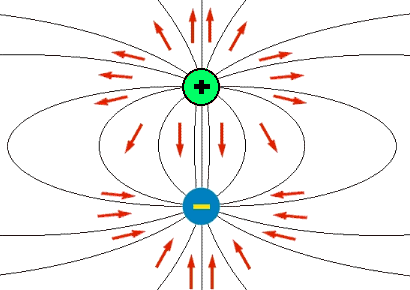
Polarity is the distribution of electric charge among the atoms or molecules that make up a substance. When atoms or molecules share electrons in a chemical bond, they may do so unequally, resulting in a partial positive charge on one end and a partial negative charge on the other end. This creates a dipole, or a pair of opposite charges separated by a distance.

The degree of polarity of a bond or a molecule depends on the difference in electronegativity between the atoms or groups involved. Electronegativity is a measure of how strongly an atom attracts electrons to itself. The more electronegative an atom is, the more it pulls electrons away from other atoms.

The polarity of a bond can be expressed by its dipole moment, which is the product of the charge difference and the distance between the charges. The polarity of a molecule can be expressed by its net dipole moment, which is the sum of all the individual bond dipoles in the molecule.

What are the types and examples of polarity?

Polarity can be classified into two main types: bond polarity and molecular polarity.

Bond polarity refers to the polarity of a single chemical bond between two atoms. A bond can be either polar or nonpolar, depending on the electronegativity difference between the atoms. A polar bond has a significant electronegativity difference, resulting in a partial positive charge on one atom and a partial negative charge on the other atom. A nonpolar bond has a negligible electronegativity difference, resulting in no charge separation.

For example, in a hydrogen-chlorine (H-Cl) bond, chlorine is more electronegative than hydrogen, so it pulls electrons away from hydrogen, creating a polar bond with a partial negative charge on chlorine and a partial positive charge on hydrogen. In contrast, in a hydrogen-hydrogen (H-H) bond, both hydrogen atoms have the same electronegativity, so they share electrons equally, creating a nonpolar bond with no charge separation.

Molecular polarity refers to the polarity of a whole molecule composed of multiple atoms or groups. A molecule can be either polar or nonpolar, depending on its shape and symmetry. A polar molecule has an asymmetrical shape and an uneven distribution of charge, resulting in a net dipole moment. A nonpolar molecule has a symmetrical shape and an even distribution of charge, resulting in no net dipole moment.

For example, water (H2O) is a polar molecule because it has a bent shape and two polar bonds that do not cancel each other out, creating a net dipole moment with a partial negative charge on oxygen and a partial positive charge on each hydrogen. In contrast, carbon dioxide (CO2) is a nonpolar molecule because it has a linear shape and two polar bonds that are opposite and equal to each other, canceling each other out and creating no net dipole moment.

Why is polarity important?

Polarity is important because it determines how substances interact with each other and with external forces. Some of the effects of polarity are:

Chemical polarity

Polarity affects solubility: Solubility is the ability of a substance to dissolve in another substance. Generally, substances with similar polarity tend to dissolve in each other, while substances with different polarity tend to repel each other. This is because polar substances attract each other through intermolecular forces such as hydrogen bonding, dipole-dipole interactions, and ion-dipole interactions, while nonpolar substances attract each other through weaker forces such as London dispersion forces. For example, water is polar and oil is nonpolar, so they do not mix well together.

Chemical polarity

Polarity affects melting point and boiling point: Melting point and boiling point are the temperatures at which a substance changes from solid to liquid and from liquid to gas respectively. Generally, substances with higher polarity tend to have higher melting points and boiling points than substances with lower polarity. This is because polar substances have stronger intermolecular forces that hold them together more tightly than nonpolar substances. For example, water has a higher boiling point than methane because water has stronger hydrogen bonds than methane has London dispersion forces.


Chemical polarity

Polarity affects conductivity

Conductivity is the ability of a substance to allow electric current to flow through it. Generally, substances with higher polarity tend to have lower conductivity than substances with lower polarity. This is because polar substances have more charge separation and more resistance to the movement of electrons than nonpolar substances. For example, water has a lower conductivity than copper because water has more charge separation and more resistance to the movement of electrons than copper.

(India CSR)

India Responsible Education & AI Summit 2026
ADVERTISEMENT
Ambedkar Chamber
ADVERTISEMENT
ESG Professional Network
ADVERTISEMENT
India Sustainability Awards 2026
ADVERTISEMENT
India CSR Image 1 India CSR Image 2
Tags: Polarity

CSR, Sustainability, and ESG success stories hindustan zinc
ADVERTISEMENT
India CSR

India CSR

India CSR is the largest media on CSR and sustainability offering diverse content across multisectoral issues on business responsibility. It covers Sustainable Development, Corporate Social Responsibility (CSR), Sustainability, and related issues in India. Founded in 2009, the organisation aspires to become a globally admired media that offers valuable information to its readers through responsible reporting.

Related Posts

India CSR
Words

What is Mahayuti or Mahayuti Alliance?

1 year ago
Bubble Wrap Appreciation Day
Important Days

Bubble Wrap Appreciation Day: Date, History, Significance, Celebrations and Important Facts

2 years ago
national puzzle day
Important Days

National Puzzle Day: The Definition, Characteristics, Role and Impact Explained

2 years ago
National Puzzle Day
Important Days

National Puzzle Day: Date, History, Significance, Celebrations and Important Facts

2 years ago
Bubble Wrap Appreciation Day
Important Days

Bubble Wrap Appreciation Day: The Definition, History, Characteristics, Role and Impact Explained

2 years ago
Kindness: The Key to Happiness and Well-being
Words

Kindness: The Key to Happiness and Well-being

3 years ago
Load More
India Responsible Education & AI Summit 2026
ADVERTISEMENT
Ambedkar Chamber
ADVERTISEMENT
India Sustainability Awards 2026
ADVERTISEMENT

LATEST NEWS

HunnyKhattar: The Artist and Strategist Working Behind Multiple Brands and Creative Platforms

Tech Jack: Trusted Laptop Store, Computer Store, and CCTV Dealer in Jaipur

R&D Veteran Dr. Vinod Dhanuka Launches iCosmétiques – A Science First Clean Beauty Brand 

Capyngen Private Limited Strengthens Its Position as a Growing IT Company in India’s Digital Economy

R.C. Reddy IAS Study Circle Produces Over 60 Successful Candidates in UPSC 2025

ABB Invests USD 75 Million in India to Expand Manufacturing and R&D for Critical Segments

Economy India Largest Media on Indian Economy and Business
ADVERTISEMENT
Ad 1 Ad 2 Ad 3
ADVERTISEMENT
ESG Professional Network
ADVERTISEMENT

TOP NEWS

Ballia Gets Its First E-Commerce Jewellery App: Dizilight India Private Limited Powers Digital Shift for DP Jeweller

Vantara Marks Foundation Day with Wildlife Rescue Milestones: PM Narendra Modi

Women’s Livelihood Participation Can Transform Local Economies

Simplify Your Finances and Pay Off Multiple Debts with a Personal Loan for Debt Consolidation

Nirmal Sarang’s Rise: From Visionary Thinker to a Voice for Youth Empowerment

CNEAR Launches AI-Powered Placement Platform ‘Falcon’ to Transform Campus Hiring and University Placement Management

Load More
STEM Learning STEM Learning STEM Learning
ADVERTISEMENT

Interviews

Prachi Kaushik, Founder and Director of Vyomini Social Enterprise
Interviews

Menstrual Hygiene Awareness Must Go Beyond Pad Distribution: Prachi Kaushik, Vyomini Social Enterprise

by India CSR
March 8, 2026

Prachi Kaushik on menstrual health awareness and empowering women through Vyomini initiatives.

Read moreDetails
Prerrit Mansingh, Secretary, Aayom Welfare Society

Scaling Compassion into Structured Social Change: An Interview with Prerrit Mansingh

February 28, 2026
Sheena Kapoor, Head – Marketing, Corporate Communication & CSR at ICICI Lombard

ICICI Lombard at 25: Sheena Kapoor on Promise-Led CSR and Lasting Impact

February 28, 2026
Arun Jain, Founder and CMD of Intellect and Founder of Mission Samriddhi

Design Thinking for Rural India: Arun Jain’s Civilisation Economics Model

February 28, 2026
Load More
Facebook Twitter Youtube LinkedIn Instagram
India CSR Logo

India CSR is the largest tech-led platform for information on CSR and sustainability in India offering diverse content across multisectoral issues. It covers Sustainable Development, Corporate Social Responsibility (CSR), Sustainability, and related issues in India. Founded in 2009, the organisation aspires to become a globally admired media that offers valuable information to its readers through responsible reporting. To enjoy the premium services, we invite you to partner with us.

Follow us on social media:


Dear Valued Reader

India CSR is a free media platform that provides up-to-date information on CSR, Sustainability, ESG, and SDGs. We need reader support to continue delivering honest news. Donations of any amount are appreciated.

Help save India CSR.

Donate Now

Donate at India CSR

  • About India CSR
  • Team
  • India CSR Awards 2025
  • India CSR Leadership Summit
  • India Responsible Education & AI Summit 2026
  • Partnership
  • Guest Posts
  • Services
  • ESG Professional Network
  • Content Writing Services
  • Business Information
  • Contact
  • Privacy Policy
  • Terms of Use
  • Donate

Copyright © 2025 - India CSR | All Rights Reserved

Welcome Back!

Login to your account below

Forgotten Password?

Retrieve your password

Please enter your username or email address to reset your password.

Log In
No Result
View All Result
  • Home
  • Corporate Social Responsibility
    • Art & Culture
    • CSR Leaders
    • Child Rights
    • Culture
    • Education
    • Gender Equality
    • Around the World
    • Skill Development
    • Safety
    • Covid-19
    • Safe Food For All
  • Sustainability
    • Sustainability Dialogues
    • Sustainability Knowledge Series
    • Plastics
    • Sustainable Development Goals
    • ESG
    • Circular Economy
    • BRSR
  • Corporate Governance
    • Diversity & Inclusion
  • Interviews
  • SDGs
    • No Poverty
    • Zero Hunger
    • Good Health & Well-Being
    • Quality Education
    • Gender Equality
    • Clean Water & Sanitation – SDG 6
    • Affordable & Clean Energy
    • Decent Work & Economic Growth
    • Industry, Innovation & Infrastructure
    • Reduced Inequalities
    • Sustainable Cities & Communities
    • Responsible Consumption & Production
    • Climate Action
    • Life Below Water
    • Life on Land
    • Peace, Justice & Strong Institutions
    • Partnerships for the Goals
  • Articles
  • Events
  • हिंदी
  • More
    • Business
    • Finance
    • Environment
    • Economy
    • Health
    • Around the World
    • Social Sector Leaders
    • Social Entrepreneurship
    • Trending News
      • Important Days
      • Great People
      • Product Review
      • International
      • Sports
      • Entertainment
    • Case Studies
    • Philanthropy
    • Biography
    • Technology
    • Lifestyle
    • Sports
    • Gaming
    • Knowledge
    • Home Improvement
    • Words Power
    • Chief Ministers

Copyright © 2025 - India CSR | All Rights Reserved

This website uses cookies. By continuing to use this website you are giving consent to cookies being used. Visit our Privacy and Cookie Policy.
Are you sure want to unlock this post?
Unlock left : 0
Are you sure want to cancel subscription?