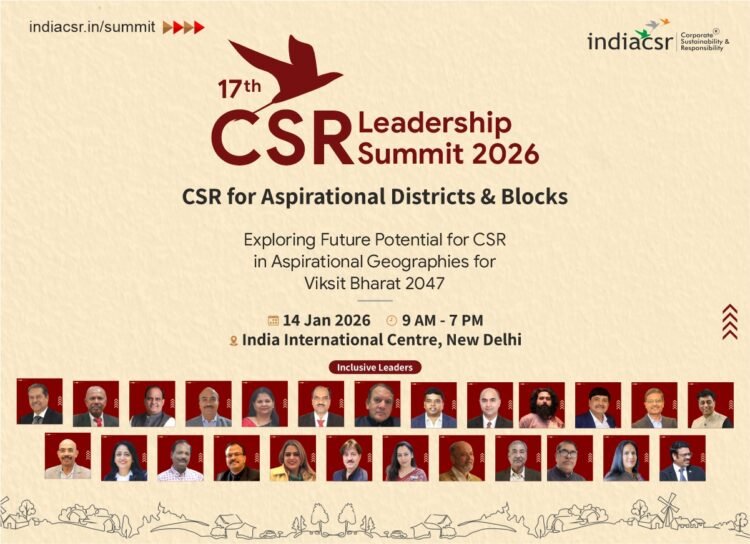



17th India CSR Summit on Jan 14 in New Delhi to Spotlight CSR Action for Aspirational Districts and Aspirational Blocks
Theme: CSR for Aspirational Districts and Blocks — Road for Viksit Bharat 2047
Date & Time: January 14, 2026 | 9:00 AM – 5:00 PM
Venue: India International Centre (IIC), New Delhi
Book your seat now I Last Chance
NEW DELHI: India’s Largest Media India CSR is organizing the 17th India CSR Summit on January 14, 2026, at the India International Centre (IIC), New Delhi. The summit is designed as a full-day platform where CSR decision-makers and development practitioners can align priorities for Aspirational Districts and Blocks—areas that demand focused interventions, measurable outcomes, and long-term partnerships. The theme highlights a forward-looking approach that connects CSR with the national development vision of Viksit Bharat 2047, with emphasis on inclusive growth and strengthening local ecosystems.
Registration and networking to set the tone for collaboration
The summit will open with Registration, Networking & Welcome Tea from 9:00 AM to 10:00 AM. This first hour is positioned as a practical space for participants to meet peers across corporate CSR, NGOs, and development leaders, and to begin conversations around partnerships, district-level priorities, and implementation realities. It also creates the early momentum of the day—where informal interactions often lead to serious collaboration opportunities later in the summit.
Inaugural Leadership Session
Setting the CSR vision for inclusive development
From 10:00 AM to 11:30 AM, the summit will host the Inaugural Leadership Session on “Setting the CSR Vision for Inclusive Development in Aspirational Districts and Blocks.” This session anchors the event by framing why aspirational geographies matter and how CSR can be aligned to outcomes such as livelihoods, education, health, and last-mile delivery. The objective is to move beyond isolated CSR projects and focus on coordinated, scalable approaches that strengthen systems on the ground.
The inaugural segment includes a Welcome Address by Rusen Kumar, Founder, India CSR. This opening sets the context of the summit’s purpose and expected outcomes, and establishes the development lens through which the day’s sessions will be viewed—especially the need for impact-led CSR that supports aspirational blocks and districts with continuity and clarity.
A Keynote Address will be delivered by Sita Ram Gupta, Rural Development Veteran, Rajasthan. The keynote is positioned to bring a practitioner’s understanding of rural realities—what works, what fails, and what CSR leaders should prioritize when they enter aspirational regions. Agenda – India CSR Summit 14 Ja… Such a keynote typically helps bridge the gap between boardroom intentions and field-level execution challenges.
The session also features a Special Address by Abhishek Ranjan (Joint Secretary – UNGC; Director & Global Head – Sustainability, Brillio). Agenda – India CSR Summit 14 Ja… This segment signals an emphasis on sustainability and responsible business approaches, linking CSR with broader ESG thinking and global sustainability frameworks—particularly useful for companies that want to connect district impact with measurable, reportable progress.
Participation is also listed from Anil Kumar Mahato (CSR, RVNL) and Meherram Gadekar (MSSRF – Jeypore). Their presence strengthens the mix of perspectives—corporate CSR implementation and social sector field expertise—both necessary to make aspirational region programs practical, locally grounded, and scalable.
Report release ceremony: Development insights from Bharatpur, Rajasthan
A significant highlight in the inaugural session is the Report Release Ceremony of “Socio-Economic Development of Bharatpur – Rajasthan,” documented by Samridh Bharat Abhiyan. A report release inside a summit like this is not symbolic—it adds evidence and local insight, and can inform CSR planning with grounded learning. It also provides a shared reference point for participants who want to understand district-level development needs and opportunities in a structured way.
Leadership Session 1: Future potential for CSR in aspirational geographies
From 11:30 AM to 12:00 PM, Leadership Session 1 will focus on “Opportunities Ahead: Future Potential for CSR in Aspirational Geographies.” The agenda identifies themes like skilling and employability, financial inclusion, MSME and enterprise development, and economic empowerment.
These focus areas reflect where aspirational districts often need structured support—building income pathways, strengthening local enterprise, and improving access to financial services and skills for youth and women.
This session includes voices such as Mangesh Wange (CEO, Swades Foundation), Satish Jha (Chairman, Edufront Technologies), Pratap Bhanu Singh (Former Advisor – CSR & Sustainability, IRCON), and Milind Chaudhary (General Secretary, Dr. APJ Abdul Kalam International Foundation). The speaker mix suggests the session will address both strategy and execution—how CSR can be designed to unlock community potential while ensuring partnerships and delivery structures remain strong.
The session will be chaired and moderated by Dr. Pratyush Panda, CEO, OneStage. A moderated session format enables sharper problem-solving—where panelists can move from broad perspectives to actionable ideas like what to fund, how to measure outcomes, and how to build multi-year plans in aspirational geographies.
Leadership Session 2: Unlocking latent potential in districts and blocks
From 12:00 PM to 12:30 PM, Leadership Session 2 will focus on unlocking latent potential in aspirational regions, with emphasis on strengthening rural livelihoods and enhancing local economies.
The session is designed to explore the “hidden” strengths of districts and blocks—local skills, community institutions, natural resources, and enterprise opportunities—and how CSR can nurture them through smart investments and long-term capacity building.
The panel includes Sushanta Kumar Bhuyan (Smile Foundation), Sireesh Kumar Ravipati (Faith Calling Foundation Trust), Kumari Manisha (VisionSpring Foundation), Vivek Prakash (SVP & Head – CSR, Jubilant Ingrevia Limited), and Ambika Prasad Nanda (Climate Action Volunteer; Former Head CSR Odisha, Tata Steel). This range supports a rich discussion: NGOs bring last-mile insight, corporate CSR brings scale and compliance strength, and climate-focused leadership adds resilience thinking—crucial for rural economies affected by environmental stress.
The moderation is listed under Prof. Rohan Sarma and Rusen Kumar. A joint moderation approach often helps keep a session balanced—one moderator can draw development depth while the other keeps CSR practicality and implementation focus on track.
Recognition ceremony: Honouring rural changemakers and CSR leadership
From 12:30 PM to 1:00 PM, the summit will host a Recognition segment for Rural Changemakers, CSR Leaders and Companies contributing to aspirational region development. Recognition segments play a strategic role: they spotlight replicable work, encourage standards of excellence, and motivate organizations to scale impactful models. They also help participants identify credible partners and programs that have demonstrated outcomes on the ground.
Networking lunch: Building partnerships beyond the panels
A Networking Lunch is scheduled from 1:00 PM to 2:00 PM. For CSR and NGO communities, lunch networking is often where serious discussions begin—about potential MoUs, joint project design, district adoption, monitoring frameworks, and how to align corporate budgets with community needs. It offers a reset before the second half of the day, which is built around innovation showcases and deeper sector role discussions.
Special Leadership Session 3: Innovation & good practices showcase
From 2:00 PM to 2:45 PM, the summit will present an Innovation & Good Practices Showcase, focusing on digital governance, development technologies, low-cost social innovations, and aspirational-region case studies. This session is meant to highlight solutions that are scalable and replicable, especially those that reduce cost, strengthen delivery, and improve transparency in impact implementation. It is also where participants can pick practical ideas—what innovations can be tried in a block, and what models can be adapted to different districts.
Speakers include Anuradha Patil (CEO, Cheshire Disability Trust), A.K. Soni (CSR and Development Sector Leader), Manisha Bhatia (Founder & CEO, Abhinandan Educational and Welfare Society), and Dhananjay Tingal (Executive Director, Association for Voluntary Action; National Coordinator – Just Rights for Children).
The diversity of backgrounds indicates a broad innovation lens—covering inclusion, social delivery, education/community work, and child rights—areas that intersect strongly with aspirational region priorities.
Moderation is again listed as Prof. Rohan Sarma. With innovations, moderation matters because it helps transform “good stories” into “usable models”—by asking how an approach was funded, what capacities were required, what challenges were faced, and what results were documented. Agenda – India CSR Summit 14 Ja…
Session 4 Panel: Role of NGOs and social sector in aspirational region development
From 2:45 PM to 3:45 PM, the summit will hold a panel on the Role of Social Sector/NGO in Aspirational Region Development. This session recognizes that CSR success in aspirational districts often depends on the social sector’s field presence, trust-building, community mobilization, and last-mile execution. It also provides space to discuss how NGOs can strengthen impact measurement, governance, transparency, and multi-stakeholder coordination in complex geographies.
Panelists listed include Dr. Neelam Gupta (Founder President & CEO, AROH Foundation), Pavan Kaushik (Author & Storyteller; Co-founder, Gurukshetra Consultancy Pvt. Ltd.), Dr. Shafia Wani (UT Lead J&K on CSR; Faculty, Jkimpard), and Arun Arora (Director, Chetak Foundation).
Their profiles suggest the discussion will bring practical, policy-aware, and community-centric viewpoints—useful for CSR leaders who want to work responsibly, reduce risks, and build credibility in aspirational districts and blocks.
Moderation will be led by Prof. Rohan Sarma. With NGO-focused panels, strong moderation helps align expectations—what corporates expect from implementing partners, what NGOs need for sustainable delivery, and how both sides can build accountability systems without weakening community trust.
Summit declaration and closing: Capturing outcomes and shared commitments
The summit will conclude from 3:45 PM to 4:30 PM with the Summit Declaration & Closing, including key takeaways, adoption of a declaration for aspirational districts and blocks, a group photograph, and formal closing. This closing segment is intended to convert discussions into a shared direction—what the community agrees to prioritize, what commitments are most urgent, and what lessons should guide CSR in aspirational regions going forward. A declaration also helps set continuity beyond a single event, encouraging follow-up actions, partnerships, and measurable CSR programs aligned to local needs.
Book your seat now I Last Chance