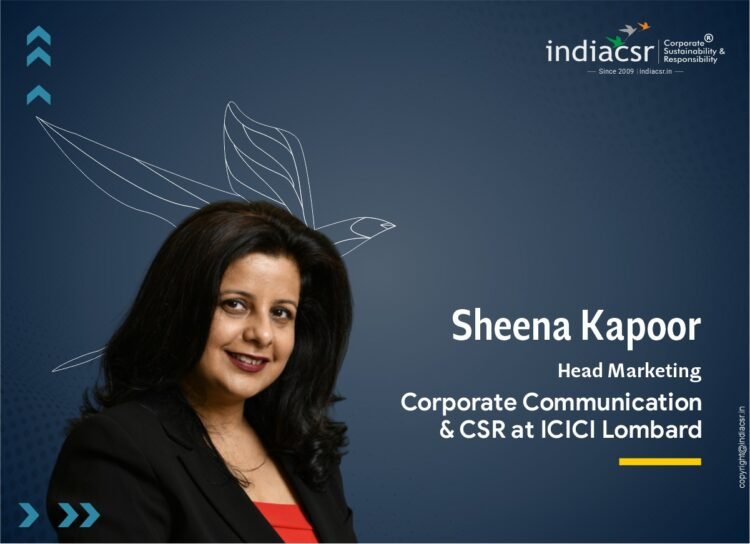


Sheena Kapoor on Scaling Impact Through Road Safety, Child Health and Sustainability
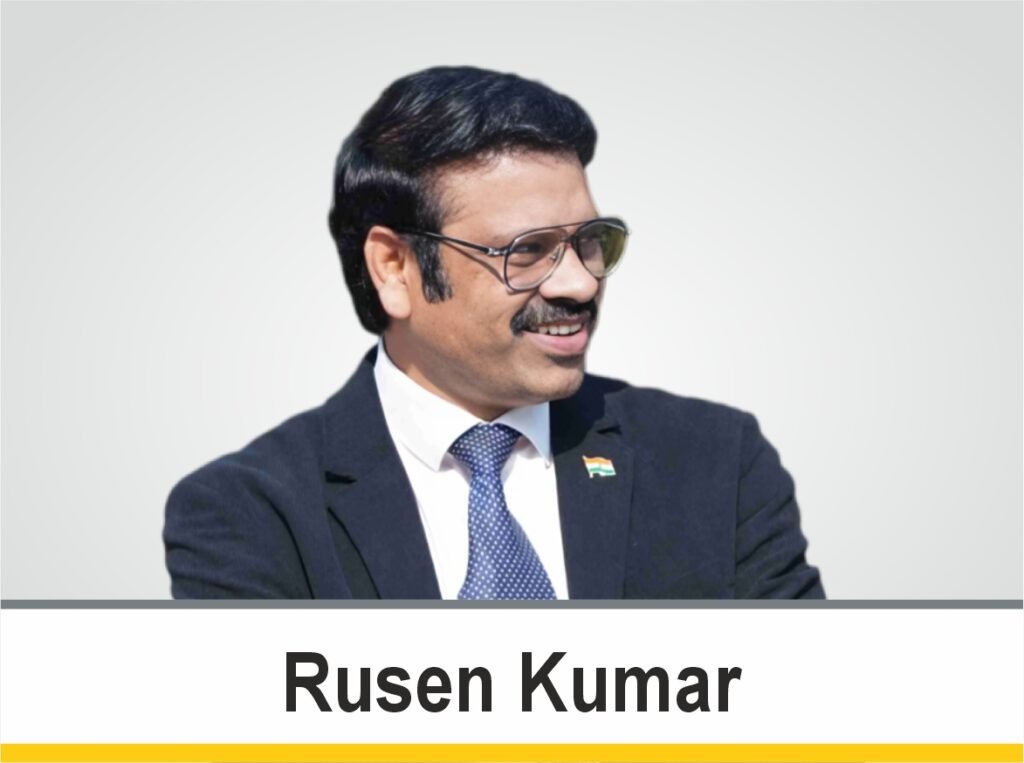
By Rusen Kumar
NEW DELHI (India CSR): In this exclusive interview, Rusen Kumar, Managing Editor, India CSR, speaks with Sheena Kapoor, Head – Marketing, Corporate Communication & CSR at ICICI Lombard, as the company marks 25 years of its enduring philosophy, “Nibhaye Vaade” — keeping promises. Beyond business milestones, the conversation explores how this promise-led ethos has shaped ICICI Lombard’s evolving CSR strategy, embedding prevention, protection, and resilience at the heart of its social responsibility efforts.
Sheena Kapoor reflects on how two-and-a-half decades of risk management expertise have influenced the company’s approach to community impact — shifting from reactive support to preventive, long-term interventions. From the employee-led Caring Hands programme improving child eye health across 2,000+ schools, to the expansive Road to Safety initiative promoting behavioural change and zero-fatality solutions, ICICI Lombard’s CSR journey demonstrates scale with depth. Initiatives like Niranjali and solar panel installations further reflect a commitment to environmental sustainability and rural infrastructure strengthening.
1. As ICICI Lombard celebrates 25 years of keeping promises, how do you see the legacy of these two-and-a-half decades shaping the way the company approaches CSR today and in the future?
As ICICI Lombard marks 25 years, the philosophy of “Nibhaye Vaade”, keeping promises remains central not only to our business but to our responsibility as a corporate citizen.
Over these two-and-a-half decades, our understanding of impact has matured. We have learned that protection should not begin only after an incident occurs; it must start much earlier. This belief has profoundly shaped our CSR strategy.
Since 2015, our Road Safety efforts are focusing on protecting lives on the road, working across the continuum of awareness, prevention and rehabilitation. The programme has evolved from awareness workshops into a comprehensive engagement model that includes helmet distribution, behavioural change efforts, working towards Zero fatality solutions and rehabilitation of accident victims.
Caring Hands, our longest running CSR programme, since 2011 has been providing preventive eye care to underprivileged school children improving their quality of life. The core of this programme are our employees- as it is 100% employees led – with them leading the end to end management of these check-up camps.
To date we have touched over 3 million lives through the programmes directly implemented by ICICI Lombard. We also work with ICICI Foundation, the CSR arm of ICICI group. The Foundation has been working in the area of healthcare, environment & ecology, livelihood and communities – focusing on scale, impact and ecosystem capacity creation leading to sustainable development. The Foundation has thus far impacted close to 20 million lives through their multiple initiatives.
Looking ahead, the past 25 years have taught us a simple but powerful lesson: social responsibility must be steady, relevant and aligned with what we understand best as an insurer-risk, prevention and resilience.
2. Over the last 25 years, which CSR achievement stands out as the most defining milestone during this journey?
At ICICI Lombard, we see each of our CSR initiatives as an achievement in its own right—because every programme represents a sustained commitment to prevention, protection and progress.
Caring Hands has become a cornerstone of this journey. Since 2011, it has screened over 5,00,000+ children across more than 2,000 schools and provided over 50,000+ spectacles to those diagnosed with refractive errors. By addressing uncorrected vision at an early stage, the initiative removes a silent barrier to learning and confidence, enabling long-term educational impact. Its employee-led model—with over 3,000+ volunteers participating in nationwide camps in a single day—reflects deep organisational ownership and purpose.
At the same time, our broader CSR portfolio reflects equally meaningful milestones. Through Road to Safety, we have advanced behavioural change in road safety and distributed over 6,00,000 helmets and impacted 10,00,000+ lives. Through Niranjali, we have enabled access to safe drinking water across thousands of schools installing 4,660+ water purifiers. We have installed 600+Solar Panels in government schools strengthen environmental responsibility while improving learning infrastructure and impacting 1,50,000 lives
Together, these initiatives underscore a shared philosophy: that sustained, preventive and thoughtfully executed interventions create enduring value. Each programme, in its own way, represents a defining achievement in our ongoing commitment to impact lives responsibly and at scale.
3. With CSR becoming more integrated with business strategy through an ESG-driven approach, how is ICICI Lombard aligning impact with long-term sustainability expectations from stakeholders?
At ICICI Lombard, our CSR approach has evolved along with the company’s broader focus on environmental, social and governance priorities, and this evolution is reflected in how we define, govern and deliver our programmes.
As a general insurer, we see risk management as part of both our business and our social contribution. That perspective naturally lends itself to preventive, long-term interventions rather than just addressing needs after they arise. Our CSR strategy focuses on social inclusion, health and wellness, environment & ecology areas where we believe sustained effort can make a meaningful difference in people’s lives.
We have a CSR & Sustainability Committee that guides the scope and delivery of our initiatives, emphasising on designing and implementing initiatives that are consistent, relevant and responsive to stakeholder expectations, and that contribute to sustainable, long-term impact rather than short-term outcomes
Our programmes collectively benefit communities over time. Initiatives such as Caring Hands, Road to Safety, Niranjali, Solar Panel and Healthy Villages initiatives have reached millions of lives since inception, and this cumulative impact reflects an intentional focus on continuity and depth rather than one-off activity.
4. The Caring Hands program has reached over 500,000 children across 2,000+ schools. Beyond scale, how does ICICI Lombard think about deepening the quality of impact within child health interventions?
The real focus of Caring Hands has always been meaningful correction rather than only numerical outreach.
Deepening quality begins with recognising that uncorrected vision is not just a medical issue, but an educational and developmental one. A child who cannot see clearly often falls behind in class, sometimes without understanding why. That understanding shapes how the programme is designed. The emphasis is on early detection, accurate diagnosis and timely intervention.
Each screening camp is conducted in partnership with qualified ophthalmologists, ensuring clinical reliability. Children identified with refractive errors are provided spectacles, the objective is to ensure that the intervention translates into improved learning ability and confidence in the classroom.
Another important dimension of quality is consistency. Caring Hands has been sustained since 2011, and that continuity has allowed us to refine execution year after year. The camps are carefully planned in advance and conducted nationwide on a single day, reflecting coordinated effort and operational discipline. This structure helps maintain uniform standards across locations.
Employee involvement also strengthens quality. Volunteers are not peripheral participants; they take ownership of coordination and execution. That ownership ensures attention to detail and personal commitment at the ground level.
In 2025, we added a yet another dimension to Caring Hands – the programme was extended to our channel partners – giving them an opportunity to volunteer and participate to make a meaningful difference.
5. ICICI Lombard’s Road to Safety initiative has demonstrated measurable behavioural change. How does the company evaluate opportunities to broaden road safety engagement while retaining measurable impact?
Our Road Safety efforts are designed to be synergistic with our motor insurance business – both focusing on protecting lives on the road. In road safety we work across the continuum – awareness, prevention and rehabilitation.
At ICICI Lombard, road safety interventions are anchored in behavioural change – equipping under privileged children and their parents with safety helmets, educating on safe driving practices and on-ground engagement programmes ensuring understanding translates into real-life practices.
Over time, our approach has evolved to address road safety in a more integrated and ecosystem-driven manner. This includes expanding into Zero Fatality Corridor initiatives, where we work across awareness, infrastructure augmentation, enforcement support and multi-stakeholder collaboration. These initiatives focus on high-risk corridors and aim to reduce accident severity and fatalities rather than operate as standalone campaigns.
We also support accident victims with rehabilitation support, providing them the required care to get back to normalcy.
Our belief is simple: every life is important, and scale is meaningful only when it delivers measurable impact on road safety outcomes.
6. With solar panel installations benefiting over 150,000 children, what principles guide ICICI Lombard when deciding which sustainability-led interventions to scale further?
Our sustainability initiatives are guided by long-term relevance, community need and sustained functionality.
Solar panel installations in government schools serve a dual purpose: reducing greenhouse gas emissions while improving access to reliable electricity in classrooms. To date, over 600 solar panels have been installed and over1,50,000 lives impacted.
When evaluating further expansion, we look beyond numerical reach. We assess the readiness of the school infrastructure, the ability to maintain the systems over time and the degree to which the intervention will meaningfully improve the learning environment. Sustainability-led initiatives require continuity, and therefore local ecosystem engagement becomes important in ensuring that installations remain functional and beneficial.
7. Initiatives like Niranjali highlight rural impact. How do you assess community readiness before deploying scale-based interventions?
Community engagement and preparedness are essential before any scale-based intervention is implemented.
Niranjali focuses on the installation of water purifiers in government-run schools with the objective of reducing the incidence of water-borne diseases and improving access to safe drinking water. To date, this initiativehas installed 4,660+ water purifiers the initiative has positively impacted students across more than 4,600 schools.
Before installation, coordination takes place with school authorities to assess infrastructure conditions, water availability and the ability to support ongoing usage. The emphasis is on ensuring that the intervention can be maintained effectively and continues to deliver health benefits over time.
We evaluate whether the local ecosystem is prepared to support long-term functionality, whether basic operational requirements are in place and whether the intervention addresses a clear community need.
8. How is ICICI Lombard incorporating digital tools into its CSR initiatives?
Digital tools have been enhancing coordination, tracking and transparency across our programmes.
We have deployed a CSR dashboard that enables NGO partners to update and access data in real time. This helps provide a high-level overview of work done, impact achieved, and investments made. The data also supports better decision-making by offering visibility into progress and outcomes across initiatives.
9. What internal culture practices help sustain strong employee participation in CSR?
Employee participation thrives because CSR is seen as shared purpose, not delegated responsibility. Programmes such as Caring Hands are volunteer-driven. Participation is voluntary, preserving authenticity and ownership.
At ICICI Lombard, the organisational philosophy of “One IL One Team” also plays an important role. Collaboration across functions is already part of how we operate as an organisation, and that same spirit carries into CSR initiatives. Working together towardscollective goals is a part of the organisational DNA, making collective participation in Caring Hands a natural extension
Further, the programmes when conducted year after year, builds familiarity and confidence in the process. Over time, CSR engagement has become part of the organisational rhythm. It is seen as an opportunity to contribute meaningfully, rather than as an additional responsibility.
10. What emerging societal priorities must responsible corporates prepare for?
Several societal priorities are becoming increasingly visible and require sustained attention.
Climate resilience is one such area. Environmental sustainability is no longer limited to compliance. It calls for practical interventions that improve resource efficiency and encourage responsible energy use, particularly in institutions and communities that may not otherwise have access to such solutions.
Preventive healthcare is another important priority. Early detection and timely intervention can significantly improve long-term outcomes, especially among children and underserved communities.
Behavioural safety, particularly road safety, continues to demand attention and requires ecosystem-wide collaboration.
For responsible corporates, the focus may need to shift from short-term outreach to consistent engagement for deeper and more meaningful outcomes.
11. What key learnings from the past 25 years will influence ICICI Lombard’s CSR philosophy going forward?
Over the past 25 years, one of the most consistent learnings has been the value of continuity. Sustained engagement tends to create deeper and more meaningful outcomes. Programmes such as Caring Hands and our road safety initiatives have evolved gradually over time, and that continuity has helped build familiarity and trust within communities.
Another important learning has been the importance of prevention. Addressing risk before it becomes a crisis often creates longer-term value. Preventive approaches may not always produce immediate visibility, but they tend to create lasting impact. Employee involvement has also shaped our thinking. When initiatives are driven by volunteers within the organisation, the engagement becomes more grounded and authentic.
Our work through ICICI Foundation, the CSR arm of ICICI group also focuses on projects of impact and scale in the area of healthcare, environment & ecology and livelihoods.
Going forward, the emphasis will remain on projects that can have long-term and sustained impact, aligned with our broader responsibility as a general insurer.
12. What has been your most personally inspiring moment in leading these initiatives?
One of the most inspiring moments has been witnessing thousands of colleagues across the country unite on the day of Caring Hands camps.
Seeing employees step beyond their formal roles, leading the Caring Hands camps from the front is a reflection of purpose in action. The moment a child wears spectacles for the first time and realises they can see clearly is profoundly moving. That quiet transformation embodies why prevention matters.
As a leader, frameworks and governance are important. But when purpose becomes culture and when people volunteer not because they must, but because they believe that is deeply inspiring.
Those moments reaffirm that our impact extends beyond metrics and is a shared responsibility.
13. As a leader managing marketing, corporate communications, and CSR, how do you balance brand-building with authentic social impact?
For me, authenticity has to remain central. CSR initiatives are most credible when they are aligned with the organisation’s core purpose. As a general insurer, our focus on prevention and protection naturally extends into areas such as road safety and early health screening. That alignment helps ensure that initiatives are grounded in what we understand and can contribute meaningfully.
From a communications perspective, the role is to present the work transparently, emphasising on sharing what has been done, how it has been implemented and outcomes and impact thereof.
Over time, when programmes are sustained consistently, trust tends to build on its own, making brand equity, a by-product of responsible action rather than the starting objective.
***
About Rusen Kumar
Rusen Kumar is a distinguished journalist, author, and visionary knowledge entrepreneur specializing in Corporate Social Responsibility (CSR) and sustainability in India. He is the founder and managing editor of India CSR Network, a leading platform dedicated to CSR and sustainability issues.
Copyright@IndiaCSR
Showcase your CSR achievements and share your insights with India’s leading CSR platform.
Contact us at biz@indiacsr.in I 9981099555 to feature your success stories and interviews.