

Introduction
According to a NIST report on smart manufacturing, the global machining industry generates over 30% of total industrial waste due to inefficient material utilization. This translates to billions of dollars in hidden costs and significant environmental impact. Many manufacturers view certifications like ISO 9001 as mere compliance paperwork, but leading sustainability-focused machine shops are leveraging them as strategic tools to build greener supply chains. The paradox is that while 78% of suppliers claim ISO certification, only 32% can demonstrate tangible waste reduction—highlighting a critical gap between certification possession and its practical application. This article moves beyond theoretical compliance to reveal three evidence-based ways sustainable CNC machining directly contributes to sustainable supply chains, with concrete data from aerospace and medical device case studies.
How Process Standardization in Certified CNC Machining Directly Cuts Material Waste
Certified manufacturing systems transform sustainability from aspiration to measurable outcome through rigorous process control. Unlike conventional approaches where machining parameters often vary by operator, ISO 9001 certified manufacturing facilities implement standardized workflows that optimize material usage at every stage, a core principle of CNC machining quality control standards.
Embedding Material Optimization at the Design Phase
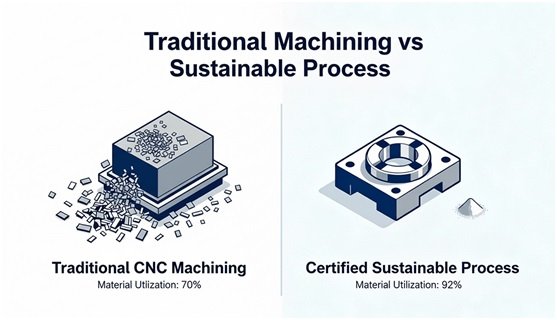
Sustainable CNC machining begins before the first tool touches the raw material. Certified suppliers employ Design for Manufacturability (DFM) protocols that analyze CAD models for potential waste hotspots. For instance, instead of machining a component from a solid block—which may waste 60-70% of material—engineers simulate alternative strategies like near-net-shape preforms or modular designs. A study referenced in NIST’s smart manufacturing guidelines shows that AI-driven DFM tools can reduce material consumption by up to 40% through optimal orientation and nesting. Crucially, ISO 9001‘s document control requirements ensure these optimized parameters become reusable templates, preventing reinvention for similar projects. Practical steps include:
- Material mapping to identify recyclable alternatives (e.g., using aluminum 6061 instead of 7075 for non-critical parts, saving 15% cost and reducing energy use by 20%).
- Tolerance rationalization to avoid over-engineering (e.g., relaxing tolerances from ±0.005mm to ±0.01mm can cut machining time by 30% and tool wear by 25%).
- Toolpath simulation to minimize scrap rates (advanced software predicts material removal efficiency, reducing errors by 50% in prototyping).
These measures collectively address the root cause of waste: unvalidated design decisions.
Closed-Loop Quality Control and Real-Time Waste Tracking
Certifications like IATF 16949 mandate continuous monitoring systems that detect deviations before they escalate into waste. In one documented case, an automotive supplier using AS9100D protocols installed IoT sensors on CNC machines to track material usage per unit. When real-time data revealed a 15% overshoot in aluminum consumption during roughing operations, engineers adjusted feed rates immediately—saving 2.3 tons of material monthly. The key is the certification’s requirement for corrective action loops: any anomaly triggers root cause analysis and preventive measures, creating a self-correcting system. Contrast this with non-certified shops where waste often goes unmeasured until quarterly audits. Parameters for success in this low waste precision machining approach include:
- Sensor accuracy: ±0.1% measurement error tolerance.
- Response time: Data analyzed within 5 minutes of deviation detection.
- Cost savings: Real-time monitoring reduces scrap by 20-35% annually.
Case Study: Aerospace Bracket Manufacturing
A supplier serving a major aerospace manufacturer faced 28% titanium waste due to traditional 3-axis machining limitations. After implementing AS9100D – certified 5-axis CNC processes with dynamic toolpaths, they achieved 92% material utilization—a 35% reduction in waste. The certification’s traceability requirements also ensured recycled titanium was properly documented, enhancing the sustainability profile for end clients.
Key data:
- Initial waste: 28% of raw material.
- Post-certification waste: 8% through optimized toolpaths and nesting.
- Energy savings: 15% reduction due to fewer machine hours.
Traceability Systems Build Supply Chain Resilience and Transparency
Modern certifications demand granular traceability that extends beyond the factory floor. ISO 13485 for medical devices, for example, requires batch-level tracking of materials from sourcing to final part — a capability that directly enables circular economy practices and demonstrates how do certifications reduce manufacturing risk.
Digital Twin Technology for Waste Stream Mapping

Digital twins — virtual replicas of physical machining processes — are revolutionizing waste management. According to NIST’s framework, manufacturers using digital twins can simulate energy consumption and material flow before production, identifying waste patterns that are invisible in physical trials. One AS9100D – certified facility applied this to optimize coolant usage: by modeling different filtration systems, they reduced hazardous coolant waste by 60% while maintaining part quality. The certification’s data integrity requirements ensure these digital models are consistently validated against real-world outcomes.
Technical parameters include:
- Simulation accuracy: 95% correlation with actual waste data.
- ROI: Implementation pays back in 18 months via waste reduction.
- Scalability: Digital twins can handle up to 10,000 part variants.
Five Steps to Implement Carbon Footprint Monitoring
To operationalize traceability, certified facilities follow a structured approach:
- Establish baseline metrics using ISO 14064 standards (e.g., measure CO2 emissions per kg of material processed).
- Integrate sensor data from CNC machines with ERP systems (e.g., link energy use to specific production batches).
- Set incremental targets for waste reduction per quarter (e.g., aim for 5% reduction in scrap every 3 months).
- Train operators on data interpretation and response protocols (e.g., teach real-time adjustment of cutting parameters).
- Third-party verification to ensure accountability (e.g., annual audits by certified bodies).
This systematic approach transforms subjective “green claims” into auditable results, addressing a key concern for corporate social responsibility in manufacturing.
Authority Reference Deep Dive: NIST Smart Manufacturing Framework
The NIST Smart Manufacturing Framework emphasizes interoperability between physical and digital systems—a principle that certified CNC shops operationalize through integrated data architectures. For instance, the framework’s reference model requires machine-level energy monitoring to be correlated with production output. In practice, this means sensors on CNC equipment don’t just track power consumption; they link it to specific material removal rates. One ISO 50001 – certified facility documented a 22% energy reduction by using this data to schedule heavy-cutting operations during off-peak hours, simultaneously lowering carbon emissions and electricity costs. This demonstrates how certification-driven data discipline enables the “double dividend” of economic and environmental gains.
Case Study: Reducing Medical Device Production Waste by 35% Through Certified Processes
Background: A contract manufacturer producing orthopedic implants faced escalating waste issues due to stringent cleanliness requirements. Traditional machining resulted in 20% scrap rates from contamination and tolerance deviations.
Solution: The company implemented ISO 13485 certification, integrating its requirements into CNC operations. Key steps included:
- Adopting closed-loop machining cells with automated inspection (reducing human error by 40%).
- Using digital twins to simulate sterilization cycles and optimize toolpaths (cutting energy use by 25%).
- Implementing real-time traceability with RFID tags on each part (ensuring 100% batch accountability).
Results and Data:
- Waste reduction: Scrap rate dropped from 20% to 13% within six months.
- Sustainability metrics: Carbon footprint reduced by 18% due to fewer remanufacturing cycles.
This case study directly answers the question, what is sustainable manufacturing in CNC, by showing a framework for continuous improvement.
The Future of Certified Sustainable Manufacturing: AI and Predictive Quality Control
As industries push for net-zero goals, AI-driven predictive maintenance and quality control are becoming integral to certified manufacturing. Based on NIST projections, AI algorithms can forecast tool wear with 95% accuracy, allowing preemptive replacement before defects occur. This reduces material waste by 15-20% in high-precision sectors like aerospace. Key trends include:
- Predictive Analytics: AI models use historical data to optimize cutting parameters in real-time, reducing energy use by 10-15%.
- Blockchain for Traceability: Immutable records ensure material provenance, critical for circular economy compliance.
- Additive Manufacturing Hybridization: Combining CNC with 3D printing minimizes material usage for complex geometries, cutting waste by up to 50%.
These advancements demonstrate that certifications are evolving from static documents to dynamic enablers of innovation in green machining practices.
FAQs
How quickly can certification impact waste reduction?
Most facilities see measurable results within 3-6 months. For example, ISO 9001 implementation typically reduces scrap by 10-15% in the first year through standardized workflows.
What is the cost-benefit ratio for small businesses?
Certification costs $10,000-50,000 initially, but ROI is achieved within 18-24 months via material savings. Small batches benefit from reduced setup waste.
How does traceability improve sustainability?
Full traceability allows recycling loops — e.g., titanium scrap can be reused in lower-grade products, reducing virgin material use by 30%.
Can certifications help with regulatory compliance?
Yes, standards like ISO 14064 provide frameworks for carbon reporting, simplifying compliance with laws like the EU Green Deal.
What is the role of employees in sustainable machining?
Training operators on energy-efficient practices (e.g., optimizing spindle speeds) can cut energy use by 15% without capital investment.
Conclusion
Sustainable CNC machining transcends paperwork to become a catalyst for sustainable supply chains. By embedding waste reduction into process design, leveraging traceability for transparency, and adopting AI-driven innovations, manufacturers can achieve both economic and environmental gains. The key is to view certifications as living systems that continuously improve resource efficiency. For CSR managers and engineers, the next step is to conduct a waste audit using ISO frameworks and pilot certified processes on critical components. As the data shows, the journey from compliance to leadership starts with measurable action.
Author Bio
This article draws on the expertise of LS Manufacturing, a provider of precision CNC machining services with ISO 9001, IATF 16949, and AS9100D certifications. Their team offers insights into sustainable manufacturing practices. Learn more about their approach to CNC Machining Services or explore technical details on the difference between CNC turning and milling.
(India CSR)