

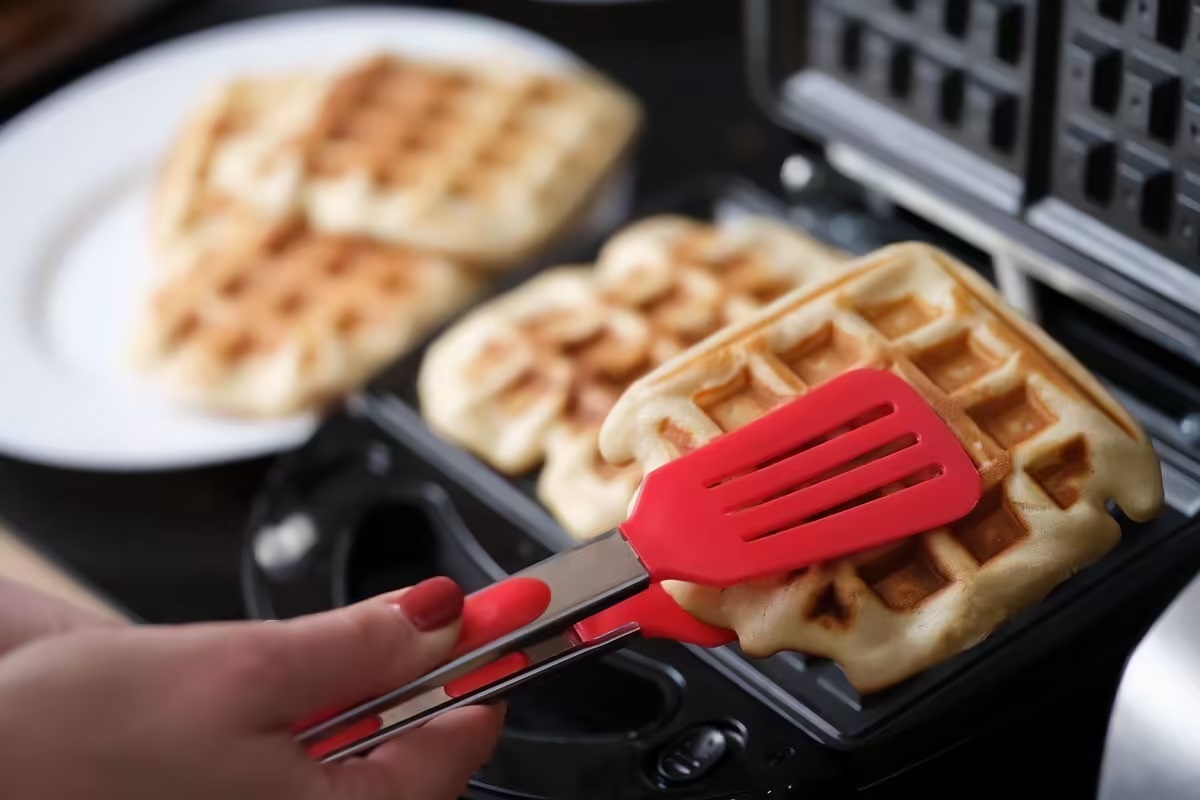


Crispy waffles can become unsold food for very different reasons. Some emerge from the iron with the wrong texture; others are acceptable until a stack, a covered tray or an early topping changes the surface. Calling all of those pieces waste tells a business how much it discarded. It does not explain where to act. For a café or small food producer, the useful question is when the product stopped meeting its intended purpose.
A practical reduction effort follows the waffle from batter preparation to service and separates avoidable process losses from uncertain food that must be discarded. That boundary matters. Saving a piece is never a reason to overlook its handling history, and a better-looking surface does not establish that food is safe to serve.
Put a reason beside each discarded portion
Begin with a short observation period during normal work. Ask staff to record the stage and the reason when a waffle is rejected. Useful descriptions include incomplete filling, tearing on release, unacceptable colour, a texture complaint after holding, and more portions prepared than customers wanted. Keep the language concrete enough that another shift would recognise the same event.
Do not combine batter left in a vessel with finished pieces sent back from the counter unless the record clearly separates those streams. The causes and possible responses differ. Likewise, record damaged product separately from product with an uncertain safety history. A manager should be able to see which issues belong to portion control, equipment condition, demand planning or food handling.
UDTECH’s food guides treat baking, cooling and the final texture as connected parts of a process. That makes a useful starting point for a loss record. If crispness is assessed only beside the waffle iron, staff can miss changes that happen between release and service, then keep adjusting a recipe that was not responsible for the original complaint.
Distinguish a soft start from a soft finish
Compare a piece at release with a piece after the intended service interval, using a consistent and safe evaluation method. If the centre or surface is already outside the agreed description at release, investigate the batter, deposit, baking conditions and appliance operation. If the result changes later, the post-bake route deserves attention first.
King Arthur Baking advises placing cooked waffles on a rack to cool before storage, allowing steam to escape rather than making the waffles soggy. The broader practical lesson is to inspect where moisture is being trapped. A tray piled high, a tightly covered container and a plate beneath a wet topping expose a waffle to different conditions.
Test the actual serving arrangement. A plain sample resting alone does not represent a waffle covered with sauce and carried across a busy dining room. Write down the topping, the order of assembly and the interval before service. Otherwise, an apparent change in the recipe may simply reflect which sample received syrup first.
Use modest comparisons instead of changing the whole routine
Choose a manageable question. For example, compare the existing holding arrangement with a spaced arrangement while keeping the recipe, portion and cooking method unchanged. Label the samples, agree on the evaluation point and note anything unusual that happened. The purpose is to learn whether a change is worth testing again, not to prove a general law from a single breakfast.
Invite the people who do the work to describe the awkward parts. Perhaps there is nowhere to put a rack, customers arrive in bursts, or the person topping waffles also takes payment. A technically sensible instruction that cannot fit the service layout may be abandoned within a morning. Look for a change that staff can actually repeat.
For an illustrative tally, suppose 80 waffles are produced and 8 are rejected for a texture problem. The recorded rejection fraction is 10%. If a later trial produces 80 and rejects 4, that trial has a 5% fraction. Those are arithmetic examples, not measured outcomes or a promised reduction. Different demand, staff or ingredients could explain part of a real change, so retain the context and repeat the comparison.
Bring batter preparation into the waste record
Inconsistent portions can make the same bowl seem like several recipes. Record how batter is dispensed and whether the deposit changes near the end of a batch. Overfilling may cause overflow; underfilling may produce a shape that cannot be sold as intended. Neither problem is usefully described only as poor quality.
Check ingredient changes as well. A new flour, a different measuring method or an unrecorded substitution can alter a familiar routine. Keep the recipe version with the batch record and make substitutions visible. When staff improvise separately, comparing the results becomes difficult even if each person’s decision seemed reasonable at the time.
Mixing and waiting belong on the same page. Record the sequence used for the batter and follow the recipe’s handling instructions. Do not extend a holding period merely because the mixture still looks normal. Any change to the food-safety process needs a suitable basis; a texture test cannot supply that basis on its own.
Separate loss causes before choosing an action
| Loss recorded | Useful investigation | Boundary |
| Uneven or incomplete waffle | Deposit and baking consistency | Do not assume a single cause |
| Crispness lost before service | Spacing, covering and topping sequence | Use the intended serving condition |
| Too many portions prepared | Demand pattern and batch size | Keep safe handling limits intact |
| Uncertain storage history | Handling records and staff training | Appearance cannot establish safety |
Match preparation to the way customers arrive
Overproduction is a different problem from a failed bake. Record demand across the service period rather than using only the daily total. A morning with a sharp rush followed by a quiet hour may need a different preparation pattern from a steady stream of orders, even if both mornings sell the same number of portions.
Compare smaller preparation batches with the labour they require. Fewer ready-made portions may reduce unwanted leftovers but create a longer queue. That is a trade-off to measure, not a reason to announce that smaller batches are always better. Ask staff to note the queue, the amount waiting and the number of portions rejected during the same interval.
Where a texture problem crosses several stages, the food and texture guides from UDTECH can help frame the next questions about batter, baking and crisp snacks. Use them to organise an investigation around the food being made. They do not provide a business-specific waste baseline or evidence for a claimed environmental saving.
Report the result without overstating the benefit
Keep the first report modest: what was observed, what changed, how many portions were produced, and which losses remained. If a comparison was limited to a short run, say so. A reduction in discarded waffles does not automatically establish a quantified reduction in emissions, water use or annual cost. Those claims need their own measurements and boundaries.
UDTECH’s emphasis on production trials is relevant to this final step because a useful record includes unsuccessful samples as well as attractive ones. Retaining the failed conditions helps the next shift avoid repeating them. It also prevents a later recipe or packaging change from quietly invalidating a result that management still treats as settled.
- Keep texture defects separate from overproduction and safety-related disposal.
- Check the same stage of the process when comparing batches.
- Record ingredient and handling changes with the result.
- Count accepted portions alongside total portions made.
- Review whether the change is repeatable before expanding it.
Less waste starts with a clearer explanation of the loss. When a team knows whether the problem begins in the batter, on the plates or during service, it can choose a smaller and more credible intervention. The result is a practical learning loop, with food quality and safe handling kept inside the same decision.



