

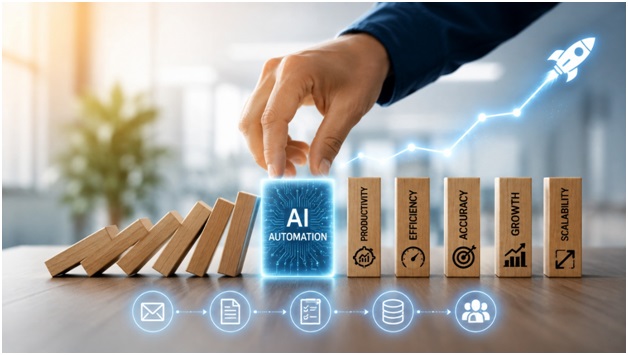


Every growing business eventually hits the same wall: revenue keeps climbing, but the manual work required to support it climbs just as fast. Someone has to answer every support ticket, chase every invoice, and re-enter the same customer data into three different tools. For a long time, the only fix was hiring more people to keep pace. That’s changing — a growing number of companies are now solving the same problem with technology instead of headcount, and it’s why AI automation services by IM Digital have moved from a nice-to-have to a core part of how modern businesses plan for scale. The shift isn’t about replacing people — it’s about removing the repetitive work that was never a good use of their time in the first place. The businesses adapting fastest are the ones treating automation as core infrastructure rather than a one-off project bolted onto an existing team.
How AI Automation Reduces Repetitive Work
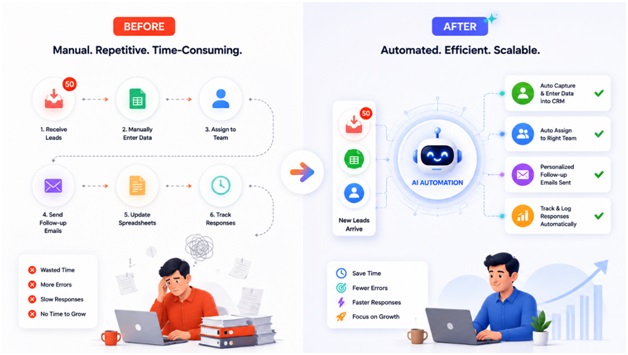
Most operational bottlenecks don’t come from one big broken process — they come from dozens of small, repetitive tasks that quietly eat up a team’s day: manually sorting inbound leads, copying data between spreadsheets and a CRM, or sending the same follow-up email fifty different times with slightly different names filled in. Individually, each task takes minutes; multiplied across a growing customer base, they consume entire job functions. IM Digital AI automation work typically starts by mapping exactly where this repetition lives, then building automated workflows and AI agents that handle it without a person needing to trigger every step manually. The result isn’t just time saved — it’s fewer errors, faster response times, and a team that spends its energy on decisions that actually require human judgment instead of data entry.
Role of Custom Software in Business Scalability
Automation only goes so far when it’s layered on top of software that wasn’t built to support it. Off-the-shelf tools are useful early on, but they tend to break down once a business has workflows, data structures, or customer requirements that don’t fit a generic template. This is where custom software development by IM Digital becomes less of a luxury and more of a structural necessity — purpose-built systems can scale alongside a business instead of forcing that business to work around software limitations. A custom-built platform can connect directly to automation tools, expose the right data to the right teams, and adapt as processes change, rather than requiring a workaround every time the business outgrows what a generic tool was designed to handle.
AI Agents, CRM Systems, and Business Process Automation Examples
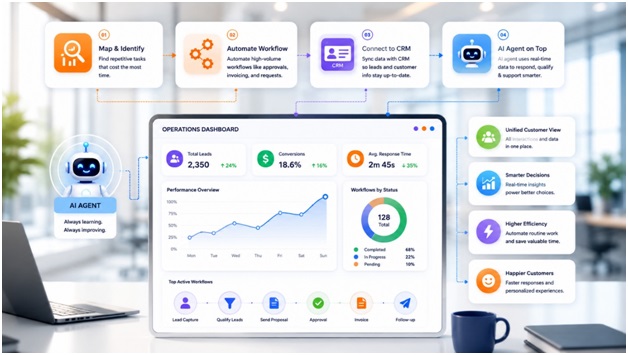
In practice, businesses tend to introduce this combination in a fairly predictable order rather than adopting everything at once:
- 1.Map which repetitive tasks are costing the most hours across support, sales, or operations
- 2.Automate the highest-volume workflow first, usually through business process automation covering approvals, invoicing, or routine requests
- 3.Connect that automated workflow to a CRM system so customer and lead data updates without manual re-entry
- 4.Layer in an AI agent once the underlying process is stable, so it can handle first-response support or lead qualification using real-time data instead of guesswork
Skipping ahead to AI agents before the underlying workflow and data are in order is one of the most common reasons automation projects stall — the agent ends up working from incomplete or outdated information instead of a system built to support it. This is also where dedicated AI agent development services tend to pay off: not as a standalone add-on, but as the last step in a sequence that already has clean data behind it.
How IM Digital Builds Scalable AI and Software Systems
The common thread across all of this is sequencing: automation and AI agents need reliable software and clean data to work with, and software needs to be built with automation in mind from the start rather than retrofitted later. IM Digital approaches both as one connected engineering problem — mapping where manual work is slowing a business down, then building the custom software and automated systems needed to remove it, instead of selling automation as a bolt-on feature. For businesses that have outgrown spreadsheets, manual approvals, and disconnected tools, that combination of automated workflows, AI agents, and purpose-built software is usually what separates a team that scales smoothly from one that just hires its way through growing pains. Getting the sequencing right early tends to matter far more than which specific tool a business starts with.



