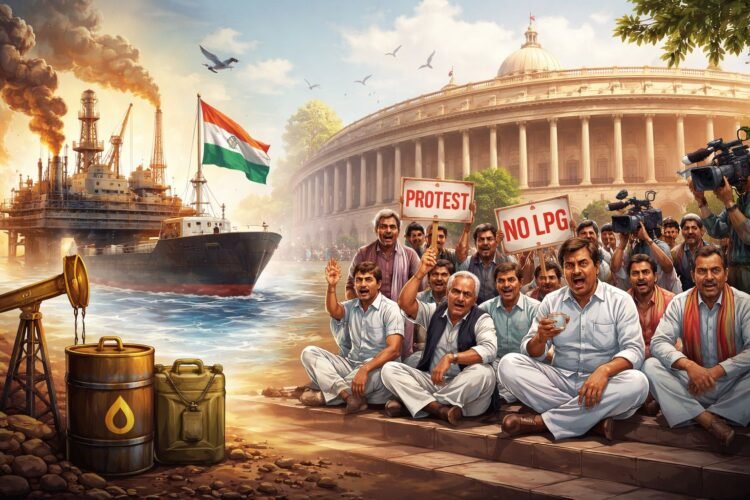


How Domestic Politics and Television Debates Amplify the Perception of a Fuel Emergency

The world is watching West Asia burn again. Missiles streak across tense skies, naval fleets patrol fragile shipping routes, and global energy markets tremble with every headline involving the United States, Iran and Israel. At the centre of the crisis lies the Strait of Hormuz — a narrow maritime artery through which a significant portion of the world’s oil flows.
When tensions rise there, the shockwaves travel fast — from Wall Street trading floors to the fuel pumps of Mumbai.
For energy-importing countries like India, such moments demand calm strategy: diplomatic engagement, diversified sourcing, strategic petroleum reserves and responsible communication. Global crises require steady governance and national unity.
But back home, something else seems to be cooking.
Instead of a moment of collective national focus, the political playbook has quickly shifted to its familiar script — outrage, alarm and theatrics. The moment global oil prices reacted to the West Asian conflict, warnings of LPG shortages and fuel crises began echoing loudly across political platforms.
Which raises a simple question: Is the crisis about oil — or about optics?
India, after all, is not entering this situation unprepared. Over the last few years the country has diversified crude imports, strengthened refinery capacity and built strategic petroleum reserves precisely to cushion such geopolitical shocks. Supply channels remain operational, diplomacy continues, and contingency mechanisms exist.
Yet the domestic narrative being amplified in some corners suggests a nation on the brink of running out of fuel tomorrow morning.
And then comes the real spectacle — Parliament.
At a time when the country would expect urgent discussions on energy security, price stability and inflation management, precious parliamentary hours are instead spent on political choreography. A no-confidence motion against the Speaker suddenly becomes the day’s most pressing national priority.
Outside the House, the theatre continues. Dharna politics unfolds neatly on the Parliament stairs — complete with the now familiar visual grammar: a cup of tea in hand, the white T-shirt, loose trousers, chappals, and television cameras perfectly aligned to capture the moment.
Meanwhile, the global oil crisis politely waits outside the Parliament gates.
If satire were writing the script, it would hardly need exaggeration.
Because the performance does not end with politicians. Television news channels, forever hungry for dramatic visuals, amplify the spectacle with remarkable enthusiasm. Studio debates erupt over “fuel crises,” scrolling tickers warn of shortages, and the same stair-side protests loop endlessly across prime-time screens.
In the race for ratings, nuance quietly exits the studio.
Panic, after all, makes better television than policy.
One cannot help but wonder: if their own families were facing a crisis, would these political actors rush to publish a dramatic advertisement in a national daily announcing it — or would they first sit together and solve it?
That is what mature societies do.
Global crises demand political maturity and responsible communication. Markets react not only to barrels of oil but also to barrels of speculation. Panic spreads faster than pipelines.
Today the government faces a two-front challenge — navigating a volatile global energy landscape while simultaneously countering a domestic narrative built on alarmism and amplified by television theatrics.
Oil markets will stabilise. Geopolitics will shift again.
But the real question remains:
When the world is dealing with war, should national politics be cooking solutions — or chaos?
About the Author
Pavan Kaushik is Co-Founder of Gurukshetra Consultancy, an author and storyteller who writes on contemporary issues.