



ESG becomes tangible only when it is measured with rigor and consistency.

By Rusen Kumar

Environmental, Social, and Governance principles are reshaping global finance and corporate accountability. Making ESG real requires measurable impact, disciplined governance, and integration into core financial decision-making. Learn how ESG becomes measurable through governance, climate risk integration, and sustainable finance strategies shaping long-term value.
ESG as a Structural Shift in Capitalism
Environmental, Social, and Governance (ESG) principles are no longer optional in modern economic systems. They have moved from voluntary corporate initiatives to structured expectations embedded within global financial architecture. Investors, regulators, multilateral institutions, and communities increasingly demand measurable responsibility rather than symbolic commitments. ESG has evolved beyond marketing language and policy declarations. It now influences access to capital, cost of borrowing, investor confidence, and long-term enterprise valuation. The transition from shareholder capitalism toward stakeholder-oriented models reflects this shift.
Businesses are expected to create value not only for equity holders but also for employees, customers, communities, and future generations. Climate instability, widening inequality, and governance failures have demonstrated that unmanaged externalities eventually translate into financial risk. As a result, sustainability considerations are being integrated into credit risk assessments, investment screening processes, and strategic planning frameworks. This structural transformation redefines competitiveness itself. Companies that internalize ESG principles are increasingly perceived as resilient and future-ready, while those that ignore them risk regulatory penalties, reputational damage, and capital constraints. Making ESG real therefore begins with recognizing it as a systemic economic shift rather than a temporary compliance trend.
The Importance of Measuring Social and Environmental Value
ESG becomes tangible only when measured rigorously and consistently. Without structured measurement systems, sustainability commitments remain abstract aspirations detached from operational reality. A credible ESG framework distinguishes clearly between input, output, outcome, and long-term impact. Inputs represent the resources allocated toward sustainability initiatives, while outputs reflect immediate activities or services delivered. Outcomes describe direct changes experienced by beneficiaries, and impact captures the broader, long-term transformation generated within society and the environment. True ESG accountability requires focusing on outcomes and impact rather than simply reporting expenditures or program counts. Objective measurability is essential to maintain credibility and avoid overstating achievements.
Conservative assumptions, third-party data sources, and standardized proxies enhance reliability. Balanced measurement also requires acknowledging negative externalities such as emissions, waste, and resource consumption. When organizations quantify both positive and negative contributions, stakeholders gain a more transparent understanding of net impact. Annual measurement cycles aligned with financial reporting further embed ESG within core management systems. By converting sustainability performance into structured metrics, leadership teams can allocate capital more efficiently, refine strategy, and continuously improve performance based on evidence rather than narrative.
Table 1: Core Components of Making ESG Real
| Component | Key Focus | Practical Application |
|---|---|---|
| Measurement | Impact quantification | Annual ESG accounting aligned with financial reporting |
| Risk Integration | Climate & social risks | Scenario analysis and stress testing |
| Governance | Board oversight | ESG-linked KPIs and committee supervision |
| Capital Allocation | Sustainable finance | ESG product screening and responsible investment |
| Transparency | Disclosure standards | Public reporting and independent verification |
Climate Strategy and Risk Integration
Climate change represents one of the most material and complex ESG risks confronting modern institutions. It influences asset valuations, supply chain continuity, infrastructure resilience, and overall financial stability. Climate-related risks are generally categorized into transition risks and physical risks. Transition risks arise from regulatory reforms, carbon pricing mechanisms, technological innovation, and evolving market preferences toward low-carbon solutions. Physical risks stem from extreme weather events and long-term climate shifts such as rising temperatures or sea-level changes. Both categories have measurable financial implications, including increased operational costs, asset impairment, credit defaults, and insurance volatility.
Table 2: Climate Risk Categories
| Strategy | Objective | Long-Term Outcome |
|---|---|---|
| Renewable Energy Financing | Support clean power generation | Emissions reduction |
| Inclusive Lending | Expand access to credit | Social equity and stability |
| ESG Bonds | Channel capital to sustainable projects | Measurable impact |
| Net-Zero Roadmaps | Reduce operational and financed emissions | Climate resilience |
Effective climate governance requires integration at both board and executive levels. Strategic oversight ensures that climate considerations inform capital expenditure decisions, portfolio diversification, and risk management frameworks. Scenario analysis and climate stress testing allow institutions to assess exposure under multiple pathways, including orderly transitions, delayed adjustments, or high-emission futures. Embedding climate risk into enterprise risk management systems ensures alignment between sustainability objectives and financial resilience. When climate considerations shape credit ratings, lending criteria, and investment screening processes, ESG transitions from peripheral discussion to core financial discipline.
Sustainable Finance as a Core Mechanism
Sustainable finance serves as a primary mechanism through which ESG principles translate into economic impact. Capital allocation determines which sectors expand, innovate, or decline. By directing funds toward renewable energy, clean transportation, energy efficiency, sustainable agriculture, and inclusive infrastructure, financial systems can accelerate structural transformation. Clear classification frameworks are essential to distinguish genuinely sustainable activities from superficial claims. Transparent eligibility criteria, independent review processes, and standardized taxonomies help prevent greenwashing and maintain stakeholder trust.
Sustainable financial products must be evaluated not only for profitability but also for environmental and social alignment. Screening mechanisms can exclude harmful sectors, while positive selection criteria prioritize projects with measurable benefits. Importantly, sustainable finance is not synonymous with philanthropy. It represents strategic capital deployment aligned with long-term resilience and risk mitigation. Institutions that integrate sustainability into lending, investment, and advisory services strengthen portfolio stability and anticipate regulatory evolution. When sustainable finance becomes embedded within mainstream product development and investment strategy, ESG is no longer a separate initiative but a defining characteristic of modern financial systems.

Governance as the Foundation of ESG
Governance provides the structural foundation necessary to operationalize ESG commitments. Without clear accountability mechanisms, sustainability initiatives risk fragmentation or symbolic compliance. Effective governance begins at the board level, where directors establish strategic direction, oversee risk exposure, and monitor performance. Executive leadership must translate these directives into operational frameworks supported by measurable key performance indicators. Embedding ESG targets within executive compensation structures reinforces accountability and aligns incentives with long-term sustainability outcomes. Risk management committees play a critical role by incorporating environmental and social variables into enterprise risk models. Transparent reporting and internal control systems ensure consistent monitoring of ESG performance.
Diversity and inclusion further strengthen governance by enhancing decision-making quality and representing broader stakeholder perspectives. Inclusive leadership fosters innovation and reduces blind spots in risk assessment. Governance also demands transparency in communication with investors, regulators, and communities. When oversight structures, risk management systems, and disclosure practices operate cohesively, ESG principles transition from theoretical commitment to embedded organizational discipline. Strong governance ensures that sustainability is integrated systematically rather than pursued episodically.
Social Responsibility and Financial Inclusion
The social dimension of ESG extends beyond corporate philanthropy into systemic financial inclusion and equitable access. Inclusive finance ensures that marginalized communities can access affordable credit, secure savings instruments, housing finance, and insurance services. Financial exclusion perpetuates structural inequality, whereas responsible lending and microfinance can enhance economic resilience and entrepreneurship. Measuring social responsibility requires tracking tangible outcomes such as improved access, reduced financial vulnerability, and enhanced economic stability. Customer protection mechanisms, transparent communication, and robust data security frameworks further reinforce trust in financial systems.
Table 3: Pathways to Sustainable Finance
| Risk Type | Description | Financial Implication |
|---|---|---|
| Transition Risk | Policy, technology, market shifts | Asset revaluation and compliance costs |
| Physical Risk | Extreme weather and long-term climate effects | Infrastructure damage and credit risk |
| Reputational Risk | Stakeholder perception changes | Investor withdrawal and brand erosion |
Financial literacy initiatives empower individuals to navigate increasingly digital banking environments, reducing exposure to fraud and mismanagement. Employee well-being also contributes to sustainable organizational performance. Policies supporting work-life balance, professional development, and equitable advancement foster long-term productivity and engagement. Diversity initiatives strengthen institutional culture and broaden talent pipelines. When organizations quantify these social contributions through structured methodologies, stakeholders gain insight into the broader societal value generated through financial operations. Making ESG real therefore requires embedding social equity considerations into product design, service delivery, and internal governance frameworks.
From Disclosure to Continuous Improvement
ESG reporting must evolve beyond regulatory compliance into a dynamic system of continuous improvement. Disclosure provides transparency, but real progress requires iterative refinement of strategy and performance. Annual evaluations enable benchmarking against prior results and peer institutions. Mid- and long-term roadmaps create clarity around measurable milestones such as net-zero emissions targets, sustainable finance expansion goals, or diversity representation objectives. Operational emissions and financed emissions must both be monitored to capture direct and indirect environmental exposure. Financed emissions are particularly critical because they reflect the carbon intensity embedded within lending and investment portfolios.
Periodic scenario analysis helps assess progress under evolving regulatory and market conditions. Data quality and methodological consistency remain essential to maintain credibility. Organizations must adapt to advancements in sustainability science, emerging regulatory standards, and technological innovation. Continuous improvement transforms ESG from static reporting into strategic evolution. When feedback loops connect measurement, governance, and capital allocation, sustainability performance strengthens progressively over time.
Case Study: Making ESG Real at KB Financial Group
KB Financial Group is one of South Korea’s leading financial holding companies, providing comprehensive financial services across banking, credit cards, insurance, securities, and asset management. Headquartered in Seoul, the Group operates through major subsidiaries including KB Kookmin Bank and serves millions of retail and corporate customers domestically and internationally. The organization plays a significant role in Korea’s financial system by offering diversified products such as loans, deposits, investments, and advisory services. With a strong focus on digital innovation, risk management, and sustainable finance, KB Financial Group positions itself as a long-term value creator committed to responsible management, stakeholder trust, and sustainable growth.
KB Financial Group presents a structured case of institutionalizing ESG within mainstream finance. In its 2022 Sustainability Report, the Group explicitly frames ESG as moving beyond adoption into an “internalization stage,” emphasizing objective measurement and systematic management of social value and impact. Rather than treating ESG as a parallel initiative, the organization integrates sustainability into mission, strategy, and governance. Its strategic goal centers on promoting responsible management for the environment and society while disseminating healthy corporate governance. This positioning demonstrates that ESG is embedded within long-term value creation and stakeholder trust. The Special Report titled “Making ESG Real” highlights the Group’s effort to give concrete shape to ESG by measuring and managing social value created through finance. This approach reflects a transition from narrative-based sustainability reporting to data-driven accountability, aligning ESG management with financial performance and strategic oversight.
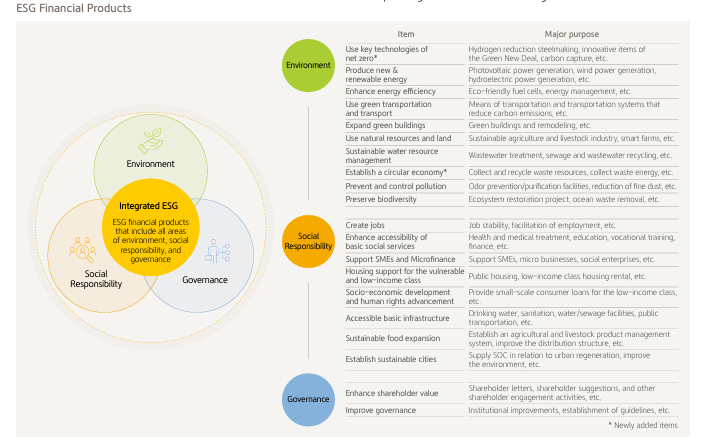
A defining feature of this case is the development of the “KB Social Value & Impact” framework. The Group applies five major principles, including yearly measurement, balanced measurement, and result-centered evaluation. Importantly, the framework includes both positive and negative externalities, such as greenhouse gas emissions, water use, and waste. Social value is classified across environmental, social responsibility, and governance dimensions. In financial areas, the measurement scope focuses on ESG financial products selected by the Group ESG Financial Product Council. The methodology distinguishes between direct interest benefits provided to customers and long-term indirect impacts generated through large-scale project financing. In 2022, total social value generated through ESG activities reached KRW 3,548.5 billion, demonstrating how quantified measurement translates sustainability into measurable outcomes.
Climate strategy further illustrates operational integration of ESG. The Group established “KB Net Zero S.T.A.R.” to achieve carbon neutrality for internal emissions by 2040 and financed emissions by 2050. Emissions targets were set using SBTi methodologies and received external approval. Beyond target setting, KB developed a climate risk management system incorporating stress testing, measurement, disclosure, and response strategies. Climate risks are categorized into physical and transition risks and integrated into enterprise risk management. Scenario analysis evaluates exposure under varying climate pathways, including potential credit losses under different policy scenarios. This systematic risk integration demonstrates how ESG considerations directly inform financial stability and strategic planning.
Sustainable finance expansion represents another pillar of making ESG real. Under the “KB Green Wave 2030” strategy, the Group aims to expand ESG products, investments, and loans to KRW 50 trillion by 2030. As of December 2022, the balance of ESG products, investments, and loans stood at KRW 32.2 trillion. The establishment of the “Group ESG Financial Product Council” enables integrated management and selection of ESG financial products. Additionally, the Group expanded ESG bond issuance supported by certified management systems, reaching cumulative issuance of KRW 13.8 trillion. These initiatives show how capital allocation mechanisms reinforce environmental and social objectives while maintaining financial discipline.
Finally, the social dimension reinforces stakeholder-oriented governance. The Group advances financial inclusion, youth development, and community engagement through programs such as KB Dream Wave 2030, which aims to support 300,000 youths by 2030. Consumer protection governance structures operate under CEO supervision, while diversity strategies such as “KB Diversity 2027” promote inclusive leadership. Together, these measures illustrate a comprehensive ESG architecture linking measurement, climate action, sustainable finance, and stakeholder responsibility. KB Financial Group’s 2022 report therefore offers a practical model of how ESG can transition from principle to performance through structured governance, quantitative evaluation, and strategic capital deployment.
About the Author: Rusen Kumar is a renowned thought leader in the area of Corporate Sustainability and Responsibility (CSR)