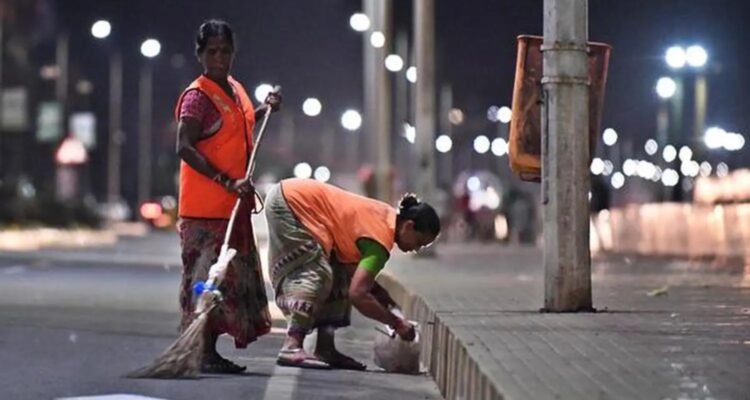


Latest reservation data highlights strong representation in Group C safai karmachari posts, while gaps remain in higher-level government positions
NEW DELHI (India CSR): More than two-thirds of sanitation workers employed in Group C posts across the Central government come from Scheduled Caste (SC), Scheduled Tribe (ST), and Other Backward Classes (OBC) communities, according to the Department of Personnel and Training’s (DoPT) Annual Report for 2024–25.
The report, released last week, provides one of the most detailed updates in recent years on caste-based representation in Central government services. It shows that over 66% of safai karmacharis — workers engaged in sanitation and cleaning roles — are drawn from historically disadvantaged social groups.
The findings have renewed attention on the continuing concentration of marginalized communities in lower-level government jobs, even as reservation policies aim to ensure representation across all grades of employment.

Sanitation Workforce Dominated by Reserved Category Representation
The DoPT data indicates that safai karmacharis under Group C services form one of the most socially concentrated categories of government employment.
According to the report, more than 66% of Group C sanitation workers across Central government ministries and departments belong to SC, ST, or OBC backgrounds.
This statistic reflects a long-standing structural reality: sanitation and cleaning roles in both public and private sectors have historically been performed largely by marginalized communities, particularly Scheduled Castes.
While reservation policies have opened access to government jobs, the report suggests that occupational segregation continues to persist, with disadvantaged groups remaining heavily represented in the lowest rungs of the workforce.
Representation in Group A Posts Still Below Reservation Targets
The report also provides figures for higher-level posts in Central government ministries and departments, where representation remains comparatively lower.
Among all Group A posts, which include senior administrative and officer-level roles:
- 14.20% were held by SC employees
- 6.54% by ST employees
- 19.14% by OBC employees
These numbers are below the prescribed reservation norms in direct recruitment, which mandate:
- 15% reservation for SCs
- 7.5% for STs
- 27% for OBCs
- 10% for Economically Weaker Sections (EWS)
The shortfall in Group A positions has often been highlighted by social justice advocates as evidence that representation becomes thinner at higher decision-making levels.
Group B and Group C Posts Show Mixed Progress
In mid-level and clerical posts, representation appears closer to reservation benchmarks, though variations remain.
For Group B posts, the DoPT report states:
- SC employees comprised 16.20%
- ST employees 7.63%
- OBC employees 21.95%
For Group C posts (excluding safai karmacharis):
- SC representation was 16.75%
- ST representation 8.94%
- OBC representation 27.29%
These figures suggest that while reservation policies have had a stronger impact in Groups B and C, OBC representation still falls short in some categories, particularly in higher posts.
Overall Central Government Workforce Data Covers 32.52 Lakh Employees
The annual report accounts for a total of 32.52 lakh Central government employees across 80 ministries and departments.
Overall representation across the workforce stood at:
- 16.84% SC
- 8.70% ST
- 26.32% OBC
The DoPT clarified that these figures reflect the status of Central government employment as of January 1, 2024.
Notably, the report does not provide data on the representation of employees from the Economically Weaker Sections (EWS), despite the 10% reservation introduced in recent years.
The absence of EWS statistics has raised questions among policy analysts about transparency and the completeness of representation reporting.
DoPT Releases Full Data After Several Years of Partial Reporting
This year’s report marks the first time since 2018–19 that the DoPT has published representation data covering most Central government ministries and departments.
Between 2019 and 2023, annual reports included only partial workforce figures, accounting for around 19–20 lakh employees rather than the full strength of government staffing.
In earlier submissions to Parliamentary committees, DoPT had attributed this gap to delays from ministries and departments in furnishing complete data on time.
The release of broader data in 2024–25 is therefore being seen as a significant step toward improved reporting and accountability.
Comparison With 2018–19 Shows Shifts in OBC Representation
The report also allows a comparison with 2018–19 figures, the last time a full dataset of over 32 lakh employees was published.
Since then:
- SC representation declined slightly from 17.49% to 16.84%
- ST representation rose marginally from 8.47% to 8.70%
- OBC representation increased significantly from 21.57% to 26.32%
The sharpest growth has been seen in OBC representation, while SC and ST proportions have remained relatively stable over the years.
Experts suggest this could reflect improved recruitment trends, stronger implementation of OBC quotas, or changes in workforce composition.
Persistent Questions Over Social Equity in Occupational Roles
While the data confirms increasing representation of reserved groups in government employment, the high concentration of SC, ST, and OBC communities in sanitation roles has once again highlighted concerns about caste-linked occupational patterns.
Social commentators argue that true equity cannot be measured only by overall numbers, but also by the distribution of marginalized communities across hierarchies of power and prestige.
The underrepresentation in Group A services and the dominance in sanitation work together present a complex picture of progress and persistence.
Policy Focus Expected on Diversity in Senior Government Roles
With updated data now available, experts expect renewed focus on:
- Improving recruitment diversity in higher services
- Strengthening promotional pathways for marginalized employees
- Ensuring transparency in EWS representation
- Addressing occupational segregation in government roles
As the government continues to emphasize inclusive development, the DoPT report serves as an important indicator of how reservation policies are shaping the administrative workforce — and where gaps still remain.
(India CSR)