

India’s inclusive education policies have made progress, but implementation gaps remain in urban contexts.
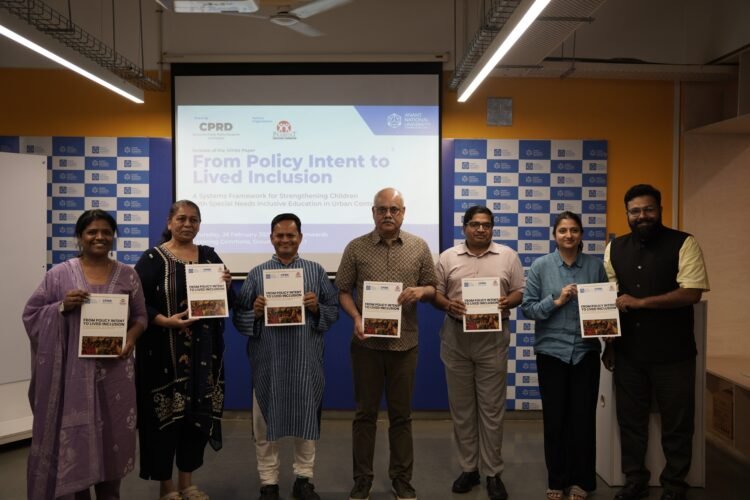
NEW DELHI (India CSR): India has made significant policy commitments toward inclusive education, particularly for children with special needs. Yet, the translation of these commitments into meaningful, on-the-ground change remains uneven. Recognising this gap between policy intent and lived reality, Anant National University recently released a white paper titled “From Policy Intent to Lived Inclusion: A Systems Framework for Strengthening Inclusive Education for Children with Special Needs in Urban Contexts”.
The white paper was formally released by Dr. Sanjeev Vidyarthi, Provost of Anant National University, along with Keshav Chatterjee, Founder of Prabhat Education Foundation. The initiative reflects a collaborative effort between academic research and field-level experience to better understand how inclusive education policies are implemented within complex urban environments.
The study highlights that despite progressive policy frameworks, systemic and institutional barriers continue to limit access to quality education for children with special needs. In high-vulnerability urban contexts, factors such as fragmented governance structures, limited institutional capacity, and inadequate coordination across service providers often hinder the effective implementation of inclusive education initiatives.
Moving beyond a compliance-driven understanding of inclusion, the white paper advocates for a systems-level approach to reform. It emphasises the need to examine how different components of the education ecosystem, such as policy design and service delivery, interact with one another. By identifying structural gaps within these systems, the research aims to provide a clearer pathway for translating policy commitments into tangible outcomes for children.
A key concept introduced in the paper is the “Inclusion Funnel,” a framework that illustrates how children with special needs often get filtered out of the education system at different stages. These exclusions can occur due to limited awareness, inadequate infrastructure, insufficient teacher training, or weak coordination between educational and social support systems. By mapping these stages of exclusion, the framework enables policymakers and practitioners to identify where targeted interventions are most needed.
The research also places particular emphasis on strengthening urban education ecosystems. Cities often present unique challenges, ranging from population density and resource constraints to fragmented service networks, that can disproportionately affect children requiring specialised educational support. Addressing these challenges requires coordinated action among government institutions, educators, civil society organisations and community stakeholders.
The white paper is a product of the work undertaken by the Centre for Public Policy Research and Design at Anant National University. The centre approaches public challenges through a design-thinking lens, treating policy problems as design problems that require empathetic, human-centred solutions. This perspective allows researchers to explore policy implementation not only through legislation and administrative structures but also through the lived experiences of those affected by these policies.
The collaboration with Prabhat Education Foundation further strengthens the study’s foundation by integrating field insights from practitioners working directly with children and schools. This combination of academic research and real-world experience ensures that the framework proposed in the white paper is both analytically robust and grounded in practical realities.
Through this initiative, Anant National University continues to advance its commitment to inclusive and equitable education. By fostering research, dialogue and cross-sector partnerships, the university aims to contribute to policy frameworks that move beyond intent and enable genuine inclusion for children with special needs in urban India.
(India CSR)