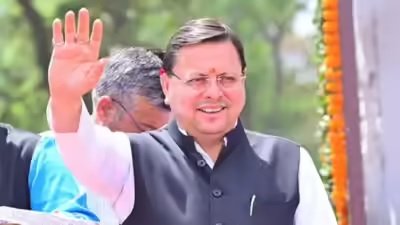



Chief Minister Pushkar Singh Dhami disburses direct benefit transfers to support girl child welfare and higher education, as political debate surfaces over timing.
UTTARAKHAND (India CSR): In a significant push toward girl child welfare and financial inclusion, the Uttarakhand government has transferred nearly ₹146 crore directly into the bank accounts of more than 33,000 girls under the flagship Nanda Gaura Yojana for the 2025–26 financial year. The funds were disbursed through the Direct Benefit Transfer (DBT) mechanism, reinforcing the state’s focus on promoting gender equality and supporting higher education for girls.
Chief Minister Pushkar Singh Dhami announced the transfer during a programme held at his official residence in Dehradun, describing the scheme as a key pillar of the government’s social welfare strategy.
The large-scale transfer comes at a time when welfare schemes and pre-election financial disbursements are under national scrutiny, adding both social and political dimensions to the initiative.
Rs 146 Crore Directly Credited to Beneficiaries
According to official figures, a total of 33,251 beneficiaries received financial assistance under the scheme this year.
The distribution was structured in two phases:

- 5,913 newborn girls were granted Rs 11,000 each at birth.
- 27,338 girls who successfully passed Class 12 received Rs 51,000 each to support higher education and career advancement.
The cumulative transfer amounted to approximately Rs 145.9 crore, credited directly into beneficiaries’ bank accounts to ensure transparency and eliminate middlemen.
The Direct Benefit Transfer system has increasingly been used by governments across India to streamline welfare payments and reduce leakages, ensuring targeted beneficiaries receive funds efficiently.
Objective: Ending Gender Discrimination at Birth
Speaking at the event, Chief Minister Dhami said the scheme aims to address discrimination against girls at birth and encourage families to support female education.
“To eliminate discrimination between sons and daughters at birth and to promote the birth of girls, the state government is operating the Nanda Gaura Yojana,” he said.
The scheme seeks to tackle deep-rooted social challenges, including:
- Female foeticide
- Low female literacy rates
- Financial barriers to higher education
- Gender-based inequality
Officials claim that over the years, the scheme has contributed to improving institutional deliveries and encouraging families to prioritize girls’ education.
Linking Welfare to Education and Empowerment
The financial assistance provided after Class 12 is seen as a strategic move to reduce dropout rates among girls and promote college enrollment.
Education experts note that financial constraints remain one of the key reasons girls discontinue studies after school in hill states like Uttarakhand, where economic opportunities are often limited and migration rates are high.
The state government has also linked the Nanda Gaura Yojana with broader women-centric initiatives such as the Lakhpati Didi scheme, which focuses on enhancing women’s economic independence through skill development and self-employment.
Officials say these combined efforts aim to create a long-term ecosystem of empowerment rather than short-term financial relief.
Political Debate Over Timing
While the transfer has been widely welcomed by beneficiaries and social welfare groups, its timing has sparked political discussion. The disbursement comes ahead of next year’s assembly elections, prompting opposition leaders to question whether such large-scale cash transfers close to poll season are politically motivated.
Recently, a three-judge bench of the Supreme Court observed that the growing trend of state governments announcing large cash benefits ahead of elections could be perceived as “appeasement.” The bench cautioned that welfare measures should be carefully designed to avoid undue strain on public finances and to preserve the integrity of democratic processes.
Congress leaders in Uttarakhand have cited this observation while criticizing the ruling government. Party spokesperson Garima Dasauni remarked that distributing funds in a pre-election year reflects a broader national pattern and questioned whether similar strategies were being replicated from other states.
The state government, however, maintains that the scheme is part of its annual budgetary commitment and not linked to electoral considerations.
Strengthening Public Finance Safeguards
Officials clarified that the funds allocated under the Nanda Gaura Yojana are provisioned within the state’s social welfare budget and are subject to financial audits.
The DBT process is integrated with Aadhaar-linked bank accounts, minimizing duplication and ensuring funds reach intended recipients. Government data indicates that digital transfers have significantly reduced administrative costs and delays compared to traditional disbursement methods.
Experts argue that as welfare spending increases, states must balance social objectives with fiscal prudence, particularly in smaller states like Uttarakhand that depend heavily on central grants.
A Broader Push for Gender Equity
Beyond immediate financial assistance, the scheme reflects a broader shift in policy focus toward gender equity. Nationally, India’s female literacy rate has improved over the past decade, but disparities remain across rural and mountainous regions.
By combining birth incentives with education-linked grants, the Uttarakhand government aims to create a structured support pathway for girls from infancy to adulthood.
Whether the initiative translates into measurable long-term outcomes—such as higher college enrollment rates, reduced early marriage, and improved workforce participation—will depend on sustained implementation and monitoring.
For now, the Rs 146 crore transfer represents one of the largest direct benefit disbursements for girl child welfare in the state’s recent history.
(India CSR)