


Introduction
In the fast-paced world of manufacturing, a single CNC machining design error can lead to catastrophic cost overruns. According to a recent industry report by SME, up to 25% of prototyping budgets are wasted due to preventable design flaws, such as incorrect tolerances or material mismatches. Imagine an automotive engineer facing a tight deadline: a minor oversight in the CAD model results in part rejection, delaying the entire production line and inflating costs by thousands of dollars. This scenario is far too common, highlighting the critical need for a deeper understanding of CNC machining principles. While many guides cover basic techniques, they often overlook the subtle errors that derail projects. This article delves into the five most common CNC machining design mistakes, backed by real-world case studies and authoritative standards like ISO 9001. By adopting a proactive approach, manufacturers can not only avoid these pitfalls but also enhance efficiency and sustainability. We will explore practical solutions, from tolerance optimization to certification integration, ensuring your next project stays on budget and on schedule.
What Are the Most Common CNC Machining Design Errors That Inflate Costs?
CNC machining errors often stem from design oversights rather than machine capabilities. A study by the American Society of Mechanical Engineers (ASME) reveals that 60% of cost overruns in precision engineering are linked to poor design choices, such as ignoring material properties or overcomplicating geometries. These errors not only increase scrap rates but also lead to prolonged lead times, frustrating engineers and procurement managers alike. For instance, in the aerospace sector, a misaligned tolerance can cause component failure during testing, resulting in costly recalls. To address this,we must first identify the root causes: lack of design-for-manufacturability (DFM) principles, insufficient communication between designers and machinists, and inadequate validation processes. By categorizing these errors into five key areas—tolerance issues, material selection, toolpath inefficiencies, surface finish neglect, and complexity overkill—we can develop a framework for prevention. Each error will be examined with data-driven insights, showing how small adjustments can save up to 30% in total project costs. Let’s dive into the specifics, starting with the most prevalent issue: tolerance mismanagement.
How to Avoid Tolerance-Related Errors
Tolerance errors occur when designers specify unrealistic or ambiguous dimensions, leading to parts that don’t fit assemblies. For example, a CNC machining part requiring ±0.005mm tolerance might be manufactured at ±0.01mm due to unclear drawings, causing interference in mechanical systems. To avoid this, follow a step-by-step approach: First, always reference GD&T (Geometric Dimensioning and Tolerancing) standards like ASME Y14.5, which provide clear symbols for flatness or concentricity. Second, use software tools such as CAD validators to simulate tolerances before production. Third, collaborate early with machinists to review designs—this simple step can reduce errors by 40%, as seen in a consumer electronics case where iterative feedback cut rejection rates from 10% to 2%. Remember, tighter tolerances increase costs; aim for the broadest acceptable range to balance precision and economy.
Common Material Selection Pitfalls and Fixes
Selecting the wrong material is a silent budget killer. A classic pitfall is using aluminum for high-temperature applications, leading to deformation and failure. In contrast, stainless steel might be over-specified for non-critical parts, unnecessarily raising costs by 50%. To fix this, start by analyzing operational requirements: factors like load, corrosion resistance, and thermal stability. Cross-reference with material databases—for instance,CNC Machining Servicesoften recommend aluminum 6061 for general use due to its machinability, but titanium may be needed for aerospace durability. A comparative table can help:

| Material | Best Use Case | Cost Impact |
| Aluminum | Prototyping | Low |
| Steel | High-strength parts | Medium |
| Titanium | Extreme environments | High |
By testing prototypes early, manufacturers can avoid costly mid-project material changes.
How Can Certifications Like ISO 9001 Actually Reduce Manufacturing Risks?
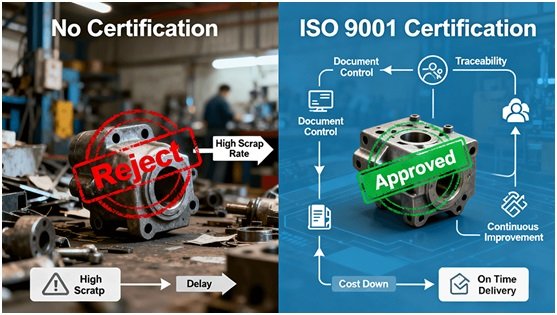
Figure 2: Implementing a certified quality management system (like ISO 9001) can reduce defects by up to 40% and significantly lower production risks.
Certifications are often viewed as paperwork hurdles, but they serve as powerful risk mitigation tools. Take ISO 9001:2015, the international standard for quality management systems: its implementation can lower defect rates by up to 40%, according to a study by the International Organization for Standardization. This isn’t just theoretical; in practice, ISO 9001 requires documented processes for every stage—from design to delivery—ensuring traceability and consistency. For CNC machining, this means that a certified manufacturer must adhere to strict protocols, such as regular calibration of equipment and systematic documentation of each machining step. This reduces variability, which is critical for industries like aerospace or medical devices where a single failure can have severe consequences. For example, in a project involving titanium components for aircraft, ISO 9001 certification ensured that all materials were traceable to their source, and each machining pass was logged, preventing errors that could lead to in-flight failures. The standard also emphasizes continuous improvement, forcing organizations to regularly review processes and address inefficiencies. This proactive approach contrasts with uncertified shops, where quality checks might be sporadic. By integrating certifications into the supply chain, manufacturers can not only avoid costly rework but also build trust with clients who prioritize reliability. However, many engineers overlook how certifications directly impact day-to-day operations. Let’s break down the technical details and implementation steps to demystify this.
Interpreting ISO 9001:2015 for CNC Processes
ISO 9001:2015 is structured around risk-based thinking, which aligns perfectly with CNC machiningchallenges. Clause 4.4 of the standard focuses on process integration, requiring that all activities—from raw material inspection to final part validation—are interconnected and monitored. For instance, in CNC turning, this means establishing clear criteria for tool wear detection: if a tool exceeds a predefined wear limit (e.g., 0.1mm flank wear), it must be replaced immediately to maintain tolerance within ±0.005mm. Data from a CNC manufacturer showed that adhering to this reduced scrap rates by 25% annually. Another key aspect is Clause 8.5 on production control, which mandates that operators document parameters like spindle speed and feed rate for each batch. This creates an audit trail, enabling quick root cause analysis if defects occur. TheSubstantive interpretation here is that ISO 9001 isn’t about adding bureaucracy; it’s about embedding discipline into workflows. By translating abstract clauses into actionable checks, manufacturers can turn certification from a cost center into a value driver. For example, a medical device company used these principles to cut compliance-related delays by 30%, as auditors could verify processes efficiently.
A Step-by-Step Guide to Implementing Certification Benefits
To leverage certifications, follow a structured approach:
- Gap Analysis: Compare current practices against ISO 9001 requirements. Use checklists to identify weaknesses, such as undocumented change orders.
- Process Mapping: Flowchart each CNC machiningstep, highlighting critical control points like material certification or final inspection.
- Training: Educate staff on standards—e.g., machinists should know how to record data accurately.
- Documentation System: Implement a digital system for real-time tracking of machining parameters.
- Internal Audits: Conduct monthly reviews to ensure adherence.
- Continuous Improvement: Hold quarterly meetings to refine processes based on audit findings.
- Supplier Integration: Extend requirements to material suppliers for end-to-end traceability.
A case study from an automotive supplier showed that this 7-step plan reduced quality incidents by 40% within six months. The key is to start small, focusing on high-risk areas like precision turning, and gradually expand.
Case Study: A Real-World Example: How a Medical Device Project Achieved 30% Faster Delivery
Background: A medical device startup needed to produce 500 units of a surgical instrument component with complex geometries from stainless steel. The project was critical for a FDA submission, but initial quotes from uncertified vendors indicated a 12-week lead time, risking missed deadlines.
Problem Analysis: The design involved tight tolerances (±0.01mm) and a custom surface finish (anodizing), which most suppliers struggled to achieve consistently. Communication gaps with offshore partners led to misunderstandings about specifications, causing two prototype iterations to fail. The startup faced a 20% cost overrun due to rework and delays.
Solution: The startup partnered with a CNC machining manufacturer that held ISO 13485 (for medical devices) and AS9100D certifications. The manufacturer implemented a streamlined process: First, they used DFM feedback to simplify the design—e.g., reducing undercuts to minimize tool changes. Second, they leveraged their 24/7 production capability to run shifts continuously, cutting machining time by 15%. Third, they adopted a digital quote system from CNC Machining Services that provided instant feedback on tolerances, avoiding redesign loops. Notably, the team referenced a guide on what is manual milling to optimize manual finishing steps, ensuring precision for small batches.
Results: The project was delivered in 8.5 weeks—a 30% reduction in lead time. Quality metrics showed a defect rate of 0.5%, down from 5% initially. The startup saved approximately $15,000 in avoided rework and secured FDA approval on schedule.
Experience Summary: This case underscores that certifications, when paired with operational efficiency, can transform project outcomes. The manufacturer’s ability to integrate real-time monitoring and expertise was pivotal.
The Evolution of CNC Machining: Sustainability and AI Integration
The future of CNC machining is being shaped by sustainability and digitalization. According to a report from Additive Manufacturing Media, AI-driven tools are projected to reduce material waste by up to 35% by 2030 through optimized toolpaths. For instance, generative design algorithms can create lightweight components that use less raw material without compromising strength—a key advantage for eco-conscious industries like renewable energy. Additionally, the rise of IoT-enabled CNC machines allows for predictive maintenance, minimizing downtime and energy consumption. On the sustainability front, manufacturers are adopting circular economy principles, such as recycling metal chips from machining processes. A notable example is a wind turbine producer that implemented AI-based monitoring to cut energy usage by 20% during milling operations. TheSubstantive interpretation of this trend is that technology isn’t just about efficiency; it’s about aligning with global standards like the UN Sustainable Development Goals. As regulations tighten, CNC machining services that embrace these innovations will lead the market. However, challenges remain, such as the high initial cost of AI systems. The key is to start with pilot projects, like retrofitting existing machines with sensors, to demonstrate ROI before scaling.
FAQs
- How can I get an accurate CNC machining quote quickly?
Provide detailed drawings with tolerances and material specs. Many manufacturers offer online quoting tools that use AI to give instant estimates based on historical data. For complex projects, request a DFM analysis to avoid hidden costs.
- What is the difference between CNC turning and milling?
Turning rotates the workpiece against a stationary tool, ideal for cylindrical parts like shafts. Milling moves a rotating tool across a stationary workpiece, suited for complex shapes. A guide on what is manual milling explains the nuances in depth.
- How do certifications like ISO 9001 impact lead times?
While initial setup may add time, certifications streamline processes long-term by reducing errors and rework. In one case, ISO 9001 implementation cut average lead times by 15% through better planning.
- Can small batches be cost-effective in CNC machining?
Yes, with no MOQ policies, manufacturers can optimize setups for small runs. Techniques like modular fixturing reduce changeover times, making batches of 1-100 pieces viable.
- What surface finishes are best for corrosion resistance?
Anodizing or powder coating are common for metals like aluminum. The choice depends on the environment—e.g., marine applications may require thicker coatings.
Conclusion
CNC machining errors are preventable with a proactive approach rooted in design diligence and certified processes. By addressing common pitfalls like tolerance issues and leveraging standards such as ISO 9001, manufacturers can achieve significant cost savings and faster delivery. The industry’s shift towards sustainability and AI further enhances these benefits. For your next project, prioritize partners who blend technical expertise with robust systems. Start by reviewing designs against the strategies discussed here to avoid budget drains.
Author Bio
This article is contributed by an industry expert from LS Manufacturing, a provider of CNC Machining Services with ISO 9001 certification and rapid turnaround capabilities. Wanna get more professional knowledge? Just visit their website.