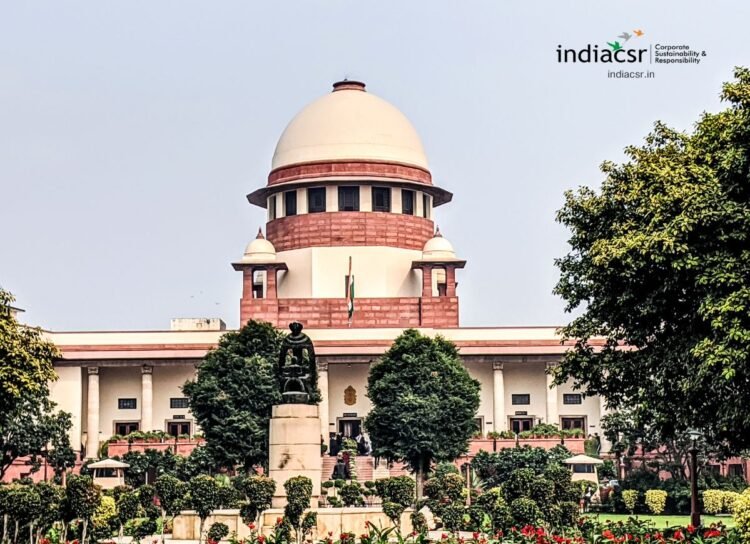


No Fresh or Renewed Mining Leases Without Supreme Court Permission
NEW DELHI (India CSR): In a major relief for environmental safeguards, the Supreme Court on Monday kept in abeyance its November 20 judgment that had upheld a government expert panel’s restrictive definition of the Aravalli Hills and Ranges, one of the world’s oldest surviving mountain systems.
The court ordered that the stay will remain in effect until the proceedings reach “logical finality,” ensuring that no irreversible administrative or ecological actions are taken under the current framework.
Importantly, the apex court directed that no fresh or renewed mining leases should be granted in the Aravalli region without prior permission from the Supreme Court.
The November ruling had sparked widespread concern across Rajasthan, Haryana, Uttar Pradesh and Delhi, with activists and environmentalists warning that a narrower definition would weaken protections and open the door to unregulated mining, threatening the Aravallis’ role as a green barrier against the eastward spread of the Thar Desert and worsening pollution in cities including Delhi.
A three-judge vacation Bench headed by Chief Justice of India Surya Kant took suo motu cognisance of public apprehension that the restrictive definition could drastically reduce the number of protected hills. The court noted reports suggesting that in Rajasthan alone, only 1,048 hills out of 12,081 would meet the 100-metre elevation threshold, potentially leaving vast stretches exposed. If true, the court said, it would create a “significant regulatory lacuna.”
The Bench proposed setting up a high-powered committee to study whether “regulated” or “sustainable” mining in newly demarcated areas could still cause ecological damage. It also flagged a “structural paradox” in defining hill clusters as those within 500 metres, warning that ecologically connected areas could be excluded and become vulnerable.
The matter has been listed for further hearing on January 21.
(India CSR)