

Most trading failures on MetaTrader platforms do not originate from bad entries or poor technical analysis. Internal platform statistics released by MetaQuotes show that over four out of five blown MT4 and MT5 accounts collapsed due to flawed capital control, not incorrect market bias.
This distinction matters because it reframes trading success as a structural problem rather than a predictive one.
Money Management Tools exist to solve this structural weakness. They do not attempt to forecast price direction. Instead, they regulate how capital is deployed, protected, and recovered across sequences of trades, especially during drawdown cycles where emotional decision-making tends to peak.
From Stop Losses to Capital Frameworks
Modern money management systems go far beyond setting stop losses. Advanced tools now operate as capital governance engines, monitoring account-level behavior in real time.
Well-designed Money Management Tools can:
· Normalize risk per trade regardless of market volatility;
· Cap total exposure across correlated instruments;
· Halt trading automatically when equity rules are breached;
· Adjust lot sizes dynamically as balance changes;
· Preserve risk-to-reward consistency across different strategies.
Independent testing data shows that optimized money management experts can reduce peak drawdowns by up to 45%, even when trade accuracy remains unchanged.
Click here to explore the best tools for protecting and growing your capital
Capital Rules Matter More in Prop Firm Environments
Prop firm evaluation models amplify the importance of strict risk enforcement. Daily drawdown ceilings, equity-based stopouts, and algorithmic rule validation leave no room for discretionary overrides.
In this environment, Money Management Tools act as compliance systems, not convenience features. A single rule violation, often caused by emotional scaling or miscalculated lot size, can invalidate weeks of profitable trading.
Most Reliable Money Management Tools
Here are the best and most popular money management tools that offer reliable risk management:
Prop Firm Capital Protection
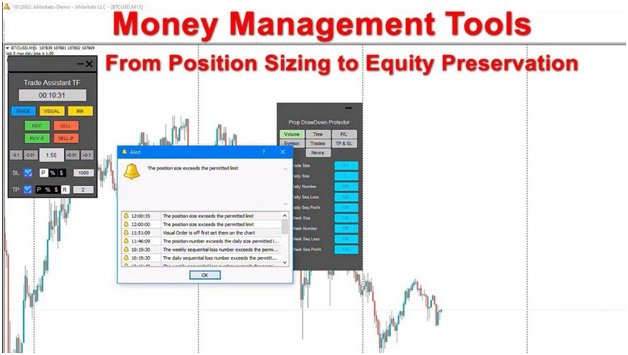
Prop Firm Capital Protection is engineered specifically for environments where rule enforcement must be absolute. Instead of managing individual trades in isolation, it continuously monitors the entire account state.
Its core logic operates on three layers:
- Equity Surveillance: The EA tracks both intraday and cumulative drawdown in real time. Once a predefined threshold is reached, all trading activity is immediately stopped; no delays, no confirmations;
- Exposure Balancing: Multi-symbol risk oversight prevents unintentional stacking across correlated currency pairs, a common cause of hidden overexposure;
- Automated Position Sizing: Lot sizes are calculated using equity percentage, stop-loss distance, or fixed risk units, ensuring uniform exposure regardless of market conditions.
Additional safeguards, such as news-event blocking and dynamic break-even logic, make this tool particularly suitable for passing prop firm evaluations where volatility spikes can instantly invalidate accounts.
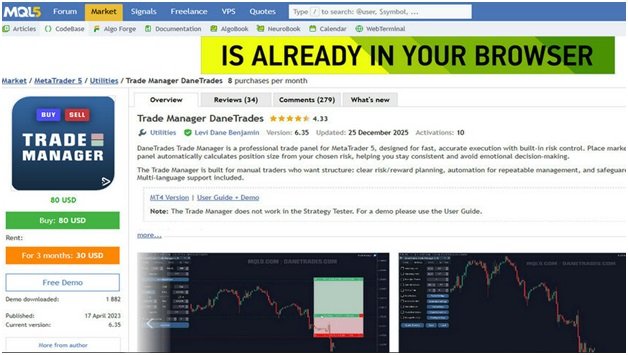
Trade Manager DaneTrades
Manual traders rarely fail because they misread market direction; failure more often occurs when risk parameters shift during execution.
Position size is increased slightly, stops are delayed, or exposure is added without recalculation, small deviations that accumulate over multiple trades. Trade Manager DaneTrades is built to prevent these execution-level errors by enforcing predefined risk rules at the moment an order is placed.
It calculates exact position size before execution, applies break-even and trailing stop logic instantly, manages OCO orders to control alternative entries, and locks trading automatically once daily profit or loss thresholds are reached.
The tool does not interfere with trade selection; it restricts how trades are executed, ensuring that every position follows the same risk structure regardless of speed, pressure, or emotional bias.
Risk Killer AI MT5
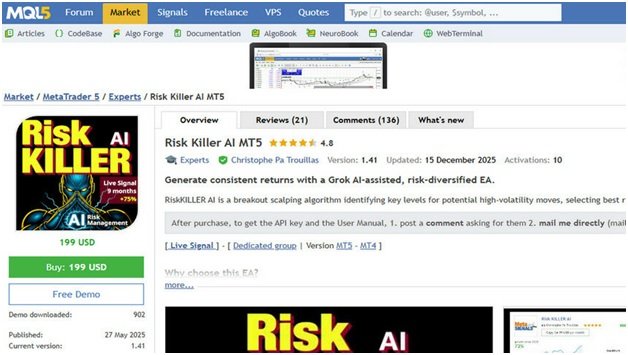
Risk Killer AI MT5 combines money management with portfolio-level diversification logic. Rather than focusing on single-asset optimization, it distributes exposure across multiple uncorrelated instruments.
Distinctive features include:
- Volatility-sensitive risk adjustment using sentiment inputs
- Asset diversification across up to five markets
- Hard-coded capital safety thresholds that cannot be overridden
- Specialized modes for high-volatility assets such as Bitcoin
- Validation through Monte Carlo simulations and extensive backtesting
This tool is designed to limit catastrophic loss scenarios, even during extreme market dislocations.
How Money Management Tools Extend Account Longevity
Data from a 2025 Myfxbook study shows that traders using a money management expert achieved up to 38% higher account longevity and reduced catastrophic losses by over 52% compared to manual risk control.
These results highlight a crucial insight: profitability is less fragile than risk mismanagement. Traders do not fail because strategies stop working; they fail because capital rules collapse under pressure.
Choosing the Right Money Management Tool
Choosing the right money management tool should be driven by the specific constraints of your trading account rather than promotional claims or feature lists. The first consideration is whether you are operating under prop firm rules, where strict daily and total drawdown limits require automated enforcement rather than discretionary control.
Your trading style also matters: manual traders benefit more from execution-focused risk panels, while semi-automated or fully automated strategies require account-level protection and consistent position-sizing logic.
It is equally important to define whether your primary objective is maximum drawdown protection or faster execution flexibility, as these priorities shape the tool’s architecture.
Finally, consider whether your strategy requires exposure management across multiple instruments or precise control over a single pair, as not all money management tools are designed to handle portfolio-level risk.
Final Thoughts
Modern trading failures are driven primarily by poor capital control rather than flawed market analysis, with over 80% of MT4 and MT5 account blow-ups linked to money management errors.
Money Management Tools directly address this structural weakness by enforcing consistent position sizing, equity-based loss limits, exposure control across correlated instruments, and automated trading halts during rule breaches or high-volatility conditions.
This role is especially critical in prop firm environments, where strict drawdown rules and algorithmic compliance leave no margin for discretionary mistakes. Whether through account-level protection systems, execution-focused trade managers, or AI-driven risk engines, Money Management Tools transform trading plans into enforceable frameworks.
By preventing emotional decisions from compounding into catastrophic losses, they shift trading from a fragile, judgment-driven activity into a controlled and repeatable process focused on equity preservation and long-term survival.
FAQ
Why do most MT4 and MT5 accounts fail despite having profitable strategies?
Because position sizing, exposure control, and drawdown limits are not enforced consistently, allowing small execution errors to compound into account-ending losses.
How do Money Management Tools reduce drawdowns without changing strategy accuracy?
They standardize risk per trade, cap correlated exposure, and halt trading when equity limits are breached, preventing loss escalation during drawdown periods.
Are Money Management Tools necessary for prop firm trading?
Yes. Prop firm evaluations rely on strict daily and total drawdown rules that require automated enforcement to avoid disqualification from single execution mistakes.
What is the difference between trade managers and account-level protection tools?
Trade managers control execution and position sizing per trade, while account-level tools monitor total equity, exposure, and rule compliance across all trades.
Can AI-based money management tools improve account stability?
When properly designed, AI tools adjust risk dynamically based on volatility and diversification logic, reducing catastrophic losses rather than increasing trade frequency.