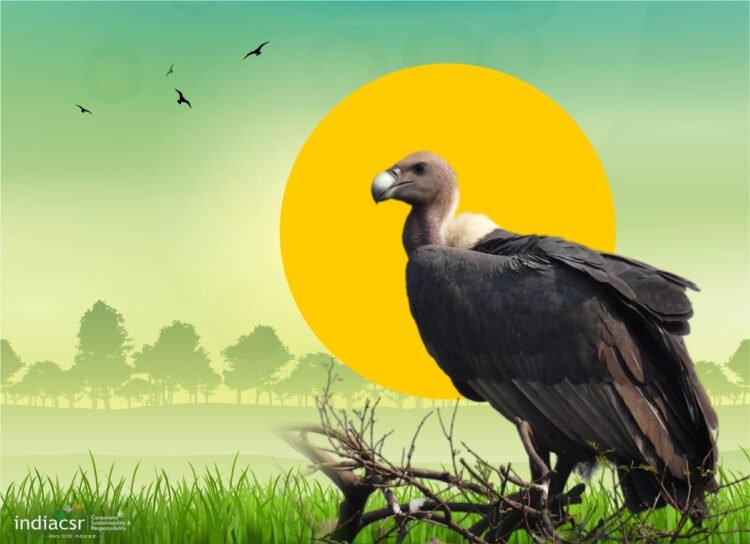


UPL Limited’s Khambhat Vulture Conservation Project exemplifies how corporate social responsibility (CSR) can drive meaningful environmental change. By combining scientific monitoring, habitat restoration, and community engagement, the project has become a benchmark in biodiversity conservation.
In 2024-25, 125 vultures have been recorded as compared to 86 in the year 2022-23
Khambhat Vulture Conservation Project is a Corporate Social Responsibility (CSR) initiative in Gujarat, India. UPL Limited is a global leader in sustainable agriculture solutions. The initiative operates in Khambhat taluka of Anand district, Gujarat, a region that hosts several species of vultures vital to the ecological balance.
The project’s goal is to protect and restore the population of the White-rumped Vulture (Gyps bengalensis) — one of the most threatened bird species in India. Listed as Critically Endangered under the IUCN Red List since 2000 and protected under Schedule I of the Wildlife Protection Act, 1972, this vulture once thrived across the Indian subcontinent. Today, however, its population faces a drastic decline due to habitat loss, poisoning from veterinary drugs like diclofenac, and reduced food availability.
***
Vultures in India
In 1980, India’s skies were home to nearly 40 million vultures, primarily White-rumped and Long-billed species, which played an essential ecological role as natural scavengers. However, within just two decades, this thriving population began to collapse at an alarming rate. By the year 2000, the International Union for Conservation of Nature (IUCN) sounded a grave warning, declaring that “the Indian vulture is only one step away from total extinction.” The situation continued to deteriorate rapidly, and by 2007, an estimated 99% of the country’s vultures had vanished, with the White-rumped Vulture population declining by an unprecedented 99.9%. This near-extinction event was one of the fastest population crashes ever recorded among bird species, marking a tragic ecological crisis in India’s conservation history. (Source: Bombay Natural History Society)
Also Read: Population of Vultures in India – 2024 I India CSR
Vulture Population in Gujarat: State Statistics and Estimates (2005–2010)
Table: Vulture Population Estimates in Gujarat
| Sr. No. | Year | Estimated Population |
|---|---|---|
| 1 | 2005 | — (Data not available) |
| 2 | 2007 | 1,431 |
| 3 | 2010 | 1,065 |
Source: Vulture Conservation Success Story | PCCF & HoFF
With seven of India’s nine vulture species found in Gujarat, the project aims to document the populations’ breeding habits and threats.
***
Origin and Context of the Project
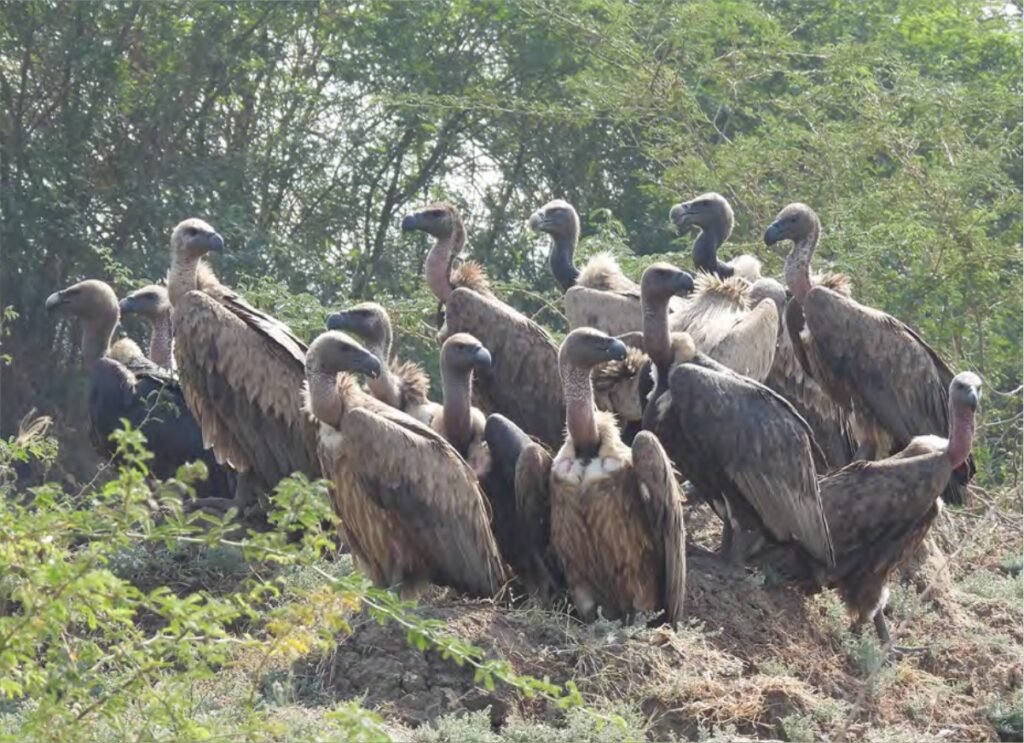
The community initiative was conceptualized following the GEER Foundation’s 2022 survey, which reported only 2,143 vultures of seven species across Gujarat — including just 283 White-rumped Vultures, down from 352 in 2018. This alarming decline triggered the need for urgent, community-driven conservation measures.
UPL identified Khambhat’s Mahi River plains as an ideal project location due to its natural feeding and nesting habitats for vultures. Drawing inspiration from UPL’s successful Sarus Crane Conservation Project, the company replicated a similar model for the vultures, blending science, community participation, and advocacy.
***
Purpose and Vision
The Khambhat Vulture Conservation Project aims to:
- Document the population trends, breeding patterns, and roosting sites of the species.
- Protect nesting and feeding habitats to ensure long-term survival.
- Engage the local community in vulture monitoring, awareness, and protection.
- Reduce threats arising from habitat degradation, poisoning, and lack of awareness.
UPL envisions a sustainable model of conservation that goes beyond mere protection — focusing instead on building a community-based ecosystem of responsibility and participation.
***
Four Pillars of Conservation
1. Monitoring and Documentation
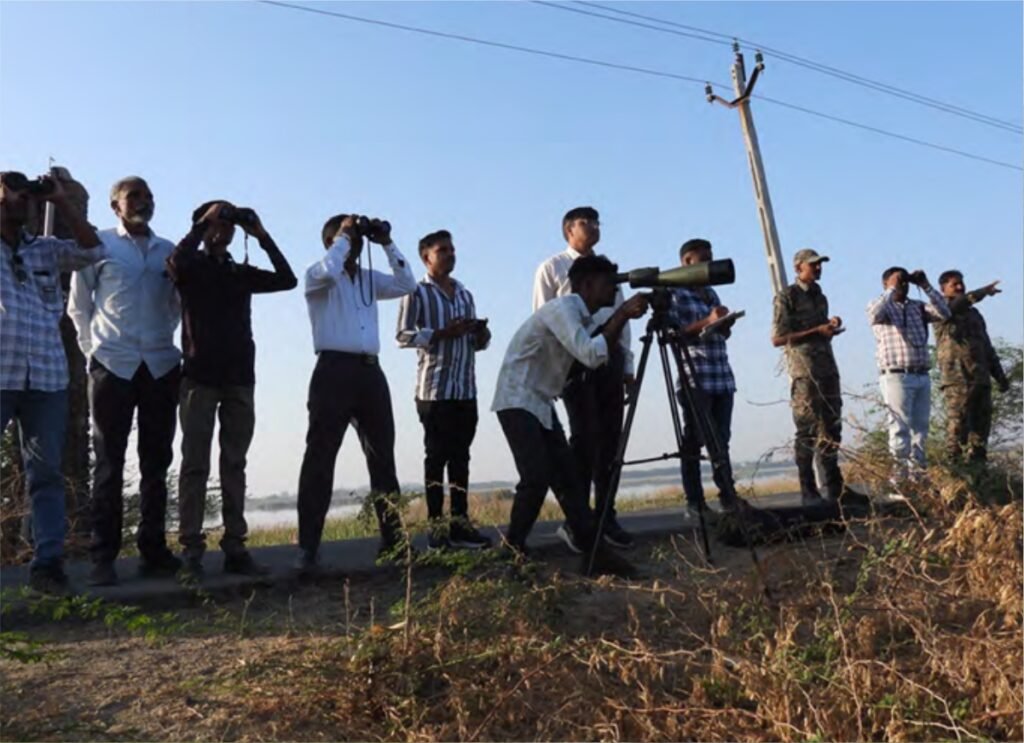
Regular field surveys are conducted across Khambhat and Tarapur talukas to record data on vulture species, nesting colonies, and feeding patterns. In 2023–24, the team documented:
- 95 White-rumped Vultures
- 12 Indian Vultures
- 4 Egyptian Vultures
- 2 Eurasian and 3 Griffon Vultures
Such detailed documentation provides insights into breeding success, migration, and survival rates, forming the foundation for all subsequent conservation actions.
2. Habitat Preservation
The project team works to safeguard natural nesting and roosting areas, many of which are located on large trees and cliffs near the Mahi River basin. Efforts are made to:
- Prevent habitat destruction and encroachment.
- Promote safe disposal of livestock carcasses to ensure an uncontaminated food chain.
- Discourage the use of harmful veterinary drugs like diclofenac that are fatal to vultures.
By preserving their ecosystem, UPL ensures that these natural scavengers can thrive and continue performing their ecological role — cleaning the environment and preventing disease spread.
3. Community Engagement and Awareness
Local engagement is the cornerstone of the initiative. The project organizes awareness programs for students, teachers, and farmers through creative methods like drawing and painting contests, rangoli-making, elocution, and quiz competitions.
In 2023–24, UPL conducted:
- 16 awareness programs reaching 1,811 community members
- 5 village-level meetings attended by 471 participants
This has fostered a sense of pride and responsibility among locals, particularly the youth, in protecting vultures as “guardians of nature.”
4. Advocacy and Capacity Building
The project’s advocacy efforts extend to regional and national forums. In 2024, UPL presented its paper “Conserving the White-rumped Vulture (Gyps bengalensis) in Khambhat, Anand District, Gujarat” at the National Symposium on Vulture Conservation 2024, showcasing its replicable model.
Two MoUs were also signed — one with the Social Forestry Division, Anand, and another with Shroff’s UPL Foundation — to institutionalize conservation efforts.
***
‘Jatayu Mitra’: The Community Vanguard
A unique innovation under the project is the creation of Jatayu Mitra (Friends of Vulture) groups — local youth and farmers who volunteer to support the initiative. Working alongside UPL teams and Forest Department officials, these volunteers assist in monitoring, reporting, and rescuing vultures in distress.
- 15 Jatayu Mitra volunteers have been trained so far.
- They help identify nesting sites, prevent disturbances, and educate others.
This grassroots approach not only creates local employment opportunities but also ensures the sustainability of conservation efforts through community ownership.
***
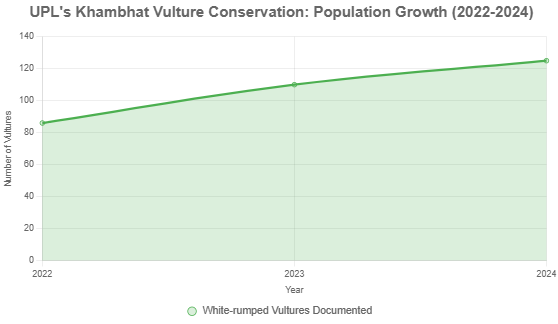
Achievements and Impact (2022–2025)
| Year | White-Rumped Vultures Documented | Other Species Recorded | Key Achievements |
|---|---|---|---|
| 2022 | 86 | — | Baseline study conducted |
| 2023 | 110 | Egyptian (2), Indian (8), Griffon (10) | Initiated awareness campaigns |
| 2024 | 125 | — | Documented 10 feeding sites, 11 nesting locations |
| 2025 | — | — | Presented study at National Symposium, signed MoUs |
Through continuous monitoring, the vulture count in the Khambhat region has shown a steady increase from 86 to 125, signaling a gradual recovery.
***
Community Outreach and Recognition
By 2024–25, the project reached over 2,000 individuals, including students, skinners, and farmers. Such extensive participation has built a community culture where vulture conservation is seen as both a social and environmental responsibility.
UPL’s broader Species Conservation Project, which includes this vulture initiative, was recognized at the 75th District-level Van Mahotsav in Anand, where it received an appreciation plaque and memento for outstanding contribution to biodiversity conservation.
***
The Broader Ecological and Social Significance
Vultures are among nature’s most efficient waste management systems. By feeding on carcasses, they prevent the spread of diseases such as anthrax and rabies. Their decline, therefore, has public health implications.
UPL’s Khambhat Vulture Conservation Project stands out not only for saving a species but for addressing public hygiene, biodiversity restoration, and rural ecological education in a single framework.
The Khambhat Vulture Conservation Project has contributed to:
- Increasing vulture numbers in Khambhat and Tarapur.
- Strengthening public awareness of biodiversity.
- Inspiring community-led conservation in rural Gujarat.
- Providing a replicable CSR model for species preservation in India.
Vultures play a crucial role in maintaining environmental hygiene by disposing of animal carcasses and controlling disease spread. UPL’s initiative not only safeguards this species but also promotes ecological balance and sustainable coexistence.
***
Corporate Responsibility in Action
Through this pioneering initiative, UPL Limited has redefined CSR in biodiversity conservation by linking scientific rigor with community empowerment. The success of the Khambhat Vulture Conservation Project is a testament to the power of corporate partnerships, local participation, and sustained ecological stewardship.
As the project continues to expand, it offers a replicable model for conservationists, corporations, and governments alike — proving that when business aligns with biodiversity, both nature and society thrive.
Terms & Conditions: India CSR does not permit other Websites/agencies to copy or reproduce, or reprint the above article/feature in any form or means.