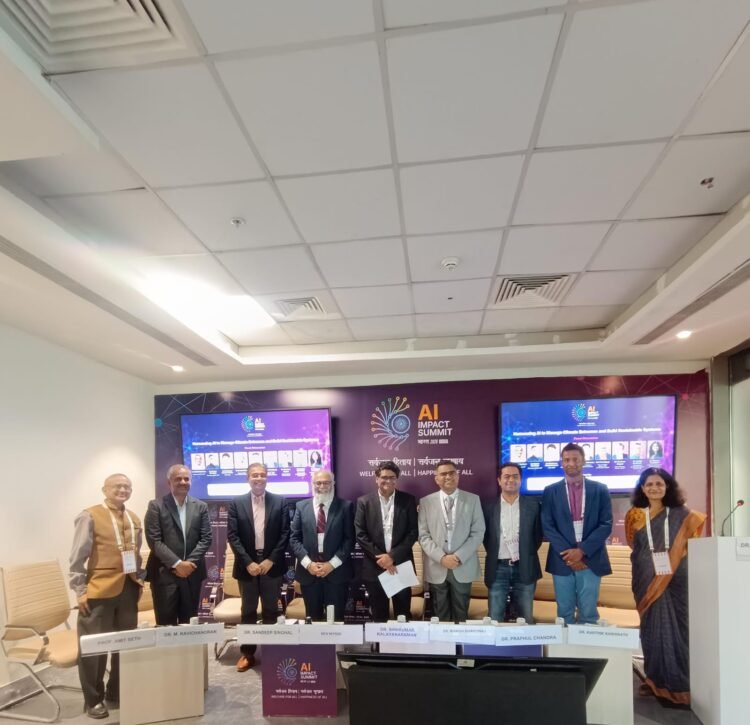


NEW DELHI (India CSR): Senior government leaders, AI scientists, climate experts, and investors convened at the India AI Impact Summit for a high-level panel discussion on “Harnessing AI to Manage Climate Extremes and Build Sustainable Systems.”
The session was jointly hosted by the India AI Research Organisation (IAIRO), Atria University, Centre for Development of Advanced Computing (C-DAC), Indian Institute of Tropical Meteorology under the Ministry of Earth Sciences, and Lokniti.
Panelists
- Dr. M. Ravichandran, Secretary, Ministry of Earth Sciences, Government of India
- Er. Manish Bhardwaj, Secretary, National Disaster Management Authority (NDMA), Government of India
- Dr. Shivkumar Kalyanaraman, CEO, Anusandhan National Research Foundation (ANRF)
- Prof. Amit Sheth, Founding Director, IAIRO & Professor, University of South Carolina
- Dr. Praphul Chandra, Professor and Dean (Research), Atria University
- Dr. Karthik Kashinath, Distinguished Scientist & Engineer, NVIDIA, Santa Clara, USA
- Prof. Dev Niyogi, William Stamps Farish Chair Professor and UNESCO Chair, University of Texas at Austin, Jackson School of Geosciences
- Sandeep Singhal, Senior Adviser & Investment Committee Member, Avaana Capital
- Dr. Akshara Kaginalkar, Professor of Practice, Centre for Climate Change, Atria University
“We Need to Fuse Physics-Based Models and AI”, Dr. M. Ravichandran, Secretary, Ministry of Earth Sciences
Dr. Ravichandran emphasized the increasing complexity of weather forecasting in the context of climate change and the need for integrated modeling approaches.
“If you want to go for spatial prediction, the physics-based numerical model does a better job. But if you want to go for time series and local rhythm, AI is better. We need to integrate or fuse both together.”
On high-impact weather events, he noted, “For cloudbursts and extreme events, we cannot rely only on numerical models or only on AI. We need both.”
“AI Must Support Trusted Early Warning Systems” – Er. Manish Bhardwaj, Secretary, NDMA
Er. Bhardwaj underscored the importance of reliable and citizen-centric warning systems.
“AI cannot be purely standalone. It has to be a hybrid model connected with physical sensor systems and satellite data.”
He added, “We must create trusted, reliable and resilient early warning systems for citizens at low cost. AI can definitely play a supporting role.”
“India Must Shine-Not Follow” – Prof. Amit Sheth, Founding Director, IAIRO
Prof. Amit Sheth framed the discussion within India’s broader AI strategy.
“This is a fantastic opportunity for India to shine, not necessarily follow the West or China, but to decide what we need to do.”
He highlighted IAIRO’s focus on building original, domain-specific models:
“We are developing original work on building very agile, small, specific models. If you want a model for hyper-local extreme weather, you need spatial-temporal modeling and predictive algorithms designed for that purpose.”
He further stated, “We will not be building on top of large-language models that come with a lot of baggage. You don’t know what kind of data they are trained on.”
IAIRO is building a platform over India’s AI infrastructure to create trustworthy, sector-specific AI systems, with climate and earth sciences identified as a key vertical alongside health and pharma.
From Weather Outputs to Decision Intelligence – Prof. Dev Niyogi, University of Texas at Austin
Prof. Niyogi emphasized that climate AI must move beyond variable prediction toward decision support.
“People don’t need weather. They need weather that helps them make a decision.”
He advocated for purpose-driven digital twins: “We don’t need to predict every variable at every scale. If we define what decision we are going to make, we can create intelligent, scalable modeling systems.”
A Converging Consensus
The panel underscored that India’s climate resilience strategy must integrate:
- Physics-based numerical weather prediction
- AI-driven time-series and predictive models
- Satellite and sensor data ecosystems
- Decision-specific digital twins
The discussion reinforced that hybrid, sovereign, and trustworthy AI systems will be central to strengthening disaster preparedness, sustainability planning, and long-term climate resilience.
(India CSR)