


• India CSR Awards 2025
  • India CSR Leadership Summit
  • Guest Posts
Friday, February 20, 2026
India CSR
  • Home
  • Corporate Social Responsibility
    • Art & Culture
    • CSR Leaders
    • Child Rights
    • Culture
    • Education
    • Gender Equality
    • Around the World
    • Skill Development
    • Safety
    • Covid-19
    • Safe Food For All
  • Sustainability
    • Sustainability Dialogues
    • Sustainability Knowledge Series
    • Plastics
    • Sustainable Development Goals
    • ESG
    • Circular Economy
    • BRSR
  • Corporate Governance
    • Diversity & Inclusion
  • Interviews
  • SDGs
    • No Poverty
    • Zero Hunger
    • Good Health & Well-Being
    • Quality Education
    • Gender Equality
    • Clean Water & Sanitation – SDG 6
    • Affordable & Clean Energy
    • Decent Work & Economic Growth
    • Industry, Innovation & Infrastructure
    • Reduced Inequalities
    • Sustainable Cities & Communities
    • Responsible Consumption & Production
    • Climate Action
    • Life Below Water
    • Life on Land
    • Peace, Justice & Strong Institutions
    • Partnerships for the Goals
  • Articles
  • Events
  • हिंदी
  • More
    • Business
    • Finance
    • Environment
    • Economy
    • Health
    • Around the World
    • Social Sector Leaders
    • Social Entrepreneurship
    • Trending News
      • Important Days
        • Festivals
      • Great People
      • Product Review
      • International
      • Sports
      • Entertainment
    • Case Studies
    • Philanthropy
    • Biography
    • Technology
    • Lifestyle
    • Sports
    • Gaming
    • Knowledge
    • Home Improvement
    • Words Power
    • Chief Ministers
No Result
View All Result
  • Home
  • Corporate Social Responsibility
    • Art & Culture
    • CSR Leaders
    • Child Rights
    • Culture
    • Education
    • Gender Equality
    • Around the World
    • Skill Development
    • Safety
    • Covid-19
    • Safe Food For All
  • Sustainability
    • Sustainability Dialogues
    • Sustainability Knowledge Series
    • Plastics
    • Sustainable Development Goals
    • ESG
    • Circular Economy
    • BRSR
  • Corporate Governance
    • Diversity & Inclusion
  • Interviews
  • SDGs
    • No Poverty
    • Zero Hunger
    • Good Health & Well-Being
    • Quality Education
    • Gender Equality
    • Clean Water & Sanitation – SDG 6
    • Affordable & Clean Energy
    • Decent Work & Economic Growth
    • Industry, Innovation & Infrastructure
    • Reduced Inequalities
    • Sustainable Cities & Communities
    • Responsible Consumption & Production
    • Climate Action
    • Life Below Water
    • Life on Land
    • Peace, Justice & Strong Institutions
    • Partnerships for the Goals
  • Articles
  • Events
  • हिंदी
  • More
    • Business
    • Finance
    • Environment
    • Economy
    • Health
    • Around the World
    • Social Sector Leaders
    • Social Entrepreneurship
    • Trending News
      • Important Days
        • Festivals
      • Great People
      • Product Review
      • International
      • Sports
      • Entertainment
    • Case Studies
    • Philanthropy
    • Biography
    • Technology
    • Lifestyle
    • Sports
    • Gaming
    • Knowledge
    • Home Improvement
    • Words Power
    • Chief Ministers
No Result
View All Result
India CSR
No Result
View All Result
Home Articles

How to Pick a CEO

Selecting a CEO is one of the most important functions of a board: some believe it is the second most important function after monitoring CEO performance.

India CSR by India CSR
October 14, 2011
in Articles, Corporate Governance
Reading Time: 4 mins read
Corporate Governance

Photo: patrizia.ag

Share Share Share Share

Headless PSUs can learn lesson from former P&G CEO


By TT Ram Mohan

Professor, IIM Ahmadabad

Infosys Technologies initiated a much-publicised search for a chairman and CEO, which ended a few months ago. Deutsche Bank’s recent search for a CEO too was widely publicised. In both these cases, the process began long before the incumbent was due to step down and the boards were said to be involved.

Selecting a CEO is one of the most important functions of a board: some believe it is the second most important function after monitoring CEO performance. And yet it is among the most neglected. A 2009 survey by the National Association of Corporate Directors in the US revealed that 43% of US public companies had no formal succession plan and 61% had no emergency plan. Boards tend to ignore succession planning until close to the retirement of the incumbent .

This is because, all too often, the incumbent’s idea of succession planning is to prevent any succession in the first place. When the CEO finally decides to move on, the board lamely accepts his recommendation on a successor. These days, CEO departures can be both abrupt and frequent. In these situations, boards turn to a headhunter.
The headhunter’s list mostly comprises outsiders, as it lacks knowledge of the inner workings of the company. Research shows that the selection of outsiders generally leads to inferior performance compared to the selection of insiders. In other words, there is little to beat a planned succession from amongst a set of inside executives whom the board has had the opportunity to watch over a long period of time. A recent article in Harvard Business Review (October 2011) by A G Lafley, a former CEO of Procter & Gamble, shows what succession planning at its best can be. Lafley decided that the search for a successor would begin at the beginning of his term. He also decided that one out of six meetings of the board would be devoted to CEO succession and leadership development. Lafley helped the process along in two ways.

First, he ensured that the company’s directors had first-hand exposure to a range of future leaders. Every director was encouraged to meet at least twice a year with business or functional leaders without any corporate P&G managers present. In addition, before and after every board meeting, the board was given an opportunity to meet P&G’s senior executives on any subject of their choosing. Once a year, the directors and the management team would go to an international business location to meet directly with regional and local leaders. Secondly, in collaboration with the directors, Lafley developed criteria for the CEO’s job, scenarios for the company in the future and a list of experiences that would prepare candidates for the job.

He measured candidates against these criteria and scenarios and provided his inputs to the board from time to time. Lafley took upon himself the task of identifying and training the top 500 executives in the company. In addition , every month, he had oneto-one conversations with 15-20 high potential leaders. These leaders were put through several tests. The person who finally succeeded Lafley had been on every single list from 2001 to 2010. It is possible to be sceptical about some of the things that Lafley talks about. For instance, he mentions 10 criteria that his successor was expected to meet. It was not enough for him to have character and demonstrate business performance. He would have to be compassionate, inspiring , courageous, visionary, etc. It would appear that P&G was looking not for another CEO, but the Lord Almighty himself !

Still , one must grant that P&G’s succession planning process is as thorough as can be. The most striking feature is the board’s involvement in the process. The advantage of involving the board so deeply is that the board gets to know the company and its senior executives a lot better. This has the potential to transform corporate governance. Most boards tend to be cut off from the companies they are supposed to manage. The only information they have is whatever the CEO chooses to make available. By getting the board to interact with several levels of management in a structured way, succession planning can become a means for improving the effectiveness of the board itself. Indian companies would do well to emulate the process followed by P&G . The larger industrial groups do need CEOs for their various businesses.

In the listed companies in a group, it is possible to involve boards in a rigorous search. Ditto for the few professionally-managed businesses we have. It is in the public sector that succession planning is most lacking: witness the vacuum at the top today at LIC and UTI. This is a pity because a couple of factors make it possible for the public sector to score on this account. There is a healthy turnover at the top, thanks to a fixed retirement age for the CEO. Secondly, the boards have directors who are truly independent of management as they do not owe their jobs to management.

It is legitimate for the government to want a say in the selection of public sector CEOs. There is a way in which it can both have its say and improve outcomes. The government must constitute a permanent search committee for PSUs — along the lines of the Public Enterprises Selection Board — in which its nominees are in majority but which co-opts independent directors from the companies whose CEOs are to be selected. PSU boards are among the most ineffective boards. Getting them involved in succession planning could be a way to put some life into them.
Tags: Corporate Governance in INDIA

CSR, Sustainability, and ESG success stories hindustan zinc
ADVERTISEMENT
India CSR

India CSR

India CSR is the largest media on CSR and sustainability offering diverse content across multisectoral issues on business responsibility. It covers Sustainable Development, Corporate Social Responsibility (CSR), Sustainability, and related issues in India. Founded in 2009, the organisation aspires to become a globally admired media that offers valuable information to its readers through responsible reporting.

Related Posts

VESCOA’s Beach Clean-Up Drive at DadarChowpatty
Articles

VESCOA’s Beach Clean-Up Drive at DadarChowpatty

3 days ago
Saarang Ganapathi, Chief Executive Officer Embassy Services Pvt. Ltd. india csr
Articles

From Consumer to Prosumer: Commercial Parks Powering the Grid

4 days ago
Gaurav Terdal, CHRO SMFG India Credit
Articles

Why Livestock Health Is Central to Rural Economic Stability

1 week ago
Childcare
Articles

Stronger Families, Stronger Bottom Lines: Why Childcare Support Is a Business Imperative

2 weeks ago
Satish Jha
Articles

Satish Jha: India Has Grown But Not Flourished

2 weeks ago
Corporate Social Responsibility
Articles

From Compliance to Impact: Designing Site-Specific and Need-Based CSR Programs

3 weeks ago
Load More
Ambedkar Chamber
ADVERTISEMENT
India Sustainability Awards 2026
ADVERTISEMENT

LATEST NEWS

Oratrics CSR Initiative Boosts Communication Skills and Confidence in Schools

Six Generations of Medical Legacy Power Sarkar Superspeciality Hospital’s Advanced Reproductive &Superspeciality Expansion in Agra

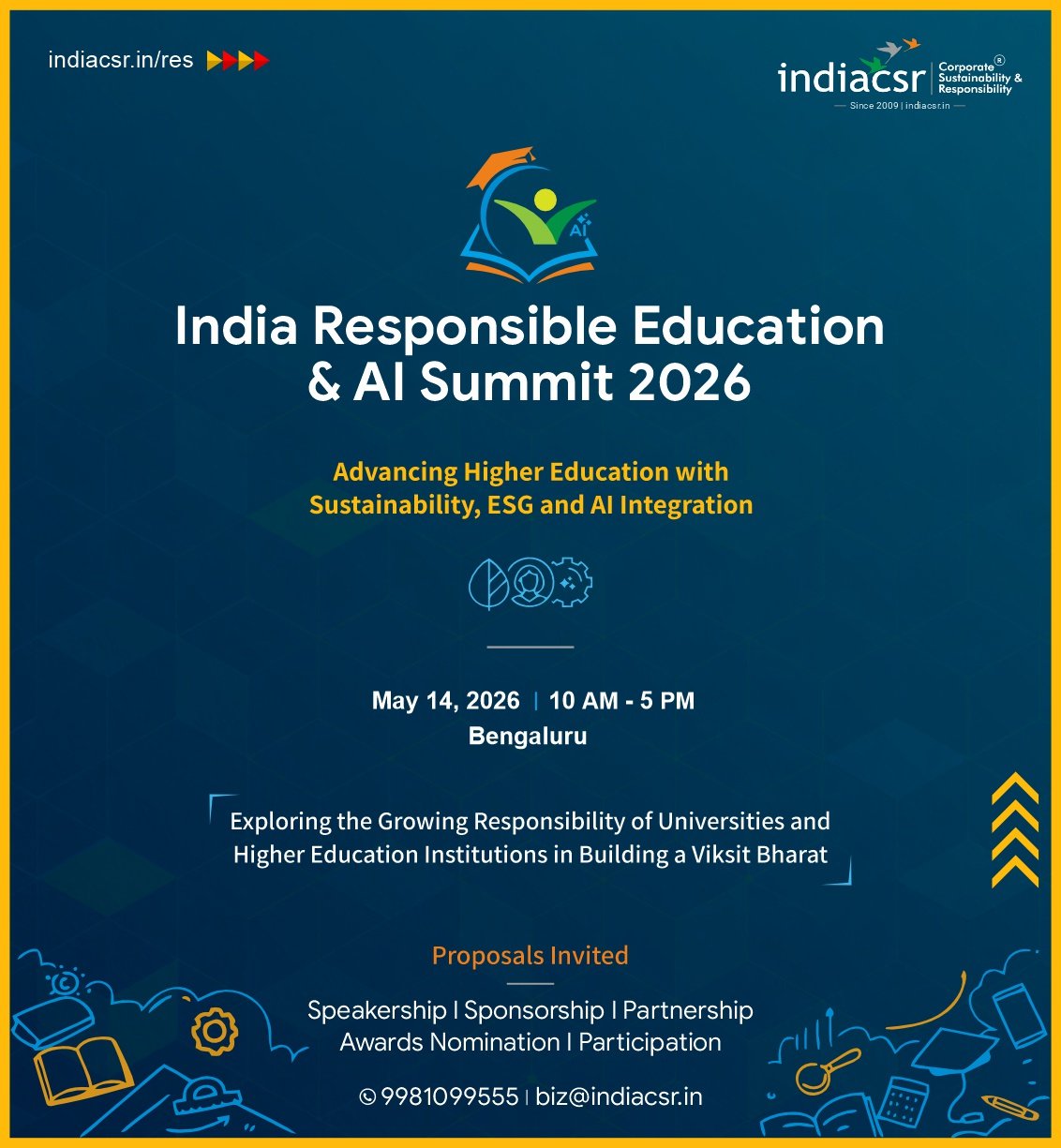
India Responsible Education & AI Summit 2026 in Bengaluru on May 14

Indigenous CAR-T Therapy Signals New Phase for India’s Cancer Care and Biotech Manufacturing

Startups and SMBs Urged to Recognize the “Iteration Tax” Slowing Growth Momentum

To Cut A Long Story Short: Eleven Stories That Look Closely at Choice, Chance, and Consequence

Economy India Largest Media on Indian Economy and Business
ADVERTISEMENT
Ad 1 Ad 2 Ad 3
ADVERTISEMENT
ESG Professional Network
ADVERTISEMENT

TOP NEWS

Government Clears Rs 10,000 Crore Fund of Funds 2.0 for Startups

Six Generations of Medical Legacy Power Sarkar Superspeciality Hospital’s Advanced Reproductive &Superspeciality Expansion in Agra

Baroda BNP Paribas debuts “Baroda BNP Paribas ESG Best-in-Class Strategy Fund” – good for investors and society

Gravton Motors Partners with Isha Yoga Center as Official EV Mobility Partner for Mahashivratri 2026

CSR: SMFG India Credit Impacts 1.55 Lakh Lives on Pashu Vikas Day

हिन्दुस्तान जिंक ने एसएण्डपी ग्लोबल सस्टेनेबिलिटी ईयरबुक 2026 में शीर्ष 1 प्रतिशत रैंकिंग हासिल की

Load More
STEM Learning STEM Learning STEM Learning
ADVERTISEMENT

Interviews

Monika Walia Head – Corporate Social Responsibility GlobalLogic
Interviews

CSR: Robots, Resolve and Rising Girls

by India CSR
February 18, 2026

Inside GlobalLogic’s STEM Push from Pune.

Read moreDetails
Prof. Kang Sung Lee, PhD

Prof. Kang Sung Lee on Academia, Policy, and Industry-Linked Career Pathways

February 5, 2026
Magma Group CEO and Founder, Neal Thakker

Embedding CSR in Responsible Manufacturing at Magma Group: An Interview with Neal Thakker

January 21, 2026
Sudeep Agrawal, CFO & Head – CSR, Ashirvad by Aliaxis

Integrating Financial Leadership With Impactful CSR Initiatives: An Interview with Sudeep Agrawal, Ashirvad by Aliaxis

December 29, 2025
Load More
Facebook Twitter Youtube LinkedIn Instagram
India CSR Logo

India CSR is the largest tech-led platform for information on CSR and sustainability in India offering diverse content across multisectoral issues. It covers Sustainable Development, Corporate Social Responsibility (CSR), Sustainability, and related issues in India. Founded in 2009, the organisation aspires to become a globally admired media that offers valuable information to its readers through responsible reporting. To enjoy the premium services, we invite you to partner with us.

Follow us on social media:


Dear Valued Reader

India CSR is a free media platform that provides up-to-date information on CSR, Sustainability, ESG, and SDGs. We need reader support to continue delivering honest news. Donations of any amount are appreciated.

Help save India CSR.

Donate Now

Donate at India CSR

  • About India CSR
  • Team
  • India CSR Awards 2025
  • India CSR Leadership Summit
  • Partnership
  • Guest Posts
  • Services
  • ESG Professional Network
  • Content Writing Services
  • Business Information
  • Contact
  • Privacy Policy
  • Terms of Use
  • Donate

Copyright © 2025 - India CSR | All Rights Reserved

No Result
View All Result
  • Home
  • Corporate Social Responsibility
    • Art & Culture
    • CSR Leaders
    • Child Rights
    • Culture
    • Education
    • Gender Equality
    • Around the World
    • Skill Development
    • Safety
    • Covid-19
    • Safe Food For All
  • Sustainability
    • Sustainability Dialogues
    • Sustainability Knowledge Series
    • Plastics
    • Sustainable Development Goals
    • ESG
    • Circular Economy
    • BRSR
  • Corporate Governance
    • Diversity & Inclusion
  • Interviews
  • SDGs
    • No Poverty
    • Zero Hunger
    • Good Health & Well-Being
    • Quality Education
    • Gender Equality
    • Clean Water & Sanitation – SDG 6
    • Affordable & Clean Energy
    • Decent Work & Economic Growth
    • Industry, Innovation & Infrastructure
    • Reduced Inequalities
    • Sustainable Cities & Communities
    • Responsible Consumption & Production
    • Climate Action
    • Life Below Water
    • Life on Land
    • Peace, Justice & Strong Institutions
    • Partnerships for the Goals
  • Articles
  • Events
  • हिंदी
  • More
    • Business
    • Finance
    • Environment
    • Economy
    • Health
    • Around the World
    • Social Sector Leaders
    • Social Entrepreneurship
    • Trending News
      • Important Days
      • Great People
      • Product Review
      • International
      • Sports
      • Entertainment
    • Case Studies
    • Philanthropy
    • Biography
    • Technology
    • Lifestyle
    • Sports
    • Gaming
    • Knowledge
    • Home Improvement
    • Words Power
    • Chief Ministers

Copyright © 2025 - India CSR | All Rights Reserved

This website uses cookies. By continuing to use this website you are giving consent to cookies being used. Visit our Privacy and Cookie Policy.



