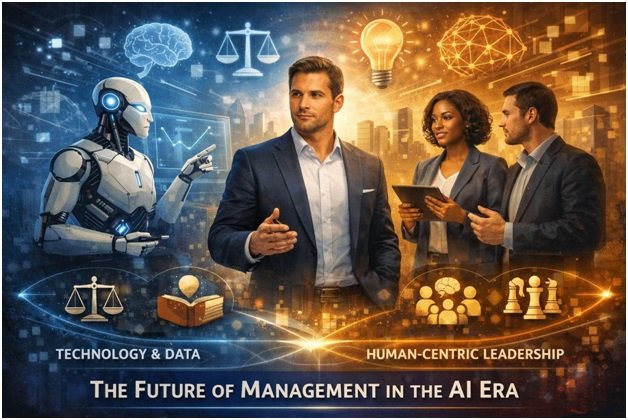


NEW DELHI (India CSR): Artificial Intelligence is fundamentally transforming the expectations placed on future managers, rewriting the competencies that business schools must cultivate. As automation takes over repetitive and analytical tasks, the true differentiator for managers is shifting from operational efficiency to strategic intelligence. Decision-making in uncertainty, ethical reasoning, creative problem-solving, and the ability to synthesize complex, ambiguous data are becoming indispensable. In this new landscape, success belongs to professionals who can harness AI as a collaborator rather than view it as a competitor.
Management roles are rapidly evolving into hybrid profiles that combine domain expertise, technological fluency, and human-centric leadership. While AI systems can process information at extraordinary speed, they lack contextual judgment, empathy, and cultural intuition—qualities essential for influencing teams, shaping organizational culture, and navigating transformation. Skills once dismissed as “soft”—such as storytelling, collaboration, emotional intelligence, and change management—are emerging as critical business enablers. They amplify the value created by AI and ensure technological interventions lead to responsible and sustainable outcomes.
This fundamental shift places renewed responsibility on business schools. The future of management education cannot be defined by tool-based training alone. Instead, B-schools must focus on developing adaptable leaders with learning agility needed to keep evolving alongside technology. Curricula need to integrate AI literacy, data-driven thinking, and ethical frameworks while strengthening human skills that machines cannot replicate. Graduates who can marry technological understanding with purpose-driven leadership will not merely remain relevant—they will actively shape how organizations innovate, compete, and create long-term value in an AI-first world.
“In today’s rapidly shifting digital ecosystem, AI is no longer just an enabler—it is a core component of managerial work. However, the rise of AI does not diminish the relevance of human judgment; instead, it elevates it. Managers must learn to work alongside intelligent systems, using AI to enhance clarity, generate insights, and simulate outcomes, while relying on their own values and contextual understanding to make final decisions. What truly differentiates a leader in the AI era is not technical mastery alone, but the ability to integrate technology with empathy, creativity, and ethical foresight.
Business schools must therefore cultivate leaders who are both analytically sharp and emotionally grounded. The future belongs to graduates who understand that AI amplifies human potential, but it is human intention and responsibility that ultimately guide how technology shapes society.”
— Dr. Harshit Kumar Singh, Assistant Professor, Information Systems
As AI becomes deeply embedded across industries, the leaders who thrive will be those who understand how to balance technological capabilities with human insight. The next generation of managers must not only be fluent in AI but also be responsible stewards of its impact. For B-schools, the mandate is clear: nurture leaders who are agile thinkers, ethical decision-makers, and effective collaborators. In an era defined by intelligent machines, it will be human wisdom and purposeful leadership that determine how organizations shape the future.