

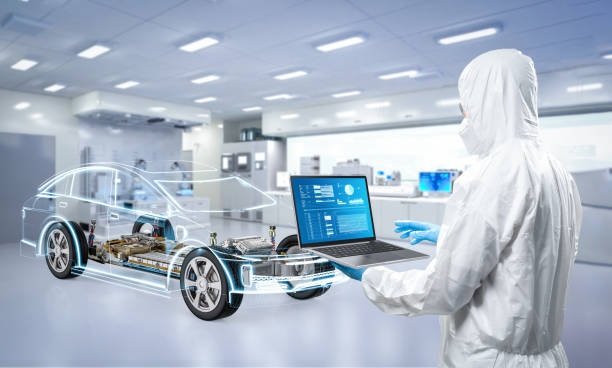



Last year, a team of four mechanical engineering students from a mid-sized college in Pune spent three weeks trying to get their motor controller to stop throwing overcurrent faults. They weren’t working from a simulation. They had a real PMSM on a test bench, a gate driver board they’d partly assembled themselves, and a faculty mentor who — wisely — refused to just hand them the answer.
They figured it out. And that experience, frustrating as it was, taught them more about power electronics than an entire semester of lectures.
That’s what a functioning EV lab actually produces. Not just projects — engineers who can think.

The Problem With How EV Engineering Gets Taught
Most engineering colleges teach electric vehicles the way they’ve always taught emerging technologies: through theory first, application maybe-later. Students learn equivalent circuit models for batteries. They derive torque equations for induction motors. They study switching waveforms in power converters on paper.
None of that is wrong. But it creates a specific blind spot.
When a real system misbehaves — and they always do — textbook knowledge alone doesn’t get you far. A student who has only ever modelled a BMS in software will freeze when a hardware fault shows up and the datasheet doesn’t explain it clearly. The gap between knowing how something should work and understanding why it isn’t working right now — that gap only closes through time spent with actual hardware.
What Shifts When the Infrastructure Is Right
The clearest sign that a college has a serious EV lab isn’t the equipment list. It’s the student projects.
Simulation-only final year projects give way to experimental ones. Students stop asking “can we model this?” and start asking “can we build it and test whether our model is even right?” That shift in question alone signals a different kind of engineering education.
A well-configured EV lab gives students the tools to run that test — battery formation cycling rigs, motor drive test benches, BMS hardware trainers, EVSE prototyping setups, CAN diagnostics tools. The point isn’t the equipment catalogue. The point is that students can take an idea from concept to measurement and find out where the theory held and where it didn’t.
According to NASSCOM, India will need over 10 lakh EV-skilled professionals by 2030. That number means very little unless colleges produce graduates who’ve actually worked on EV systems — not just studied them.
The Range of Work Students Actually Do
Give students the right lab environment and the scope of what they attempt expands in ways that are hard to predict in advance.
Battery characterisation work becomes real research. Students assemble cell modules, stress them through controlled charge-discharge cycles, measure capacity fade, and study how temperature affects performance. That’s publishable work. Several undergraduate teams have submitted findings to national conferences directly out of lab projects.
Motor control experiments get genuinely rigorous. Plotting an experimental torque-speed curve and comparing it against your theoretical model is a different exercise from plotting the model alone. Discrepancies become learning. Students start understanding loss mechanisms — iron losses, copper losses, switching losses — not as exam topics but as things they measured.
V2G experimentation is newer territory, but some advanced EV labs are already supporting it at the student level. Bidirectional charging setups, grid interaction scenarios, energy dispatch logic — it’s the kind of work that sits at the frontier of what the industry is still figuring out. Students contributing to it, even modestly, develop a research instinct that’s hard to build any other way.
EVSE prototyping — designing charging station circuits, working through IEC 61851 compliance requirements, testing smart charging behaviour — gives students a direct handle on commercially relevant problems. Startups and EV charging companies notice graduates who’ve done this work.
What Faculty Gain From It Too
The student side gets most of the attention, but instructors benefit significantly from a well-structured EV lab environment.
When experiment documentation exists — clear setup guides, expected outcomes, known failure modes — faculty can integrate lab sessions meaningfully into course syllabi. Electives in electric drives or energy storage stop being purely theoretical. Each topic maps to something students can physically verify. That’s a different kind of teaching, and most faculty who’ve experienced it don’t want to go back.
Several placement teams at engineering colleges have noted — informally but consistently — that students who’ve completed hands-on EV lab modules perform better in technical interviews. Not because they know more facts, but because they reason differently. They’ve been wrong about hardware before, and they’ve fixed it. That shows.
The Longer Effect on a Campus
It compounds. That’s the thing about EV labs that’s hard to communicate in a facilities proposal.
When credible student projects start coming out of a lab, campus culture shifts. Teams form. Students who weren’t particularly engaged in coursework find a reason to stay late. Competition entries — Formula Bharat Electric, Smart India Hackathon, internal innovation fests — go from being theoretical proposals to hardware-backed submissions.
Industry relationships follow. Companies that see real student work coming out of a college start engaging differently — with internship pipelines, component donations, collaborative projects. Alumni working in EV firms refer the college to their hiring networks.
None of that happens without the lab that started it.
Worth Saying Plainly
India’s EV industry will be built by people who understand the technology deeply. Not people who’ve read about it — people who’ve debugged it at 11 PM, rebuilt something that didn’t work, and developed an intuition for what the system is actually doing versus what it’s supposed to do.
That kind of engineer is made in labs. Colleges that understand this and invest accordingly aren’t just upgrading facilities. They’re making a bet on the quality of engineers they want to send into the world.
It’s a bet worth making.



