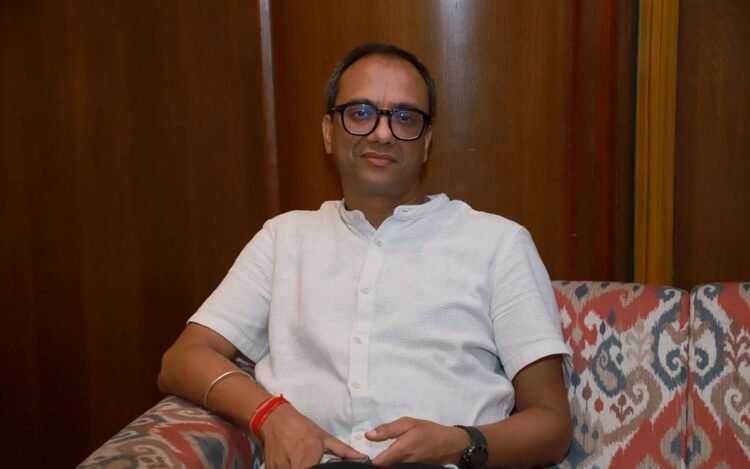


By Ashish Goyal
NEW DELHI (India CSR): Long before the invention of printed books, long before manuscripts were ever copied, stories were passed from one person to another through the spoken word.
From one generation to the next through memory. Around campfires in the evening. In temple courtyards. In village town squares. On long journeys across the land. A grandmother telling a story to a young child about a brave king. A wandering bard singing of devotion and sacrifice. A teacher explaining the meaning of right action through a simple parable.
Storytelling is older than writing. It is older than formal education. It is one of the earliest ways human beings made sense of the world.
In India, storytelling has never been a side activity. It has been central to how we remember who we are.
The epics were not merely texts. They were living conversations. Interpretations of The Ramayana and The Mahabharata occurred in countless ways: narrating, singing, performing, and debating, etc. The two epics exist in many different forms across different cultural regions. Each retelling carried the same core values, yet reflected local colour and context.
This flexibility is important. A culture lives not through the stagnation of its stories but through the breathing room they are given.
India has had a variety of storytelling techniques. Kathavachaks recited stories from scriptures in temples and public places. Yakshagana in Karnataka and Jatra in Bengal are some of the folk forms that tell stories. People use Puppetry to tell stories. They also use shadow plays. Devotional songs and classical dances are used to tell stories. Each region has its special way to keep the stories of Yakshagana and Jatra alive. The people, in each region want to keep these stories alive.
What is central to a story is not the plot. It is the value beneath it.
A good story carries emotion. It allows listeners to see themselves in the characters. It presents conflict and choice. It shows consequence. It does not simply declare what is right or wrong. It demonstrates the cost of action and inaction.
In this way, storytelling becomes a quiet teacher.
Cultural identity is not built through slogans. It grows through shared understanding. When a child hears stories about being brave being patient being kind and finding balance these stories become a part of who they are inside. The stories we tell our children help them figure out how to deal with things that happen in life.
Stories make us feel connected to the people who came before us. They show us that we are a part of something, than ourselves a story that includes many other people. Lots of people have had to make choices and get through hard times. The child learns from these stories. Figures out what it means to be wise. It is nice to know that we are not the ones to go through tough times it makes us feel more stable in a world that is always changing.
Telling stories is facing a problem nowadays.
We live in a world that is moving fast. Our attention is, over the place. Visual media dominates. Content is consumed quickly and forgotten quickly. In an environment like this, stories told in a more traditional way can feel old-fashioned.
There is also the danger of oversimplifying complex stories in a spectacular way. While stories are being used as an entertainment tool, they can become shallow. On the other hand, if they are used as hardline teachings, they become inaccessible to our youth.
So the challenge becomes how to make our stories accessible in a new form without diminishing them. This could mean stories written in a novel form interpreting philosophical teachings in a contemporary setting. It may mean films that explore moral tension rather than just visual grandeur. It may mean podcasts, digital platforms, or community readings that revive conversation.
The medium can change. The meaning should not.
One more major function of a story is that it brings together different aspects or groups (such as cultures, religions, etc.). In fact, diversity has been a big characteristic of India from ancient times until now. We have many languages and many interpretations. We are a diverse country. Still, there are some common elements in all the stories we tell. The idea of dharma as responsible action. The value of humility. The recognition of balance between human life and nature.
Stories allow these shared themes to exist without enforcing uniformity. That is cultural strength.
When looking forward to the future, it is my belief that storytelling will continue to have a place in the retention of identity. However, it will require effort. Families will have to continue to make storytelling an important part of family life. Educators will have to look beyond the literature in the textbook. Creators will have to look beyond the traditional through innovation.
Technology, which has been considered a barrier to storytelling in many cases, will become a catalyst. This will require intention. Are we utilizing this technology to gain a better understanding or are we utilizing it to gain more attention?
For me, storytelling is not about nostalgia. Storytelling is about continuity.
When we connect ourselves to our storytelling heritage, we are not disconnecting ourselves from the modern world. We are connecting ourselves more solidly. We are bringing a sense of our heritage to our understanding of our place in the world. This gives us a sense of clarity in terms of our direction in the world.
Our cultural identity will not be retained through force. Our cultural identity will be retained through memory. Our memory will be retained through stories.
As long as stories are being told from a place of sincerity and are being received from a place of openness, then our culture will continue to thrive.
About the Author
Ashish Goyal, Author of Guardian of Dharma Series.
(India CSR)