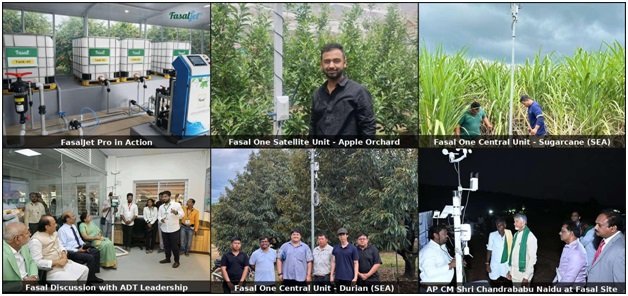
With a mature technology system operating at scale, the agri-tech firm’s new offerings have already found interest from several state government departments and other large institutions, besides thousands of farmers across India & Southeast Asia
BENGALURU: After exiting its fresh produce business in March’25, leading agri-tech company Fasal today announced bolstering the next phase of its growth through its new products developed to address the increasing farmer demand for technology-enabled farming solutions. The company announced the launch of ‘FasalJet’ and ‘FasalJet Pro’ – irrigation and fertigation automation products – which automate precision-sensitive operations for farmers. Fasal’s research depicts that these offerings, along with its robust ‘FasalOne’ family of farm IoT devices, can make the Indian horticulture sector significantly more competent globally.
As Fasal’s crop intelligence systems scaled, the company noticed a consistent pattern emerging from the fields – tight labour availability and rising wage costs, and operational complexity – made farming more demanding. FasalJet and FasalJet Pro were designed to address this need for irrigation and fertigation automation, extending the platform from sensing and recommendations into on-farm execution. These systems automate precision-sensitive operations where manual execution often breaks down, while remaining simple enough to operate in real farming conditions. The automation products have been fully developed, commercially validated, and are now being scaled across multiple Indian states, including Maharashtra, Karnataka, Andhra Pradesh, Haryana, Himachal Pradesh, besides others. The focus remains clear: build systems farmers can depend on, every day, without adding operational burden.
Fasal’s technology offerings include FasalOne, launched in April 2025, a next-generation farm Internet of Things (IoT) platform, designed to work across crops, geographies, and farm sizes. Built and proven in India’s most demanding farm conditions, Fasal’s platform reflects a simple belief: if technology can work reliably here, it can work anywhere. The company is taking this made-in-India, for-the-world approach into its next phase of growth.
Built around a modular architecture of central and satellite units, the FasalOne platform allows farms to start small and expand over time, increasing both coverage and capability without replacing existing systems. This platform design lowers entry barriers for very small landholdings while continuing to support larger and more complex operations. Since launch, the platform has been steadily scaled across farms in Maharashtra, Karnataka, Andhra
Pradesh, Telangana, Madhya Pradesh, Gujarat, Rajasthan, Himachal Pradesh, Punjab, etc., with reliability, usability, and real-world performance guiding every deployment. The company aims to support up to 100,000 farmers across India and Southeast Asia in the next 5 years.
Technology validated for regional and national institutional programmes
Over the past year, Fasal has deepened its product and technology foundation and launched these new products in response to growing on-ground needs through technology validated for regional & national sensitive institutional programmes. This phase has also been shaped by a deliberate strategic choice: Fasal sharpened its focus on farm technology as its primary operating business. That decision allowed the company to concentrate on what it had been building steadily over the years, technology designed to help farmers make the right decisions and execute them reliably on the ground, especially as labour availability becomes an increasing constraint.
Alongside farmer adoption, Fasal’s technology has increasingly been deployed through institution-led programmes focused on productivity, resource efficiency, and traceability at regional and state levels. One such initiative is the Sugarcane Productivity Improvement Programme, led by ADT Baramati. As part of this programme, Fasal implemented its IoT & crop intelligence systems across 5,000 farms in phase I, with the programme expected to expand to tens of thousands more farmers in the coming years. Fasal was also a part of Atal Bhujal Yojana, a national programme aimed at improving groundwater sustainability through community-led behaviour change. In this context, Fasal’s technology has supported data-driven irrigation decisions and more responsible groundwater use at the farm level. More recently, Fasal has been entrusted with a Grape & Pomegranate Productivity Improvement Programme in Karnataka, supported by the Karnataka Department of Horticulture. This initiative focuses on improving productivity, quality, and traceability across Grape & Pomegranate-growing regions by deploying farm-level intelligence consistently across individual farms, rather than relying on fragmented interventions. Fasal also has several other large projects in the pipeline across government institutions to expand the success to other states.
Shailendra Tiwari, Founder & CEO, Fasal, said, “Fasal now works with 12,000+ farmers and 100+ enterprises across India and South East Asia. The benefits have been robust, with over 83 billion litres of water (enough drinking and domestic water for the entire population of Goa for about one year), 210,000 Kgs of pesticides saved and more than 56,000 MT of GHC emissions saved along with significant enhancement in farmer prosperity. Taken together, these programmes reflect a growing pattern: institutions are turning to Fasal to translate policy and research intent into execution on the ground, at scale.”
Taking an India-built platform to global markets
This year also marks Bengaluru-headquartered Fasal’s expansion beyond India. From the beginning, the company set out to build technology with global relevance, but chose to first prove it in one of the world’s most complex agricultural environments. With a mature hardware platform, live automation systems, and experience operating at scale, Fasal has begun establishing its footprint in Southeast Asia since FY25-26. The company’s distribution networks are now active in markets such as Philippines, Indonesia, Malaysia, and Thailand with deployments already underway as the markets scale across crops such as Sugarcane, Durian, Banana, and vegetables. Early response from these markets has reinforced a simple insight: the challenges Fasal is addressing – labour stress, execution reliability, and resource efficiency are structural issues across countries and specially relevant in Asia, Africa & Middle East.
Building for the future of farming
Across these developments, Fasal is building a closed-loop farm technology stack that connects sensing, decision-making, and execution into a single system. As labour stress continues to intensify across agriculture, this approach is becoming essential to sustaining productivity, quality, and consistency on farms.
Fasal will continue to expand this platform directionally, adding new capabilities where emerging on-ground challenges demand them, while staying focused on robustness, reliability, and usability.
About Fasal: Fasal is a pioneering agricultural technology company enabling precision horticulture from decision-making through on-farm automation. Founded in 2018, Fasal builds full-stack farm intelligence and execution systems that integrate patented IoT hardware, agronomic science, AI-driven models, and automation to help farmers and agri-enterprises run predictable, efficient, and resilient operations. Fasal’s platform delivers farm-level, crop-specific, and crop-stage-specific intelligence across irrigation, fertigation, and pest and disease management, translating insights directly into field actions. By closing the loop between sensing, decision-making, and execution through automation, Fasal helps horticulturists improve yield quality, reduce the cost of cultivation, and manage risk proactively. The company propagates sustainable horticulture practices that create measurable social, economic, and environmental impact, contributing directly to multiple UN Sustainable Development Goals including water efficiency, climate action, and farmer livelihoods. Co-founded by Ananda Verma and Shailendra Tiwari, Fasal is on a mission to drive a horticulture-led farming transformation globally.
(India CSR)