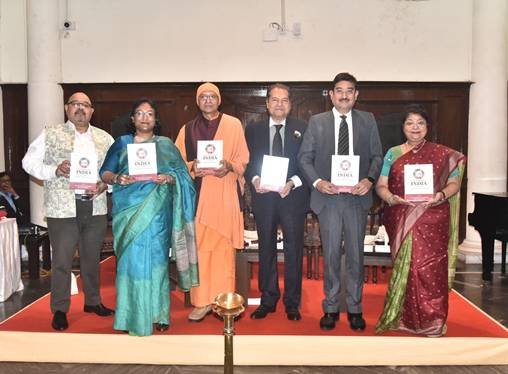


CSR Case Studies from India: 10 Years of Impact and Nation Building, a book on CSR (Corporate Social Responsibility) flagship projects by eminent corporations of India, was launched on December 18, 2025 at Sir RN Mookerjee Hall, Calcutta Club, Kolkata.
KOLKATA: The book is co-edited by Dr. Bhaskar Chatterjee and Dr. Nayan Mitra, two eminent experts in the field of CSR and sustainability and published by Sterling Publishers Private Limited. The publication presents twelve in-depth case studies of flagship CSR programmes by leading Indian corporates, highlighting how corporate purpose has translated into measurable social impact and nation-building outcomes. Contributing organisations include Capgemini Technology Services India Limited, Cargill India, Castrol India Limited, IndusInd Bank, ITC Limited, JK Organisation, JSW Foundation, Kotak Education Foundation, Mahindra & Mahindra Limited, Tata Steel, Tech Mahindra Foundation, and Vedanta Limited.
The launch event brought together policymakers, corporate leaders, academics and CSR practitioners. Swami Prajnatmananda, from Ramakrishna Mission, as the Chief Guest, provided perspectives on spiritual leadership focusing on ethics, collaboration and sustainable development. He emphasized the ethical and spiritual foundations of responsible corporate engagement, stating that charity must be practiced with honor, compassion, humility, and abundance. He explained charity (dāna) as an expression of dharma—the universal principle that sustains social and cosmic harmony, going beyond religion to promote collective well-being. He described CSR as a form of collective sacrifice aimed at the welfare of many, rooted in the principle that true joy and virtue arise from selfless giving and service.
Special Guest, Atri Bhattacharya, IAS, Additional Chief Secretary, Sundarban Affairs Department spoke on the importance of public-private collaboration in driving sustainable outcomes. He highlighted that CSR should go beyond a mandatory requirement and be seen as a means of brand building and corporate identity. He noted that while CSR in the Sundarbans has largely focused on mangrove afforestation—an area with monitoring challenges, the region’s most urgent issue is access to safe drinking water. Given the logistical and resource constraints faced by the government, especially across the 54 inhabited islands, he emphasized the potential of CSR-led solutions such as rainwater harvesting in schools and environmentally friendly infrastructure. Despite procedural barriers to public–private collaboration, he expressed commitment to engaging companies to support impactful CSR initiatives in the Sundarbans.
Keynote Address
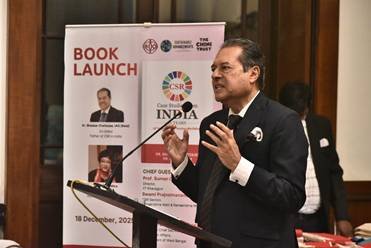
Dr. Bhaskar Chatterjee during his keynote address
In his keynote address, Dr. Bhaskar Chatterjee reflected on the evolution of Corporate Social Responsibility in India and its emergence as a globally unique, legislated framework. He spoke about his long-standing academic collaboration with Dr. Nayan Mitra, noting that the book is the outcome of years of shared scholarship and engagement with CSR policy and practice. Acknowledging the presence of senior CSR leaders and practitioners, he expressed appreciation for their role in shaping India’s CSR ecosystem.
Placing CSR in historical context, Dr. Chatterjee described Section 135 of the Companies Act, 2013 as the only CSR mandate of its kind in the world, conceptualised in India and for India. He highlighted the rapid expansion of CSR in both scale and scope over the past decade, underscoring how corporate understanding and ownership of the law has transformed CSR into a powerful instrument for inclusive national development. He also acknowledged the leadership of the twelve contributing organisations whose case studies form the core of the book.
“India’s CSR framework allows corporate enterprise to participate with dignity and purpose in nation-building.” – Dr. Bhaskar Chatterjee
Panel Discussion: Collaborating for Impact in India’s CSR Ecosystem
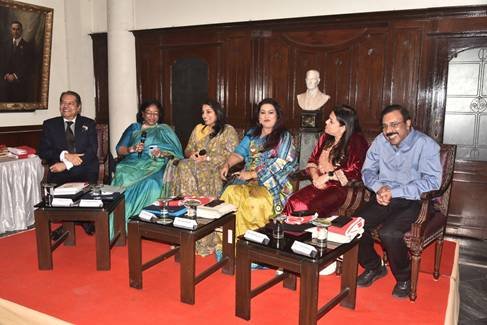
Panel Discussion in progress
The panel discussion, titled “Collaborating for Impact in India’s CSR Ecosystem”, was moderated by Dr. Nayan Mitra and brought together eminent CSR leaders to examine collaboration as the cornerstone of effective CSR. The panel featured Dr. Bhaskar Chatterjee, IAS (Retd); L Prabhakar of ITC Limited; Ridhi Bhatia of Kotak Mahindra Bank; Piya Nandi of mjunction services ltd.; and Ms. Sutanuka Ghosh of Genpact.
The discussion explored how intent, leadership, purpose, and integrity shape CSR decision-making with regards to impactful collaborations. Ridhi Bhatia spoke about aligning the what, where, whom and how of CSR through depth, sustainability, and strategic partnerships. L Prabhakar emphasised that true leadership in CSR lies in collaboration, noting that purpose must be embedded across teams rather than centred on individuals. He also highlighted a shift from infrastructure-led spending to behaviour change–oriented interventions.

“True leadership in CSR lies in collaboration. Purpose must be embedded across teams, not centred on one individual, otherwise it collapses when people move.” Mr. L Prabhakar
“Intent is what shapes impact. For us, the ‘where’, ‘what’ and ‘how’ of CSR are guided by depth, sustainability and strategic collaboration.” – Ms. Ridhi Bhatia
Focusing on purpose-driven engagement, Sutanuka Ghosh shared Genpact’s experience with skill-based volunteering and pro bono support, highlighting the role of employee engagement in solving real-world problems and creating community impact at scale. Piya Nandi discussed M-Junction’s approach to building an independent CSR identity inspired by its parent organisations, while emphasising measurable impact, digital inclusion, and a convergence-based CSR model.
“Purpose-driven collaboration is most effective when internal and external stakeholders work together. Skill-based volunteering allows us to solve real problems while creating meaningful community impact.” – Ms. Sutanuka Ghosh
“Building an independent CSR identity is both a challenge and an opportunity. Our focus has been on measurable impact, digital inclusion, and a unified approach to social investment.” Ms. Piya Nandi

Addressing the broader ecosystem, Dr. Bhaskar Chatterjee described collaboration as an intrinsic and transformative feature of India’s CSR mandate, inviting reflection on how partnerships across sectors have contributed to national development.
“What makes mandated CSR powerful is how Indian companies have understood its spirit and helped it grow into a force for inclusive development.” – Dr. Bhaskar Chatterjee
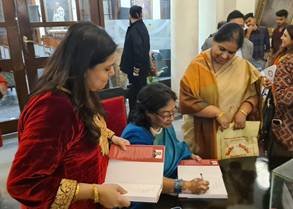
Vote of Thanks by Dr. Nayan Mitra
Delivering the vote of thanks, Dr. Nayan Mitra reflected on collaboration as the foundation of meaningful impact, noting that while resources are essential, it is collective intent and partnership that enable projects to succeed. She acknowledged the contributions of authors, corporate partners, supporting institutions, and stakeholders who made both the book and the event possible.
“This book, and this event, are themselves outcomes of collaboration. When multiple stakeholders will something to happen, meaningful change becomes possible.” – Dr. Nayan Mitra.
She thanked Calcutta Club, Sustainable Advancements, and The CHINI Trust for supporting the event, along with the publishing team at Sterling Publishers Pvt. Ltd., the contributors from participating organisations, and the audience for their engagement. Emphasising collaboration as a multiplier of impact, she described the book and the launch as a shared endeavour, and expressed hope that the dialogue would catalyse further collaborative action in India’s CSR journey.
The programme concluded with a book signing session.
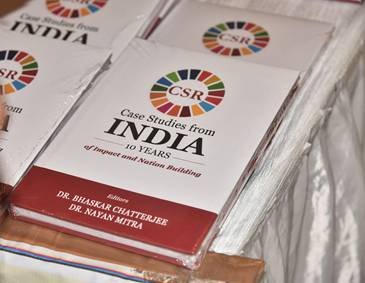
The Book: CSR Case Studies from India: 10 years of Impact and Nation Building