

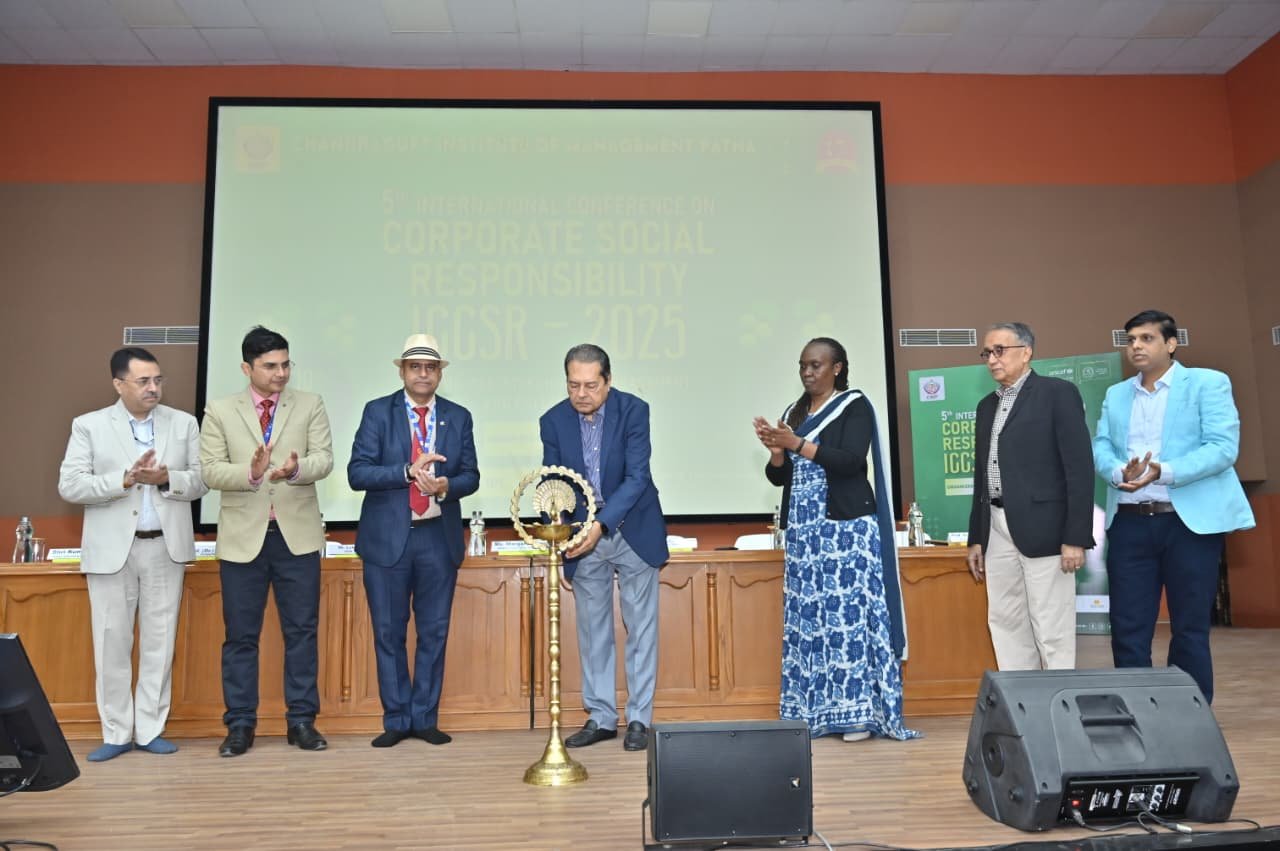


PATNA, BIHAR (India CSR): Chandragupt Institute of Management Patna (CIMP), in collaboration with UNICEF and the School of Management Studies, University of Hyderabad, organized the 5th International Conference on Corporate Social Responsibility 2025 under the CIMP Centre for CSR & ESG Studies Foundation. The conference brought together policymakers, academicians, corporate leaders, development practitioners, and students to explore emerging pathways for socially responsible and impact-driven CSR in Bihar.
In his welcome address, Professor Rana Singh, Director, CIMP, traced the evolution of CSR spending in India—from an initial estimate of Rs 20,000 crore to nearly Rs 2 lakh crore by 2020—and emphasized the need to transition from chequebook philanthropy to evidence-based, outcome-focused interventions aligned with Bihar’s priorities.

Dr. Indranil De, Axis Bank Chair Professor, delivered the keynote, presenting CSR as a second-best mechanism for private firms to support public goods where state capacity is limited. He highlighted CSR’s role in linking corporate profitability with citizen welfare, directing resources toward health, sanitation, education, livelihoods, and environmental sustainability. He stressed the need for transparency, monitoring, and third-party evaluations to maintain credibility.
UNICEF representative Ms. Margaret Gwada praised Bihar’s improving governance environment and called for deeper collaboration among government, corporates, and civil society. She highlighted UNICEF’s sanitation and community-based initiatives and urged positioning Bihar as a model for child-centric CSR innovation.
Dr. Hishmi Jamil Hussain underscored the importance of CSR in ensuring fundamental rights such as clean water, dignity, and health through multi-stakeholder partnerships.

Lakshman Kumar of NABARD outlined CSR engagements across climate resilience, health, education, water, and entrepreneurship, implemented through 43 partners and nearly 300 projects funded with over Rs 2,000 crore. He emphasized the need to correct Bihar’s CSR location bias.
Policy expert Mathew Cherian connected CSR to SDGs, noting Bihar receives only 1% of national CSR funds, and stressed principles of doing no harm, focusing on aspirational districts, and ensuring sustainability.
In a special address, Dr. Bhaskar Chatterjee, architect of India’s CSR framework, described CSR as a “bloodless revolution” built on a triangular architecture of corporates, civil society, and government. He highlighted India’s current CSR mobilization of Rs 35,000 crore from 28,000 companies, projected to reach Rs 1 lakh crore by 2035, positioning Bihar as a rising contributor.

The event also featured a CSR Roundtable on the newly gazetted Bihar CSR Policy with representatives from Palladium India, Apollo Medskills, TERI, ICICI Foundation, Dulux Paints, WABTEC, and Nalanda Charitable Trust, followed by the presentation of over 15 research papers from scholars across India.
(India CSR)



