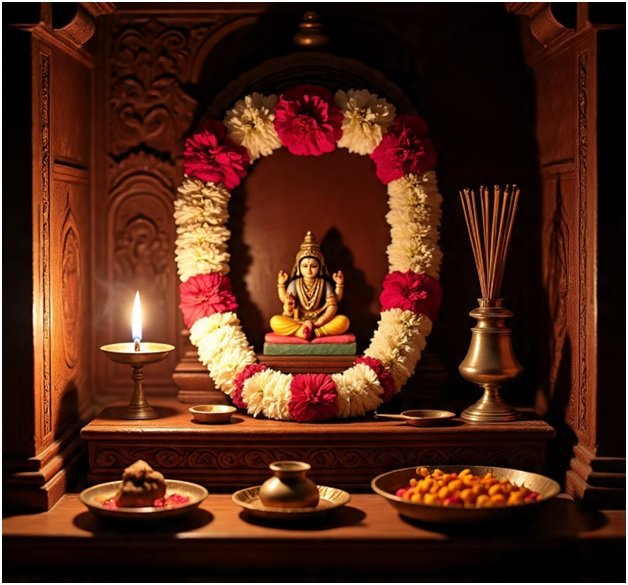



We’ve all stood in front of our pooja space, wondering whether it needs a few more pooja goods or a little less clutter. But there’s a way to add both.
Most of us build our sacred corners slowly: a diya from one festival, a forgotten incense pack from another, maybe a deity idol passed down by a grandparent. But if you truly want to invite shubh energy into your home, there are a handful of items that have stood the test of time, tradition, and grandmotherly wisdom.
So, here’s a guide to the six essential pooja items your mandir absolutely deserves. And yes, there’s a reason behind every one of them.

- Holy Books
Be it the Bhagavad Gita, Ramayana, Hanuman Chalisa, or a small compilation book of bhajans, holy texts act as the spiritual backbone of your mandir. Yes, they are for reading, but their purpose also goes way beyond that. They serve as symbolic carriers of knowledge, guidance, and clarity.
So, if you are planning to keep one or a few in your mandir, add them to thewest or south wall as it’s said to amplify positivity and make your prayer space feel more grounded.
- God Idol
To say the least, any mandir without a God idol is like a home without a front door. Something so essential should never be missing from your home. Whether you bring home Ganesh for new beginnings, Lakshmi for prosperity, Shiva for calm, Hanuman for courage, or a simple Shiva Lingam or Shaligram, an idol represents focal devotion.
And here’s a pro tip: always keep just one form of a deity in the mandir. Too many idols of the same god can create spiritual clutter, at least according to most traditional households.
- Diyas and Oil Lamps
No pooja is complete without a glowing diya. It’s probably the oldest spiritual technology humans ever invented. Across cultures, light is associated with clarity, hope, and the removal of darkness, literally and metaphorically.
In Hindu tradition, lighting a diya with sesame oil is believed to bring protection, while ghee lamps are said to invite prosperity. There’s also a fascinating, fun fact: according to Vedic texts, the flame has five elements: earth (wick), water (moisture in wick), fire (flame), air (oxygen), and space (the area in which it burns). So, lighting a diya is just like balancing nature itself.
If you follow Vastu, try placing the diya on the southeast side of the mandir. This direction belongs to Agni, the fire god, and is said to keep the flame energetically aligned.
- Flowers
Flowers have been used in worship for thousands of years, not just because they’re pretty, but because they represent impermanence. They remind us that everything beautiful is temporary, so we should appreciate it while it lasts.
Different flowers are believed to carry different energies. The lotus is linked to purity and higher consciousness, the marigold symbolizes freshness and good fortune, and jasmine is thought to attract divine blessings.
So if you are looking for an easy ritual? Offer one single fresh flower every morning. It takes just 10 seconds and somehow sets the tone for the day.
- Incense & Dhoops
Scent has a powerful effect on memory, mood, and emotion, and our ancestors understood this far earlier than modern psychology did. Burning incense and dhoops during pooja purifies the air, sharpens focus, and creates a serene environment.
There’s an interesting legend tied to incense: in ancient temples, dhoop was burned not only as an offering but also to disinfect the air, especially around crowded gatherings. Frankincense, loban, and sandal became sacred staples because they acted as natural purifiers.
If you’re someone who gets overwhelmed by strong smells, start with mild sandalwood or lavender incense. Lighting incense before starting work or studying is also a great hack as it brings serenity and removes distraction naturally.
- Tulsi Plant
If your mandir has space for just one living symbol of purity and good fortune, let it be Tulsi. Revered as a goddess in Hinduism, the Tulsi plant is believed to bring health, harmony, and prosperity into the home.
There’s a reason almost every traditional Indian courtyard had a Tulsi Vrindavan. Apart from being sacred, Tulsi is a powerhouse herb, antibacterial, antifungal, and purifying. Even NASA once listed it among the best natural air-purifying plants.
To Conclude
When you bring together holy books, a deity idol, light, fragrance, flowers, and a sacred plant, you create an environment that subtly reshapes the energy of your entire home.
You don’t need expensive rituals or elaborate setups. Just these essentials, used with sincerity, can make your mandir a magnet for peace, clarity, and good fortune. After all, spirituality is rarely about how much you keep but about how mindfully you keep it.