

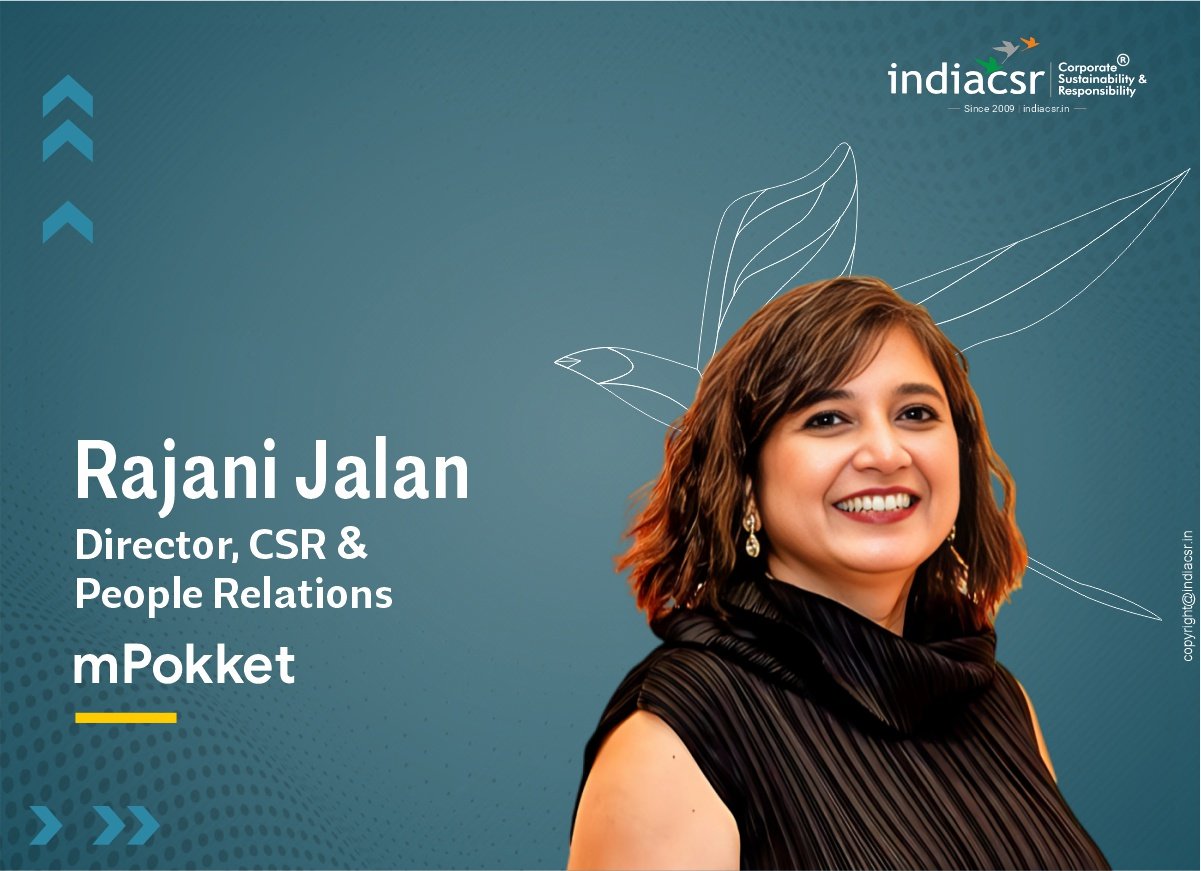


Empowering Communities: A Conversation on mPokket’s CSR Impact and Social Interventions
By Rusen Kumar
NEW DELHI (India CSR): Rajani Jalan, Director of CSR & People Relations at mPokket, leads the company’s social impact initiatives with a focus on creating sustainable, systemic change across underserved communities in India. Under her stewardship, mPokket’s CSR programs align closely with the company’s mission of expanding financial access, while addressing critical inequities in health, education, and women’s empowerment. Her initiatives have supported over 1,000 young girls through blended academic and skill-learning programs, fostering confidence, leadership, and life skills, while also scaling access through partnerships with rural schools. Through programs like Roti on Wheels, mPokket has delivered more than 70,000 nutritious meals to cancer patients and families, ensuring dignity and continuity in challenging healthcare ecosystems. Rajani has championed women’s empowerment via Dakshini Prayash and Vihaan, providing survivors of trafficking and vulnerable women with vocational skills, financial independence, and holistic support to prevent re-victimization. She has also driven patient-centric healthcare interventions, including artificial limb distribution with Mahavir Seva Sadan and facility upgrades at the Institute of Neuroscience, Kolkata, reducing wait times and restoring mobility. Guided by SDG-aligned KPIs, Section 135 governance, and skill-based employee volunteering, Rajani ensures mPokket’s CSR creates measurable, long-term impact, transforming lives, uplifting communities, and reinforcing the company’s mission to democratize opportunity across India.
1. How does mPokket’s CSR thesis align with the company’s mission of expanding financial access? What problem statements guide your portfolio choices?
At mPokket, our mission has always been to democratize opportunity, whether through financial access or through our social interventions. The same philosophy guides our CSR initiatives, we identify communities that are often excluded, whether due to poverty, gender, or geography, and build pathways that restore dignity and agency. Health, women’s empowerment, and child education are the three pillars we have consistently invested in, because these are the areas where systemic barriers most often prevent people from realizing their potential. Our problem statements are rooted in inequity: how do we bring quality education to children in rural areas, how do we ensure healthcare is accessible to those who can least afford it, and how do we empower women, especially those facing extreme adversity, to build sustainable livelihoods. These guide every choice we make in our CSR portfolio.
2. You’ve supported 1,000 young girls with blended academics and skill learning. What learning outcomes have improved most, and how will you scale or deepen this model?
Through Adhigam Bhoomi, we have had the privilege of supporting 1,000 young girls with education that goes beyond textbooks. The outcomes we are most proud of are not just academic scores but a visible growth in confidence, leadership, and life skills. Many of these girls are now daring to dream bigger, whether it is higher education, pursuing careers, or becoming community changemakers. This year, we are scaling by partnering with over 100 rural schools to embed this model locally. The idea is to keep children rooted in their communities while equipping them with tools to thrive.
We are joining hands with Adhigam Bhoomi to empower rural entrepreneurs. Our motive is to uplight young women who can use their education and creativity to build opportunities not just for themselves but also for their communities. By combining academic learning with entrepreneurial and life skills, we hope to create a ripple effect of empowerment that transforms rural India from within.
3. Over 70,000 meals served to cancer patients and families is significant. How do you ensure nutrition, dignity, and continuity of support in a hospital-ecosystem that is always in flux?
Roti on Wheels has been one of the most humbling journeys of our CSR. We began with just two days a week, and today we serve families five days a week outside the Chittaranjan National Cancer Institute. Nutrition is ensured by cooking fresh meals on-site every afternoon, which patients and families themselves have lovingly asked us to continue. But beyond food, what we really provide is dignity, a warm meal that restores a sense of normalcy and reminds families that they are not alone in their struggle. Continuity is maintained through active employee volunteering and by staying close to the needs of the community, adapting frequency and scale as their requests have grown.
4. You planted 1,000 saplings (200 in a single day) and ran bi-annual e-waste drives recycling 270 kg. What’s your sapling survival rate after 12–24 months, and how will you push from “events” to measurable circularity?
Our sapling plantation drives are not just symbolic; we actively monitor survival rates with our local partners. The next step for us is to move from “events” to ecosystems, ensuring saplings are nurtured through community stewardship and that e-waste drives become part of a larger circularity model. This could mean building long-term partnerships for recycling and creating awareness campaigns within our employee and beneficiary networks to embed responsible consumption as a habit, not just an activity.
Through regular follow-ups with our local partners, we have tracked an average sapling survival rate of 72–75% after the first year, stabilizing at around 65% at the 24-month mark. This reflects not just initial planting success but ongoing care and community involvement.
5. In your journey supporting women, through Dakshini Prayash and Vihaan, what livelihood and financial outcomes stand out for women, especially trafficked survivors? What safeguards help prevent re-victimization?
Through Dakshini Prayash, we’ve seen women gain confidence, develop vocational skills, and move toward financial independence, which transforms not just their own lives but those of their families. Vihaan has been even more profound, supporting survivors of trafficking to heal, reintegrate, and secure livelihoods. One remarkable survivor even works with us now, having rebuilt her life with courage and resilience, serving as a beacon for others. These outcomes- employment, reintegration, financial stability, are the strongest indicators of success. Safeguards lie in holistic support: not just skills and jobs, but also psychosocial support, community acceptance, and ongoing accompaniment to reduce vulnerability.
6. From artificial limbs with Mahavir Seva Sadan to facility upgrades at the Institute of Neuroscience, Kolkata, what patient-impact metrics (mobility restored, wait times reduced, throughput) best capture your results?
With Mahavir Seva Sadan, the clearest metric of impact is restored mobility and independence. Each artificial limb we support represents a person regaining the ability to move freely and reclaim dignity in daily life. At the Institute of Neuroscience, our contributions, from building a new OPD to providing an ultrasound machine, directly translate to reduced wait times, smoother patient flow, and greater access to critical diagnostic services. These tangible outcomes remind us that even modest interventions can significantly improve quality of life.
7. Stationery drives, garage sales, and essentials collections show strong volunteer spirit. How are you moving toward skill-based volunteering, and what’s your employee participation rate target for the next year?
Our employees’ enthusiasm for drives and collections has been heartening, but we are consciously moving toward more skill-based volunteering where people can share their professional expertise with communities. Whether it’s financial literacy sessions, mentoring students, or supporting women entrepreneurs, we believe skills multiply impact. This year, our Old Cloth Donation Drive became more than just a collection effort—it became a movement of empathy and shared responsibility. Through the generous contributions of our employees and partners, we gathered over 600 items of clothing, both pre-loved and brand new, to be distributed to individuals and families in need.
8. How do you govern CSR (board oversight, Section 135 priorities, independent evaluation)? Which SDGs/KPIs anchor your measurement and what are your top three bets for the next 3 years?
CSR at our Company is governed in accordance with Section 135 of the Companies Act, 2013 and the rules thereunder, with Board-level oversight through the CSR Committee. The Committee formulates the CSR policy, recommends the annual action plan, and monitors project implementation to ensure accountability and compliance.
We align our initiatives with SDGs (Sustainable Development Goals) and measure impact through clear KPIs such as outreach, beneficiary impact, and sustainability of outcomes. Independent evaluations are being increasingly adopted for transparency and validation.
Our CSR focus is anchored in three priority areas:
- Health and Well-being
- Women’s Empowerment
- Child Education
Over the next three years, we aim to expand healthcare initiatives, enhance women’s livelihood opportunities, and strengthen access to quality education, treating CSR as a long-term partnership for sustainable impact.
***
About Rusen Kumar
Rusen Kumar is a distinguished journalist, author, and visionary knowledge entrepreneur specializing in Corporate Social Responsibility (CSR) and sustainability in India. He is the founder and managing editor of India CSR Network, a leading platform dedicated to CSR and sustainability issues.
Copyright@IndiaCSR
Showcase your CSR achievements and share your insights with India’s leading CSR platform.
Contact us at biz@indiacsr.in I 9981099555 to feature your success stories and interviews.



