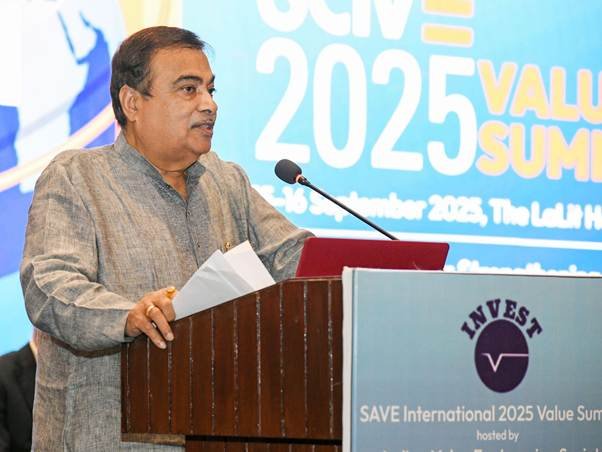



Nitin Gadkari Unveils Bold Vision for Automobile Manufacturing and Green Mobility
NEW DELHI (India CSR): In a bold declaration at the International Value Summit 2025, Union Minister for Road Transport and Highways, Nitin Gadkari, outlined India’s ambitious plan to become the world’s top automobile manufacturing hub within the next five years. Highlighting the nation’s rapid progress in green mobility, infrastructure development, and sustainable practices, Gadkari emphasized India’s growing influence in the global automotive sector. With cutting-edge innovations, robust infrastructure, and a focus on sustainability, India is poised to redefine the future of transportation.
India’s Rise in the Global Automotive Market
India has already overtaken Japan to claim the title of the world’s third-largest automobile market, trailing only behind China and the United States. Speaking at the summit, Gadkari highlighted the significant shift in the industry, noting that global automotive giants are no longer just assembling vehicles in India but are increasingly using the country as a key export hub. “Major brands like Hyundai, Toyota, and Tata are now exporting high-quality vehicles to international markets, showcasing India’s manufacturing prowess,” he said. The two-wheeler sector, a cornerstone of India’s automotive industry, exports over 50% of its production, contributing significantly to the nation’s global footprint.

The minister set an ambitious target for India to surpass its competitors and claim the top spot by 2030. This goal is supported by a favorable business environment, government incentives, and a skilled workforce. Investments in research and development, coupled with partnerships with global firms, are expected to drive innovation and boost production capacity.
Leading the Charge in Green Mobility
India’s commitment to sustainability is a key pillar of its automotive vision. Gadkari emphasized the country’s leadership in electric vehicles (EVs) and alternative fuel technologies, particularly hydrogen. “We’ve introduced hydrogen-powered trucks, and pilot projects are operational across ten major routes,” he announced. These initiatives are backed by ₹600 crore in government grants to companies like Tata Motors, Ashok Leyland, and Reliance Industries to develop hydrogen infrastructure.
In addition to hydrogen, India is exploring innovative fuel options such as isobutanol and bio-bitumen. Trials for bio-bitumen, derived from rice straw, have shown promising results, offering a sustainable alternative to petroleum-based bitumen while addressing the issue of stubble burning in rural areas. These advancements position India as a global leader in clean mobility, aligning with international climate goals.
Transforming India’s Road Infrastructure
India’s road network, now the second-largest globally, has undergone a remarkable transformation under Gadkari’s leadership. “We’ve slashed travel times across the country,” he stated, citing the example of the Panipat-Delhi Airport corridor, where travel time has been reduced from three hours to just 35 minutes. Major projects like the Chennai-Bengaluru expressway and the Rs 23,000 crore Bengaluru Ring Road are set to enhance connectivity, reduce urban congestion, and support economic growth.
These infrastructure developments are critical to supporting the automotive industry’s expansion. Improved highways and expressways ensure efficient logistics, enabling manufacturers to transport vehicles and components swiftly across domestic and international markets.
Sustainability and Circular Economy Innovations
Sustainability was a recurring theme in Gadkari’s address, with a strong focus on converting waste into valuable resources. He highlighted the innovative use of over 80 lakh tonnes of waste from the Ghazipur landfill in road construction, which has reduced the landfill’s height by seven meters. “We’re turning waste into wealth and creating a cleaner environment,” Gadkari said.
The minister also discussed the potential of bio-bitumen, which not only performs better than traditional bitumen but also provides a solution to stubble burning, a major environmental concern in northern India. These initiatives reflect India’s commitment to a circular economy, where waste is minimized, and resources are reused innovatively.
A Call for Global Collaboration
Gadkari extended an invitation to international partners to collaborate on cutting-edge technologies, including precast road construction, tunnel engineering, and hydrogen transport systems. “India has the resources and revenue to support its ambitions. What we need is your innovation and expertise,” he urged global delegates. By fostering partnerships, India aims to integrate advanced technologies into its automotive and infrastructure sectors, further solidifying its position as a global leader.
The minister’s vision is underpinned by strong financial mechanisms, with India’s road projects generating substantial revenue through monetization. This financial stability provides a solid foundation for ambitious projects and encourages foreign investment in the country’s automotive and infrastructure sectors.
A Roadmap for the Future
India’s journey to becoming the world’s leading automobile manufacturing hub is well underway, driven by innovation, sustainability, and infrastructure development. With a clear roadmap, government support, and global partnerships, the nation is on track to achieve its goal by 2030. Gadkari’s address at the International Value Summit 2025 underscored India’s determination to lead not only in production but also in shaping a sustainable and connected future for global mobility.
(India CSR)